
Annual Mileage Calculator
Add up your commute, other weekly driving and longer trips to estimate your annual mileage and compare it with the average car in England.
Free · runs in your browser · nothing is uploaded
Recent
Your last 10 settings, saved only in this browser. Nothing is uploaded.
This annual mileage calculator adds up your commute, other weekly driving and longer trips to estimate how many miles your car covers in a year. It then compares that total with the average car in England, so you can see whether you drive more or less than most people. Use it when an insurer asks for your estimated annual mileage, or when you want to plan running costs and services.
It works only from the numbers you type in. It does not look up your car or its records. For what your car really covered, compare the odometer readings recorded at its last two MOT tests on GOV.UK Check MOT history.
Average from the Department for Transport National Travel Survey, table NTS0901 (England, 2025), as of 3 November 2026.
How to use the annual mileage calculator
- Enter your commute as a round trip in miles per day. If you drive to work and back, add both journeys together. Eleven miles each way is 22 miles.
- Enter how many days a week you drive that commute. Values above 7 are capped at 7.
- Enter how many weeks a year you work. The default is 47, which allows for about five weeks of leave and bank holidays. Values above 52 are capped at 52.
- Enter your other driving per week: shopping, school runs and visits to family or friends.
- Enter holidays and long trips as miles for the whole year, not per week.
- Read the estimated total. The line beside it shows how far above or below the England average your figure is.
- Compare the three boxes (commuting, other driving and holidays) to see which part of your driving adds the most miles. If the commute box is the largest, a change in working pattern, such as one fewer day in the office, will show the biggest effect when you change the days box.
- Negative numbers count as zero, so check each box before you read the result. When you give an insurer a figure, a sensible estimate rounded up is safer than one that is too low.
How the estimate is worked out
The sum
Commute miles per day × days per week × working weeks, plus other weekly miles × 52, plus the yearly holiday miles. The tool rounds each part to whole miles before it adds them up.
A worked example with the default values
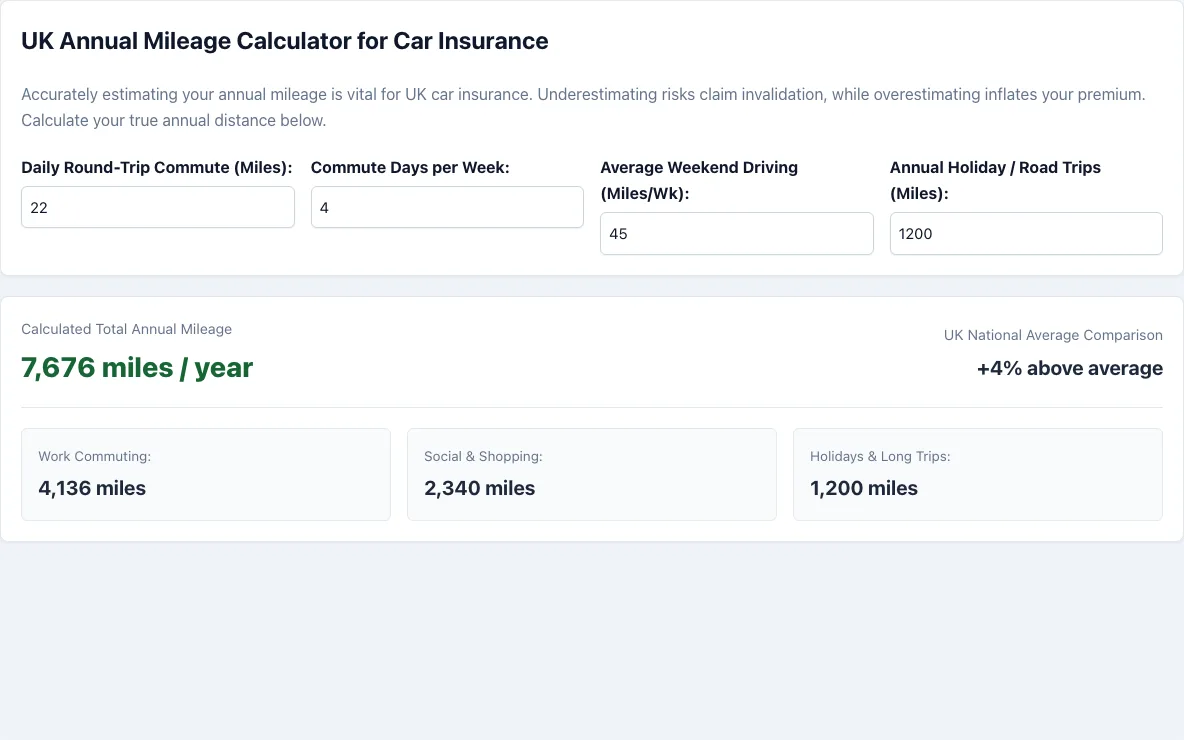
With the defaults, the calculation is 22 × 4 × 47 = 4,136 miles for commuting, plus 45 × 52 = 2,340 miles for other driving, plus 1,200 miles for holidays. The total is 7,676 miles. That is about 8% above the England average of 7,100 miles.
DfT National Travel Survey table NTS0901 (England, 2025)
The National Travel Survey puts the average car in England at about 7,100 miles a year in 2025. Petrol cars average about 6,200 miles and diesel cars about 8,000 miles. Before the pandemic the figure was about 7,600 miles (2019). The survey figures are respondent estimates, so treat the average as a benchmark rather than an exact target for your car.
Why insurers ask
More miles mean more time on the road, so mileage is one of the factors insurers use. Under the Consumer Insurance (Disclosure and Representations) Act 2012 you must take reasonable care to answer accurately. A careless or deliberate misstatement can lead to a claim being reduced or refused, or the policy being cancelled. If your driving changes, for example after a new job or when you start working from home, tell your insurer.
Telematics and pay-per-mile policies
Some policies track mileage with a box or an app and set a mileage allowance. The policy terms say what happens if you go over, so read them before you choose a figure.
Common mistakes
- Typing a weekly figure into the holiday box. That box takes miles for the whole year.
- Using 52 working weeks for a commuter. Leave and bank holidays reduce commuting miles, so the default of 47 is a more realistic start.
- Counting only one leg of the commute. The commute box expects the round trip.
Frequently asked questions
What is the average annual mileage of a car in the UK?
For England, the Department for Transport’s National Travel Survey gives about 7,100 miles per car for 2025. Petrol cars average lower than diesel cars in the same survey. The figure is a benchmark, not a target for your own car.
Does this calculator check my real mileage?
No. It adds up the numbers you type and does not look up your car or its records. For the miles your car has actually covered, use the odometer readings on its MOT history.
What if I go over my declared mileage?
Contact your insurer. Policies differ: some only adjust the premium, while others can reduce a claim if the declared mileage was clearly wrong. Read your policy terms for the exact rule.
How can I find my real annual mileage?
Look up your car on GOV.UK Check MOT history and take the difference between the odometer readings of the last two tests. Adjust that figure for the time between the two tests, because a year is not always the same length as the gap between tests.
Does lower mileage always mean cheaper insurance?
Usually lower mileage lowers the price, but mileage is only one rating factor among many. Insurers price it differently, so compare quotes with the same declared figure.
Can I change my declared mileage mid-policy?
Yes, tell your insurer when your driving changes. The premium may go up or down, depending on the new figure and the insurer’s rules.
What if two cars share the driving?
Estimate each car’s own mileage, because each policy covers one car. Adding both cars together would give a total that does not match either policy.
Related tools
- Total Cost of Ownership Calculator & Car TCO Tool
- Car Depreciation Calculator & Value Curve Estimator
- Car Trade-In Value Estimator & Part-Exchange Tool
- Car Finance PCP Calculator & Balloon GFV Tool
- Car Finance HP Calculator & Hire Purchase Tool
- Car Insurance Group Checker: Groups 1–50 Explained
- Car Scrappage Scheme Calculator & Scrap Value Estimator
- Brake Fluid Replacement Interval Checker
See all Car Running Cost and Finance Tools.