
Brake Fluid Replacement Interval Checker
Enter the months since the last brake fluid change, the fluid grade and your handbook interval: see if the change is due and a rough boiling-point estimate.
Free · runs in your browser · nothing is uploaded
Recent
Your last 10 settings, saved only in this browser. Nothing is uploaded.
This brake fluid replacement interval tool checks the months since your last fluid change against the interval in your handbook (most cars: every 2 years, some every 3) and gives a rough estimate of how far the fluid’s boiling point may have fallen as it takes up water.
Brake fluid absorbs moisture from the air over time, which lowers its boiling point. The estimate here is a straight line between the published minimum dry and wet boiling points for your fluid grade; it is not a test of your fluid. A garage moisture or boiling-point tester gives the real figure.
Boiling-point minimums from US standard FMVSS No. 116, as of 3 November 2026. Always follow the interval in your handbook or service schedule.
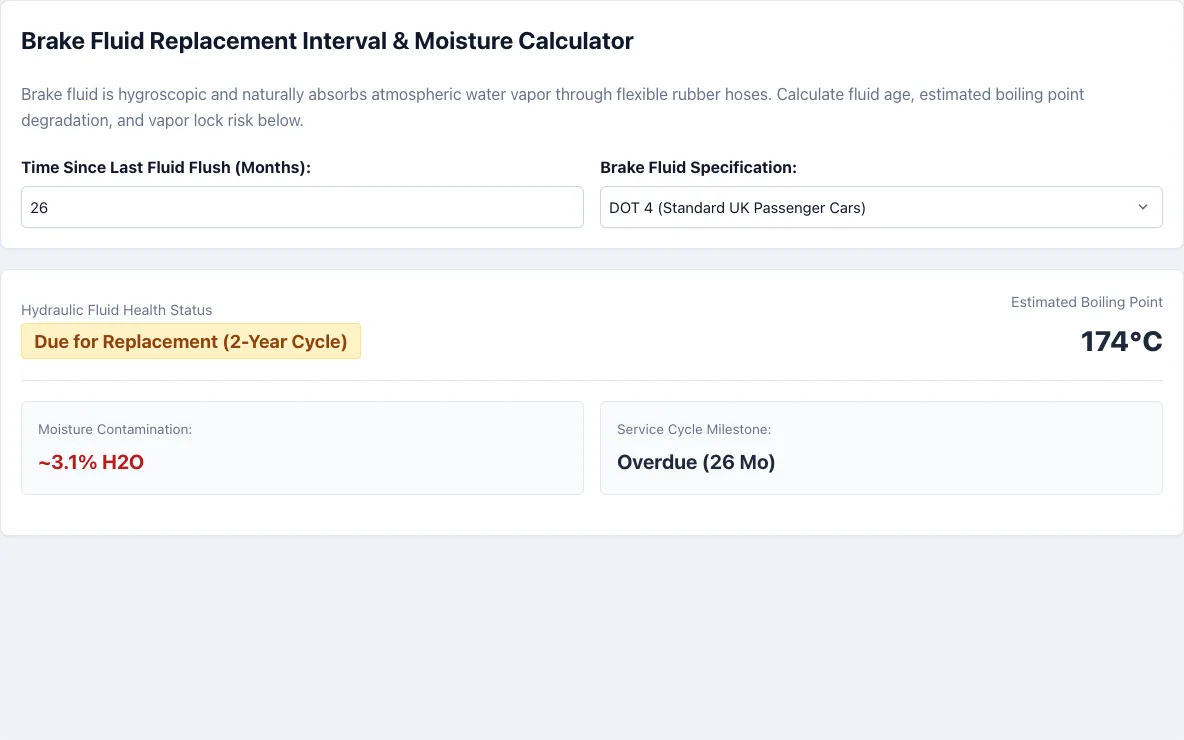
How to use the brake fluid replacement interval tool
- Find the date of the last brake fluid change in the service history and enter the months since then. Enter 0 if the change was done this month.
- Pick the fluid grade printed on the reservoir cap (DOT 3, DOT 4 or DOT 5.1).
- Pick the interval from your handbook: every year, every 2 years (the most common) or every 3 years.
- Read the status badge. “Change due now” means the months since the change have reached the interval. “Change due within 3 months” means the change is close. “Within the interval” means you have more than 3 months left.
- Read the months left or overdue, and the rough boiling-point estimate.
- Check the assumed water content line, which shows the rule of thumb the estimate uses.
- If you do not know when it was last changed, treat it as due. After a change, set the months to 0 to see the status reset.
For example, a car last changed 26 months ago, with DOT 4 fluid and a 2-year handbook interval, shows “Change due now” and 2 months overdue. The estimate for that case is about 163°C, against a dry minimum of 230°C. The estimate is only as good as the grade and month count you enter, so take the date from your service record rather than from memory.
Why brake fluid needs changing
It takes up water
DOT 3, DOT 4 and DOT 5.1 fluids are glycol-based and hygroscopic: they absorb water through seals, hoses and the reservoir vent. A common rule of thumb is about 1.5% water a year, so around 3% after two years, but it varies with climate and use.
Dry and wet boiling points
FMVSS 116 sets minimum boiling points for new (“dry”) fluid and for fluid humidified to about 3.7% water (“wet”): DOT 3 205°C / 140°C, DOT 4 230°C / 155°C, DOT 5.1 260°C / 180°C. These are the minimums a fluid of that grade must meet; the pack or data sheet gives your fluid’s own figures. Hard braking, long descents or towing heat the fluid; if it boils, vapour bubbles make the pedal go soft.
Corrosion
Water in the fluid also helps corrosion inside callipers, pipes and the ABS unit, which is one more reason handbooks set a time interval rather than a mileage.
What the MOT does and does not check
The MOT checks brake performance, pipes and hoses, warning lights and that the fluid level in the reservoir is not below the minimum mark. It does not test the fluid’s water content or boiling point, so a car can pass with old fluid.
How the estimate is calculated
The tool assumes about 0.125% of water gained per month, which is the 1.5% a year rule of thumb. It then draws a straight line from the dry minimum (0% water) to the wet minimum (about 3.7% water) and reads the estimate off that line. At 26 months that is about 3.3% water and an estimate of about 163°C for DOT 4. The result is a guide for planning, not a reading from your car.
Sources: FMVSS No. 116 (49 CFR 571.116); MOT inspection manual 1.1.10, 1.8
FMVSS No. 116 sets the dry and wet minimum boiling points used in this tool. The MOT inspection manual, sections 1.1.10 and 1.8, covers the brake fluid level, warning lights and visible contamination. Neither source gives a change interval for your car, so the handbook interval is the figure to follow.
Frequently asked questions
How often should brake fluid be changed?
Most handbooks say every 2 years regardless of mileage; some say 3. Use the figure in your own handbook or service schedule. This tool lets you choose every year, every 2 years or every 3 years.
Does the MOT test my brake fluid?
It checks the fluid level and the brake system’s performance, not the fluid’s condition. A car can therefore pass the MOT with old fluid, which is why the time interval matters.
What is the difference between dry and wet boiling point?
Dry is new fluid; wet is fluid humidified to about 3.7% water in the standard test. For DOT 4 the minimums are 230°C dry and 155°C wet. The tool’s estimate sits between these two figures for the water content it assumes.
What happens if I never change it?
The boiling point keeps falling and internal parts can corrode. Under heavy braking the fluid can boil and the pedal can go soft. Following the handbook interval avoids both problems.
Can I tell from the colour?
Darker fluid is a hint that it is old, but colour is not a reliable test of water content. Use a tester or follow the time interval instead.
Can I mix DOT 4 and DOT 5.1?
Both are glycol-based and can be mixed, though the mixture only performs to the lower grade. Never mix them with DOT 5, which is silicone-based.
Does the tool measure my fluid?
No. It works from the months you enter and the grade you pick, so the boiling-point figure is an estimate. A garage boiling-point or moisture tester gives the real state of your fluid.
Related tools
- Car Battery Lifespan Calculator
- Tyre Tread Depth Checker & 20p Coin Test Guide
- Wheel Alignment Camber Toe Checker: Tyre Wear Guide
- Speedometer Accuracy Calculator: True Speed & Tyre Size
- Stopping Distance Calculator (UK Highway Code Rules)
- Towing Capacity Weight Calculator & 85% Rule Tool
- Engine Oil Change Interval Checker
- MOT Fee Calculator & Re-Test Limits
See all Car Maintenance and Safety Tools.