
Cambelt Replacement Interval Calculator
Enter your engine's cambelt interval from the handbook and the miles and years since the last change: see the miles and time left, or how far it is overdue.
Free · runs in your browser · nothing is uploaded
Recent
Your last 10 settings, saved only in this browser. Nothing is uploaded.
This cambelt replacement interval tool takes the interval from your handbook (miles and years, whichever comes first) and the miles and years since the belt was last changed. It then shows how much is left or how far it is overdue. Use it to decide when to book the belt, water pump and tensioner work before the engine is at risk.
Cambelt (timing belt) intervals differ a lot between engines, from about 40,000 to 150,000 miles and 4 to 10 years. Some engines use a timing chain with no fixed interval at all. There is no single UK figure, so the 60,000 miles / 5 years filled in is only an example. Check your handbook, service schedule or a main dealer for your engine’s interval.
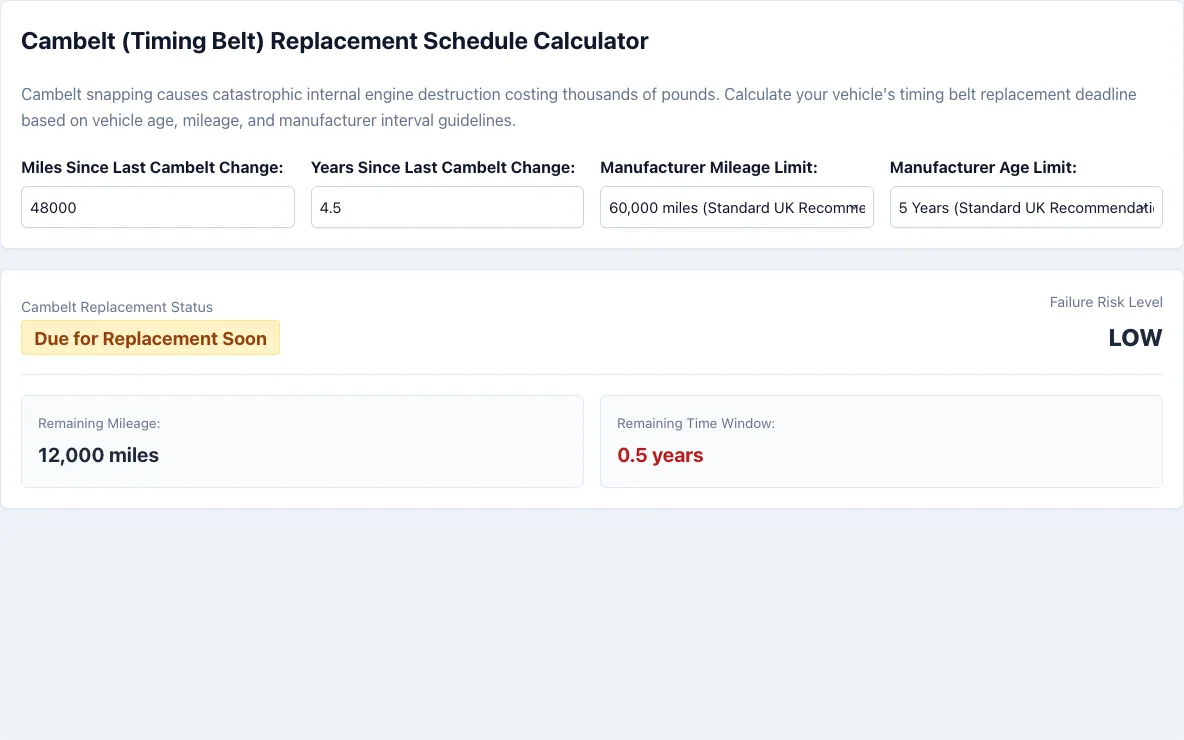
How to use the cambelt replacement interval tool
- Find the last cambelt change in the service history or on the invoice. Some garages also put a sticker under the bonnet.
- Enter the miles since that change in the first box, and the years since it in the second.
- Enter the handbook interval in miles. The example value of 60,000 is only a placeholder, so replace it with your engine’s figure.
- Enter the handbook interval in years. The example value of 5 is also a placeholder.
- Read the status badge: “Change due now”, “Due soon” or “Within the interval”.
- Read the miles and years left, or the miles and years over. The tool checks both limits, so whichever one runs out first decides the status.
- If the status is “Due soon”, book the work now rather than waiting for the limit to pass.
- If you have no record of a change, treat the belt as due.
With the default values of 48,000 miles and 4.5 years since the change, against 60,000 miles or 5 years, the tool shows 12,000 miles left and 0.5 years left. That is “Due soon”, because the time limit is 6 months or less away (the tool also shows “Due soon” when 5,000 miles or less are left). At 62,000 miles and 3 years, the mileage limit has passed by 2,000 miles, so the result is “Change due now”.
Why the cambelt matters
What it does
The cambelt keeps the camshaft or camshafts in step with the crankshaft, so the valves open and close at the right moment. It usually gives no warning before it breaks.
Interference engines
In many engines the valves and pistons share space at different moments. These are called interference engines. If the belt breaks, pistons can hit open valves, and the repair can cost far more than a belt change. Whether your engine is an interference design is in the workshop information. Assume it is unless you know otherwise.
Whichever comes first
Handbooks usually give a mileage and a time limit, and the belt is due at whichever is reached first. The tool works the same way. It compares the miles used with the mileage limit and the years used with the time limit, and shows both. If either limit is reached the status is “Change due now”; if either is within 5,000 miles or 6 months it is “Due soon”.
Manufacturer service schedules (intervals vary by engine)
Each manufacturer sets its own interval for each engine, so one figure cannot apply to every car. The schedule in your handbook or service book is the reference. The tool does not hold manufacturer data; it only does the sum with the numbers you enter.
Age matters as well as miles
A belt is rubber with reinforcing cords and ages even when the car is not driven. That is why handbooks give a time limit as well as a mileage. A low-mileage older car can be due on age.
Water pump and tensioners
On many engines the water pump is driven by the cambelt. Garages usually fit a kit with new tensioner and idler pulleys and often a new water pump, because most of the labour is shared. Ask for a quote that says what is included.
Belt or chain?
Many engines use a timing chain instead, normally meant to last much longer, though chains can wear too. Some engines use a belt that runs in oil and has its own interval. Your handbook or a dealer can tell you which your engine has.
Common mistakes
- Entering the years since the last service instead of the years since the belt was changed. These are often different.
- Keeping the example 60,000 miles and 5 years without checking the handbook.
- Assuming a belt is fine because the car has been running well. A belt usually fails without warning.
Frequently asked questions
How often should a cambelt be changed?
Follow what your handbook says for your engine. Intervals range from about 40,000 to 150,000 miles and 4 to 10 years, whichever comes first.
What happens if the cambelt breaks?
The engine stops. On interference engines the valves and pistons can collide and cause serious damage. Repair costs can then far exceed the cost of a planned belt change.
Should the water pump be changed at the same time?
If the cambelt drives the water pump, garages usually recommend changing it at the same time, because the labour overlaps. Ask whether the quote includes the tensioners and idler pulleys.
Are there warning signs?
Usually there are none that a driver will notice, which is why the change is done by interval rather than by symptoms.
Does my car have a belt or a chain?
Check the handbook, or ask a dealer with your registration number. This tool cannot tell which your engine has, so you need to confirm it before you use the result.
How much does a cambelt change cost?
It depends heavily on the engine and the garage. Ask for a quote that says whether the water pump and tensioners are included.
Does this tool look up my car?
No. It works only from the miles, years and interval you type in. It does not check your car’s records or the manufacturer’s schedule for your engine.
Related tools
- Brake Fluid Replacement Interval Checker
- Car Battery Lifespan Calculator
- Tyre Tread Depth Checker & 20p Coin Test Guide
- Wheel Alignment Camber Toe Checker: Tyre Wear Guide
- Speedometer Accuracy Calculator: True Speed & Tyre Size
- Stopping Distance Calculator (UK Highway Code Rules)
- Towing Capacity Weight Calculator & 85% Rule Tool
- MOT Expiry Calculator & Grace Period Rules
See all Car Maintenance and Safety Tools.