
Car Battery Lifespan Calculator
Enter the battery age, type and your driving: see the typical life range and where your battery sits in it.
Free · runs in your browser · nothing is uploaded
Recent
Your last 10 settings, saved only in this browser. Nothing is uploaded.
This car battery lifespan calculator compares your 12 V battery’s age with the typical service life for its type and your driving. It then tells you whether the battery is younger than a typical replacement age, in the usual replacement window or past it. Use it to decide when to have the battery tested, especially before winter.
It is an age-based estimate: it cannot measure your battery’s condition. A battery test at a garage or parts shop shows its real state. Cold mornings are when a weak battery usually shows itself, so a result in or near the window is a good reason to book a test.
Typical lives are rules of thumb: about 3–5 years for a standard flooded battery, 4–6 for EFB and 5–7 for AGM. Check your handbook for the battery type your car needs.
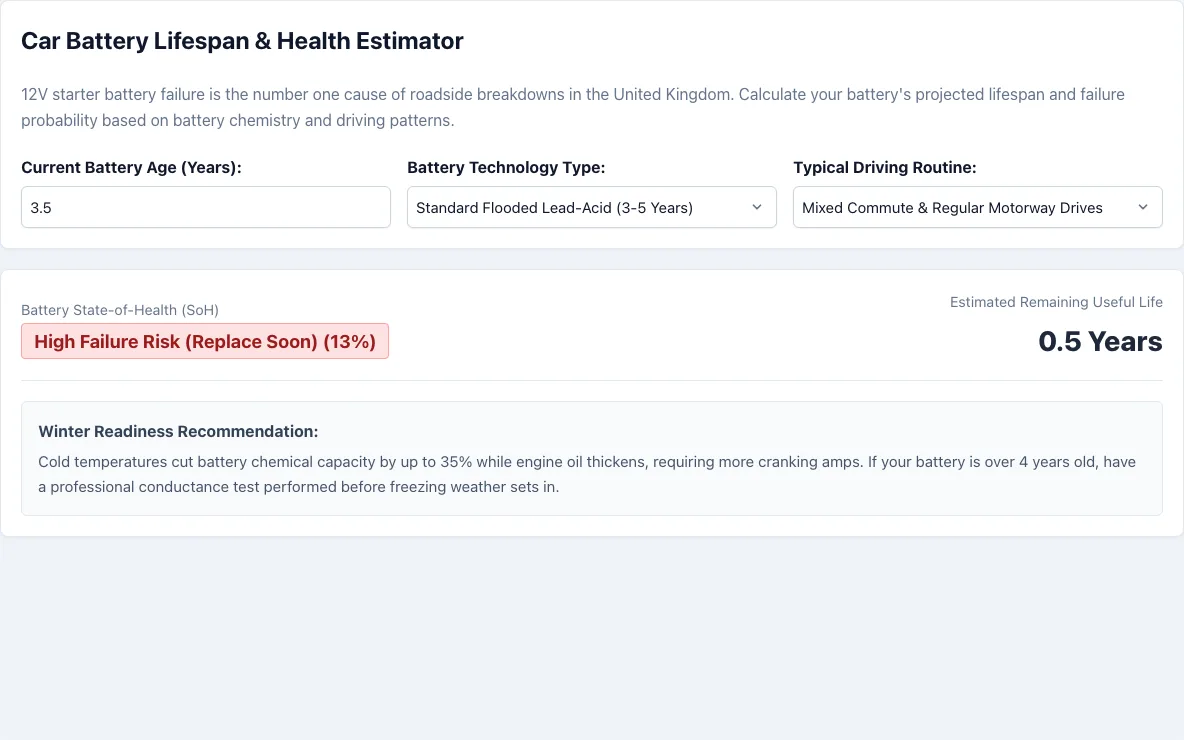
How to use the car battery lifespan calculator
- Enter the battery’s age in years. The fitting date is often printed or stamped on the case, or it is on the fitting invoice. A half year counts, so 3.5 is valid.
- Pick the battery type: standard flooded lead-acid, EFB or AGM. Start-stop cars use EFB or AGM. If you are not sure, check the handbook before you buy a replacement.
- Pick your typical driving: mostly short trips under 5 miles, mixed, or mostly longer runs.
- Read the status badge and the typical life range. The range moves by a year for short trips and by half a year for longer runs.
- Read the line that says how many years are left, or whether the battery is past the window.
- If the battery is in or past the window, or the car is slow to start, have it tested before winter. Most garages and parts shops can do this quickly.
- Compare the result with what you see on the car. Slow cranking or dim lights are signs to test sooner, whatever the age.
For example, a 3.5-year-old flooded battery used on a mixed pattern has a typical life of 3 to 5 years. It is in the typical window, with about 1.5 years to the top of the range. The same battery on mostly short trips has a range of 2 to 4 years. It is still in the window, with about half a year to the top of the range.
What wears a battery out
Typical service-life ranges for flooded, EFB and AGM batteries
The tool uses these rule-of-thumb ranges. A standard flooded battery typically lasts 3 to 5 years, an EFB battery 4 to 6 years, and an AGM battery 5 to 7 years. They are broad rules of thumb, not a maker’s figure for any one battery and not a test result. Your car’s handbook gives the battery type it needs.
Sulphation and short trips
Starting the engine takes a burst of charge, and short trips may not give the alternator time to put it back. A battery left partly charged forms hard lead-sulphate crystals that permanently reduce its capacity. That is why the tool takes a year off the range for mostly short trips.
Longer runs
Mostly longer runs give the alternator more time to recharge the battery after each start. The tool adds half a year to the range for this pattern. Longer runs do not undo the wear from other causes, such as heat or a charging fault.
Flooded, EFB and AGM
Standard flooded batteries suit cars without start-stop. EFB (enhanced flooded) and AGM (absorbent glass mat) batteries cope with the repeated cycling of start-stop systems and usually last longer under that load. A car built with an EFB or AGM battery should get the same type again.
Heat and cold
Heat speeds up internal wear. Cold slows the chemistry and thickens the oil, so a weak battery often fails on the first cold morning.
Battery registration
Some cars with battery-management systems (BMW and Volkswagen Group cars are common examples) need a new battery registered or coded, so the charging system treats it as new. The handbook or a garage can tell you if yours does.
Common mistakes
- Entering the age from the date you noticed the battery, not the date it was fitted.
- Choosing flooded for a start-stop car. The wrong type wears out faster under that use.
- Treating the typical range as a promise. A battery can fail before or after the range.
Frequently asked questions
How long does a car battery last?
Typically 3–5 years for a standard flooded battery and longer for EFB or AGM. Driving, climate and the car’s electrical load all change that.
Why do batteries fail in winter?
Cold reduces the power a battery can deliver, while a cold engine is harder to turn. A battery weakened earlier in its life often gives up on the first cold morning.
Can short journeys ruin a battery?
They can wear it faster. The alternator may not fully recharge the battery, and a battery kept partly charged loses capacity.
What are the warning signs?
Slow cranking, dim lights at idle, warning messages, or the start-stop system no longer stopping the engine. Any of these is a reason to book a battery test.
Can I fit a standard battery instead of AGM or EFB?
Not in a car that needs AGM or EFB. It will wear out quickly under start-stop use, so fit the type the car specifies.
Can a flat battery be saved?
Often, if it is recharged soon with a suitable charger. A lead-acid battery left flat for a long time can be permanently damaged.
Does this calculator check my battery?
No. It works only from the age, type and driving you enter. It cannot measure the battery’s condition, so a battery test is the only way to check its state.
Related tools
- Tyre Tread Depth Checker & 20p Coin Test Guide
- Wheel Alignment Camber Toe Checker: Tyre Wear Guide
- Speedometer Accuracy Calculator: True Speed & Tyre Size
- Stopping Distance Calculator (UK Highway Code Rules)
- Towing Capacity Weight Calculator & 85% Rule Tool
- Engine Oil Change Interval Checker
- Cambelt Replacement Interval Calculator
- MOT Checklist – Pre-MOT Checks
See all Car Maintenance and Safety Tools.