
Car CO2 Emissions Calculator
Enter your yearly miles and the official CO2 in g/km (and your mpg if you know it): see the tonnes of CO2 a year and the first-year tax band.
Free · runs in your browser · nothing is uploaded
Recent
Your last 10 settings, saved only in this browser. Nothing is uploaded.
This car CO2 emissions calculator works out how much CO2 your car puts out of the tailpipe in a year, in two ways. The first uses the official g/km figure (box V.7 on the V5C logbook). The second uses your real fuel economy in mpg, if you enter it. It also shows the first-year vehicle tax band for that g/km figure under the current rates.
You can look up a car’s official CO2 figure on the DVLA vehicle enquiry service. This page does not look anything up; it works only on the numbers you type.
As of 3 November 2026: vehicle tax rates from GOV.UK for 2026–27 (from 1 April 2026).
How to use the car CO2 emissions calculator
- Enter how many miles you drive a year. The default of 7,100 is the 2025 average for a car in England.
- Enter the official CO2 figure in g/km. The default of 125 is only an example, so use the figure for your car.
- Optional: enter the mpg you really get. Leave the box empty if you do not know it, and the tool shows a dash for that method.
- Pick the fuel: petrol, diesel that meets RDE2, or diesel that does not. The fuel only changes the tax band and the mpg method.
- Read the yearly CO2 from the official figure, then the yearly CO2 from your mpg.
- Read the first-year tax for the g/km band you entered. Compare it with the standard rate on the same card.
- If the two results differ a lot, real driving is probably different from the lab test.
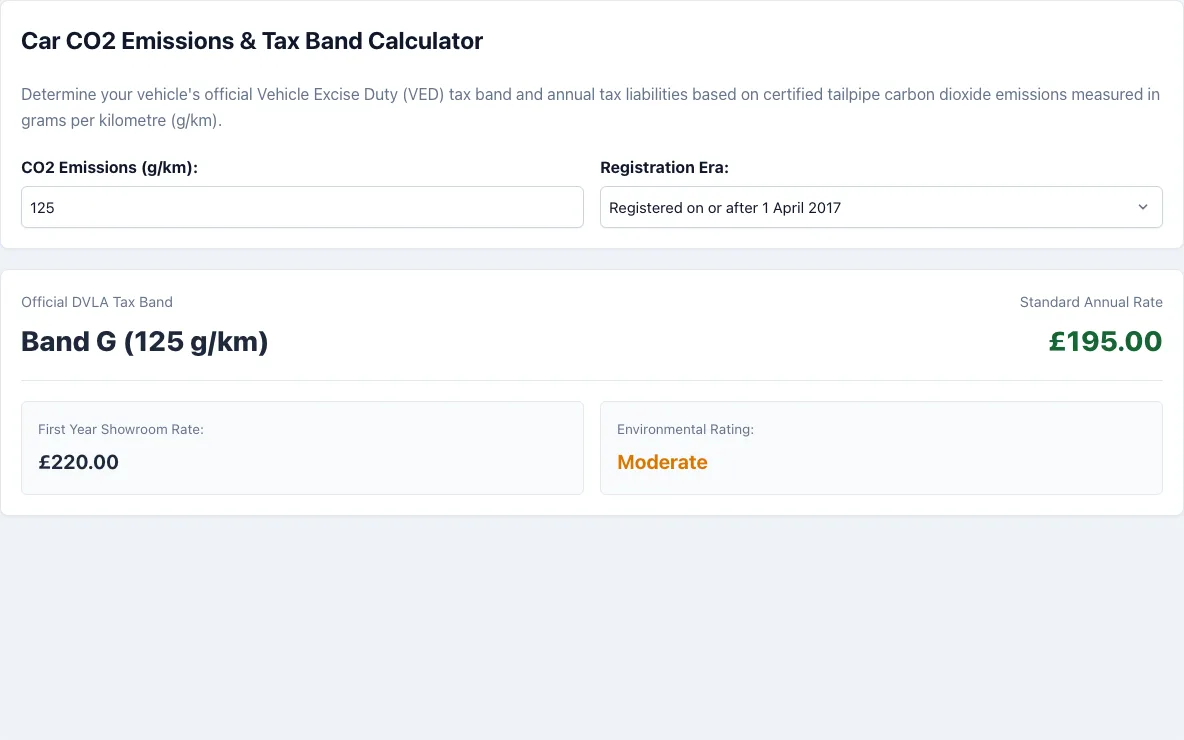
For example, a car rated at 125 g/km, driven 7,100 miles a year, gives about 1,428 kg of CO2 (1.43 tonnes). A petrol car that does 45 mpg on the same mileage uses about 717 litres and gives about 1,657 kg, which is about 145 g/km. A petrol car in the 111 to 130 g/km band pays a first-year rate of £455 in 2026–27, and the same figure for a diesel that does not meet RDE2 is £560.
How the CO2 is worked out
From the official figure
Yearly CO2 = g/km × miles × 1.609344 ÷ 1,000 kg. The 1.609344 converts miles to kilometres. At 125 g/km and 7,100 miles the total is about 1,428 kg (1.43 tonnes).
From your mpg
Litres used = miles ÷ mpg × 4.54609, using the UK gallon. The tool then applies tank-to-wheel factors for the carbon in fossil fuel: 2.31 kg CO2 per litre of petrol and 2.68 kg per litre of diesel. At 45 mpg over 7,100 miles a petrol car uses about 717 litres and emits about 1,657 kg, which works out at about 145 g/km.
What the mpg figure leaves out
The mpg figure counts only the emissions from the tailpipe. It leaves out the emissions from producing and delivering the fuel (well-to-tank). UK government reporting factors (DESNZ) list those separately, and they cover pump fuel including its biofuel share, so they are not the same numbers as the tool’s factors.
Official figures: NEDC and WLTP
Official figures come from laboratory tests. Figures from the newer WLTP test are usually higher than NEDC figures for the same car, because WLTP was designed to be closer to real driving. Real driving often comes out higher still, because of traffic, speed, short trips and cold weather.
Vehicle tax and CO2
For cars first registered on or after 1 April 2017 the CO2 figure sets only the first tax payment. After that most cars pay the standard rate of £200 a year (2026–27), plus a supplement for cars with a list price over £40,000. First payments for 2026–27 run from £10 for 0 g/km to £5,690 for over 255 g/km. Diesels that do not meet RDE2 pay the next band up.
Cars registered from 2001 to 2017
Cars first registered between 1 March 2001 and 31 March 2017 pay a yearly rate by CO2 band. This tool does not calculate that rate. Use the UK road tax calculator or GOV.UK for those cars.
Where the rates and factors come from
The first-year bands and the standard rate come from the GOV.UK vehicle tax rate tables for rates from 1 April 2026. The fuel factors of 2.31 kg for petrol and 2.68 kg for diesel per litre are the tailpipe values this tool uses. Check the GOV.UK tables before you rely on a band, because the rates change each year.
Common mistakes
- Entering the figure for a different version of the same model. Trim level and wheel size can change the official figure.
- Mixing up the official g/km figure with a real-world fuel economy figure. The two methods give different answers on purpose.
- Forgetting that the tax band is only the first payment for cars registered after April 2017.
Frequently asked questions
Where do I find my car’s CO2 figure?
On the V5C logbook, in box V.7. You can also check the DVLA vehicle enquiry service on GOV.UK.
How much CO2 does a litre of fuel produce?
About 2.31 kg of CO2 per litre of petrol and 2.68 kg per litre of diesel when burnt. These are tailpipe figures only, and they leave out the emissions from producing and delivering the fuel.
How does CO2 affect road tax for cars registered after April 2017?
It sets the first payment, which runs from £10 to £5,690 for 2026–27. After that most cars pay the standard £200 a year, plus the supplement for expensive cars.
Why do similar cars have different CO2 figures?
Wheel size, gearbox, weight and equipment all change the tested figure. Two cars of the same model can have different figures for that reason.
Does a low CO2 figure mean a car meets ULEZ?
No. ULEZ and Clean Air Zones go by Euro emission standards for pollutants such as NOx and particles, not by CO2. Use the ULEZ checker or the Euro emissions checker for that question.
Why is my real CO2 higher than the official figure?
Traffic, speed, short trips, cold weather and tyre pressures all raise fuel use above the test result. The mpg method shows the effect of your own driving.
Does this calculator check my car’s CO2 figure?
No. It works only from the miles, g/km figure, mpg and fuel you type in, so you should confirm the official figure from your logbook or the DVLA service.
Related tools
- Fuel Duty Calculator & Pump Price Tax Breakdown
- Catalytic Converter Theft Risk & Security Checker
- London ULEZ Checker – Estimate by Fuel & Age
- Clean Air Zone Checker & CAZ Fee Calculator
- London Congestion Charge Calculator & Auto Pay
- Euro Emissions Standard Checker & Vehicle Identifier
- Car Depreciation Calculator & Value Curve Estimator
See all Clean Air Zone and Emissions Tools.