
Car Finance HP Calculator & Hire Purchase Tool
Calculate monthly repayments and loan interest with our car finance hp calculator. Compare fixed rates, total payable sums, and ownership terms.
Free · runs in your browser · nothing is uploaded
Recent
Your last 10 settings, saved only in this browser. Nothing is uploaded.
The Motwatch car finance HP calculator helps British car buyers exploring Hire Purchase (HP) agreements. Unlike leasing or PCP agreements featuring balloon payments and restrictive mileage limitations, Hire Purchase represents a straightforward path toward full asset ownership. The loan principal is systematically amortized across equal monthly instalments, leaving zero terminal debt upon completion.
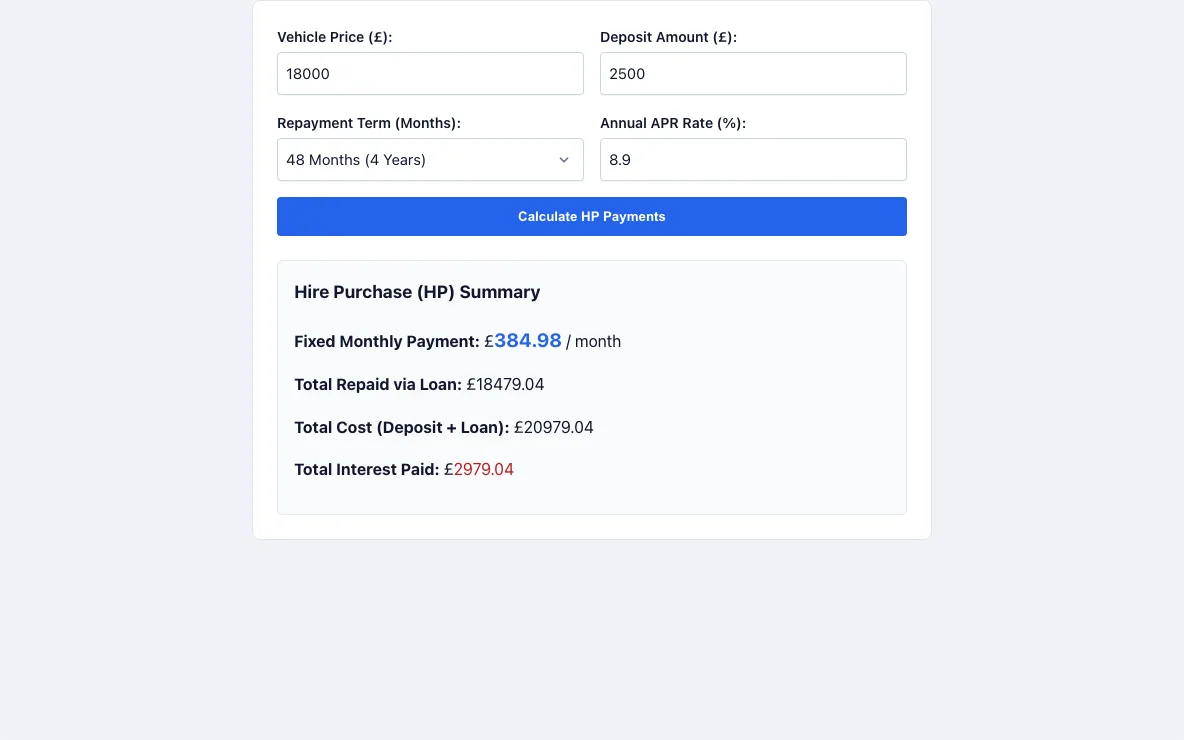
Our tool works from the price, deposit, term and APR you type in (the APR is an annual rate including compounding, converted to a monthly rate) and shows the monthly payment, total payable and interest, plus the one-third and one-half points that matter under the Consumer Credit Act. Use it to compare dealer quotes with a personal loan.
How to use the car finance hp calculator & hire purchase tool
- Step 1: Input the total vehicle purchase price quoted by the car dealership or commercial automotive retailer in Pounds Sterling.
- Step 2: Specify your initial cash deposit or accepted part-exchange valuation trade-in figure to reduce borrowing principal.
- Step 3: Select your preferred loan duration from standard 24, 36, 48, or 60 month repayment terms based on budget requirements.
- Step 4: Enter the contractual Annual Percentage Rate (APR) quoted on the official finance document or dealership quotation sheet.
- Step 5: The results update as you type; the Calculate HP payments button does the same.
- Step 6: Review your fixed monthly payment amount that remains completely unchanged throughout the entire agreement term.
- Step 7: Examine the total amount repaid through monthly instalments across the entire duration of the vehicle finance agreement.
- Step 8: Inspect the cumulative total cost of acquisition including your initial deposit and all accrued borrowing interest charges.
- Step 9: Review the total finance interest paid to evaluate financing expenses against outright cash savings or bank loan alternatives.
- Step 10: Check statutory repossession protection thresholds based on your cumulative payment milestones under British consumer credit law.
- Step 11: Compare the calculated HP repayment figures against personal unsecured bank loan borrowing options to identify savings.
- Step 12: Check the figures against your own documents and the official GOV.UK guidance before acting on them.
How hire purchase works
Protected Goods Under the Consumer Credit Act
Under Section 90 of the Consumer Credit Act 1974, once a borrower has paid at least one-third of the total amount payable on a Hire Purchase agreement, the vehicle becomes legally designated as ‘protected goods’. If the borrower then defaults, the finance lender is strictly prohibited from repossessing the vehicle from private property or the public highway without first obtaining a formal court order, ensuring essential legal protections for families facing unexpected hardship.
Fixed Interest vs Variable Financing Considerations
Most UK hire purchase contracts utilize fixed interest rates, locking in predictable monthly outgoings regardless of fluctuations in the Bank of England base rate. Amortization follows standard annuity principles where early monthly payments predominantly service accrued interest, while later payments accelerate capital debt reduction toward complete zero balance at contract maturation, ensuring you build tangible asset equity with each transfer.
Asset Ownership Rights and Nominal Option to Purchase Fees
Throughout the repayment term, the finance institution remains the legal owner of the vehicle while you are registered as the vehicle keeper on the DVLA V5C certificate. Upon payment of the final regular monthly instalment and any option-to-purchase fee set out in the agreement, full legal ownership automatically transfers to you without further encumbrance or ongoing obligations.
Comparing Hire Purchase Against Unsecured Personal Loans
While personal bank loans provide immediate vehicle ownership without security charges against the car, Hire Purchase can be accessible to buyers with moderate credit histories because the finance is secured against the vehicle asset itself. Dealer APRs vary widely, so compare the total amount payable with a bank loan before signing.
Voluntary Termination at the Half-Way Point
Under sections 99 and 100 of the Consumer Credit Act 1974 you can end a hire purchase agreement early by telling the lender in writing and returning the car. If you have paid less than half of the total amount payable, you must bring your payments up to half, unless a court orders a smaller sum; you must also have taken reasonable care of the car. The calculator shows that half-way figure and the payment number at which your deposit and monthly payments reach it.
Frequently asked questions
What is the difference between HP and PCP car finance?
Hire Purchase spreads the entire vehicle cost plus interest across equal monthly instalments until you own it outright, whereas PCP defers a large balloon payment until the end and has mileage restrictions.
Do I own the car immediately under a Hire Purchase contract?
No, the finance company remains the legal owner of the vehicle until the final payment, including any option-to-purchase fee in the agreement, is fully settled.
What is the one-third protected goods rule in UK hire purchase law?
Under Section 90 of the Consumer Credit Act, once you have paid at least one-third of the total HP price, the vehicle becomes protected goods and the finance company cannot repossess it without a court order.
Are there mileage limits or damage penalties on HP agreements?
No, because you are purchasing 100% of the vehicle asset rather than returning it to the lender, HP agreements carry zero excess mileage fees and zero return condition recharge penalties.
Can I make overpayments on my Hire Purchase agreement?
Yes. The Consumer Credit Act (s.94) gives you the right to repay early in part or in full, which cuts the interest you pay. In some cases the lender may charge limited compensation, set by law (at most 1% of the amount repaid early, or 0.5% with less than a year left).
Can I sell a car that is currently on an active HP agreement?
No, you cannot legally sell a car subject to outstanding HP finance because you do not hold legal title. The finance must be fully cleared before selling or trading in.
Related tools
- Car Insurance Group Checker: Groups 1–50 Explained
- Car Scrappage Scheme Calculator & Scrap Value Estimator
- Car Warranty Expiry Checker & End Date Calculator
- EV Charging Cost Calculator & Home vs Public Rates
- Electric Vehicle Charging Time Calculator & Speed Tool
- EV Battery Degradation Calculator & SoH Health Tool
- Car Running Cost Calculator & Cost-Per-Mile Tool
- Stopping Distance Calculator (UK Highway Code Rules)
See all Car Running Cost and Finance Tools.