
Car Insurance Group Checker: What Groups 1–50 Mean
Type the insurance group from a price list, quote or review (1–50) to see where it sits on the UK scale and what it says about a car. This tool does not look up vehicles or quote premiums.
Free · runs in your browser · nothing is uploaded
Recent
Your last 10 settings, saved only in this browser. Nothing is uploaded.
The Motwatch car insurance group checker explains the UK insurance group scale. Every new car model is placed in a group from 1 (usually cheapest to insure) to 50 (usually most expensive) by the Group Rating Panel, made up of insurers from the Association of British Insurers (ABI) and Lloyd’s Market Association, using research by Thatcham Research.
This page does not look a car up and does not estimate a premium. You type a group number you already have, from a manufacturer price list, an insurer’s quote or a car review. The tool then shows where it sits on the 1–50 scale, with a plain-English description of the kind of car usually found there. To find a specific model’s group, check the manufacturer’s price list or ask an insurer.
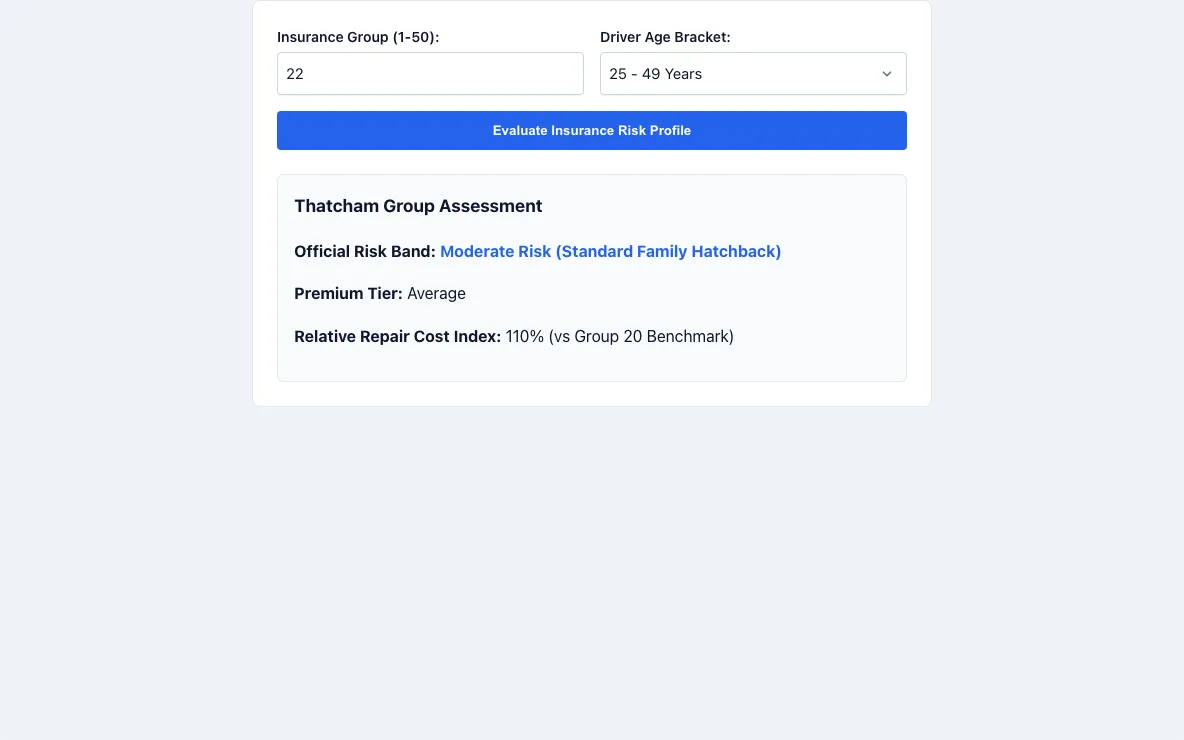
How to use the car insurance group checker
- Find the group number: It is shown on manufacturer price lists and brochures, insurer quotes and most car reviews. Use the number itself and leave out any letter that follows it.
- Type it in: Enter a whole number from 1 to 50. Numbers outside that range, and blank boxes, get an error message instead of a result.
- Read the band: See which fifth of the scale the group falls in: 1–10, 11–20, 21–30, 31–40 or 41–50. The tool also gives a label for the band.
- Read the note: The note describes the kind of car usually found in that band, for example small, low-powered cars at the bottom of the scale.
- Compare models: Run the numbers for two or three cars you are considering. A lower group usually means a lower premium for the same driver, but the gap can be small.
- Get real quotes: Your premium also depends on your age, experience, address, claims history, mileage and the insurer, so always compare actual quotes before buying.
With the default of group 22, the tool shows “Middle groups” in the 21–30 band, described as typically larger family cars, SUVs and more powerful hatchbacks. Group 35 falls in the 31–40 band, which the tool describes as executive cars, large SUVs and performance models with costlier repairs.
How insurance groups work
Who sets the group
The Group Rating Panel, made up of insurers from the ABI and the Lloyd’s Market Association, assigns each new model a group from 1 to 50. Thatcham Research supplies the technical assessment. The group is a starting point for insurers’ own pricing, not a price.
Group Rating Panel and Thatcham Research assessment
Thatcham looks at what the car is likely to cost insurers when it is damaged or stolen. That covers the cost and availability of parts, how long typical repairs take, the car’s performance, its new-car value and its security against theft. It also assesses safety systems such as autonomous emergency braking. Cars with cheap, quick-to-fit parts and good security tend to land in lower groups. Fast, expensive cars with costly repairs land in higher ones.
The five bands
The tool groups the 50 numbers into five bands of ten. Groups 1 to 10 are typically small, low-powered cars with cheap, quick-to-fit parts. The 11 to 20 band holds superminis and family hatchbacks with modest engines. The 21 to 30 band takes larger family cars, SUVs and more powerful hatchbacks. The 31 to 40 band covers executive cars, large SUVs and performance models with costlier repairs. The top band, 41 to 50, is typically high-performance and luxury cars with expensive parts and repairs.
Why your premium can differ
Insurers combine the group with facts about you: age, driving experience, address, claims history, annual mileage and where the car is kept. For a young driver the group matters a lot. For an experienced driver with a long no-claims record, the difference between neighbouring groups can be small. Two cars a few groups apart can therefore cost the same for some drivers.
Security letters
Some listings add a security letter after the group number (for example “E” for a car that exceeds the security requirements). Security performance is part of how the group itself is set, so the letter does not change the tool’s result.
What the tool does not do
The checker does not hold a list of models, does not read a registration number and does not calculate a premium. Each result is a general guide written for this site, not an official rating. The only input is the group number you type.
Common mistakes
- Typing a model’s engine size or price where the group number should go. The checker accepts only a whole number from 1 to 50.
- Assuming a lower group always gives the cheapest policy. Age, address and claims history can matter more.
- Comparing groups from different years without checking. Ask the insurer or price list for the figure for the car you are buying.
Frequently asked questions
What is the UK car insurance group rating system?
A scale from 1 (usually cheapest to insure) to 50 (usually most expensive) that every new car model is placed on. The placement is based on likely repair and theft costs, performance and value.
Who determines the insurance group for a car?
The Group Rating Panel, made up of insurers from the ABI and Lloyd’s Market Association, sets the group using Thatcham Research’s assessment of each new model.
Can this tool tell me my car’s group from its number plate?
No. It explains a group number you already have. Look the model up on the manufacturer’s price list or ask an insurer.
Why do small performance cars have high insurance groups?
Higher performance, higher theft appeal and costly parts or repairs push a model up the scale even if the car is small.
Can safety features lower a vehicle insurance group?
They can help. Thatcham’s assessment includes safety and security systems, so features such as autonomous emergency braking and strong anti-theft protection can lead to a lower group than a similar car without them.
Does modifying a car change its insurance group?
The model’s group does not change, but you must tell your insurer about modifications. They can change your premium or whether you can get cover.
What does a group number of 22 mean?
It sits in the 21 to 30 band, which the tool describes as typically larger family cars, SUVs and more powerful hatchbacks. It is a general guide, and your own premium depends on your circumstances.
Will this tool give me a quote?
No. It does not estimate or quote a premium. Compare actual quotes from insurers, using the group number from the car you are buying.
Related tools
- Car Scrappage Scheme Calculator & Scrap Value Estimator
- Car Warranty Expiry Checker & End Date Calculator
- EV Charging Cost Calculator & Home vs Public Rates
- Electric Vehicle Charging Time Calculator & Speed Tool
- EV Battery Degradation Calculator & SoH Health Tool
- Car Running Cost Calculator & Cost-Per-Mile Tool
- Fuel Economy MPG Calculator & Trip Fuel Cost Tool
- Towing Capacity Weight Calculator & 85% Rule Tool
See all Car Running Cost and Finance Tools.