
Car Tax Check: Due Date & Renewal Cost
Look up the tax status on GOV.UK, type the due date and the V5C details here, and get a countdown, the 2026-27 renewal cost and a calendar reminder.
Free · runs in your browser · nothing is uploaded
Recent
Your last 10 settings, saved only in this browser. Nothing is uploaded.
To check whether a car is taxed, use the official GOV.UK vehicle enquiry service: enter the registration and it shows the tax status (taxed, untaxed or SORN), the date tax is due and the MOT status. Motwatch does not look up registrations. It does the part GOV.UK leaves to you: type the tax due date it shows and the car’s details from the V5C, and this page counts down to the due date, works out the renewal cost at the 2026-27 vehicle tax rates (from 1 April 2026) and saves a calendar reminder.
Use it before a renewal reminder arrives, when you buy a used car (tax does not transfer to you), or to budget for the next 12 months.
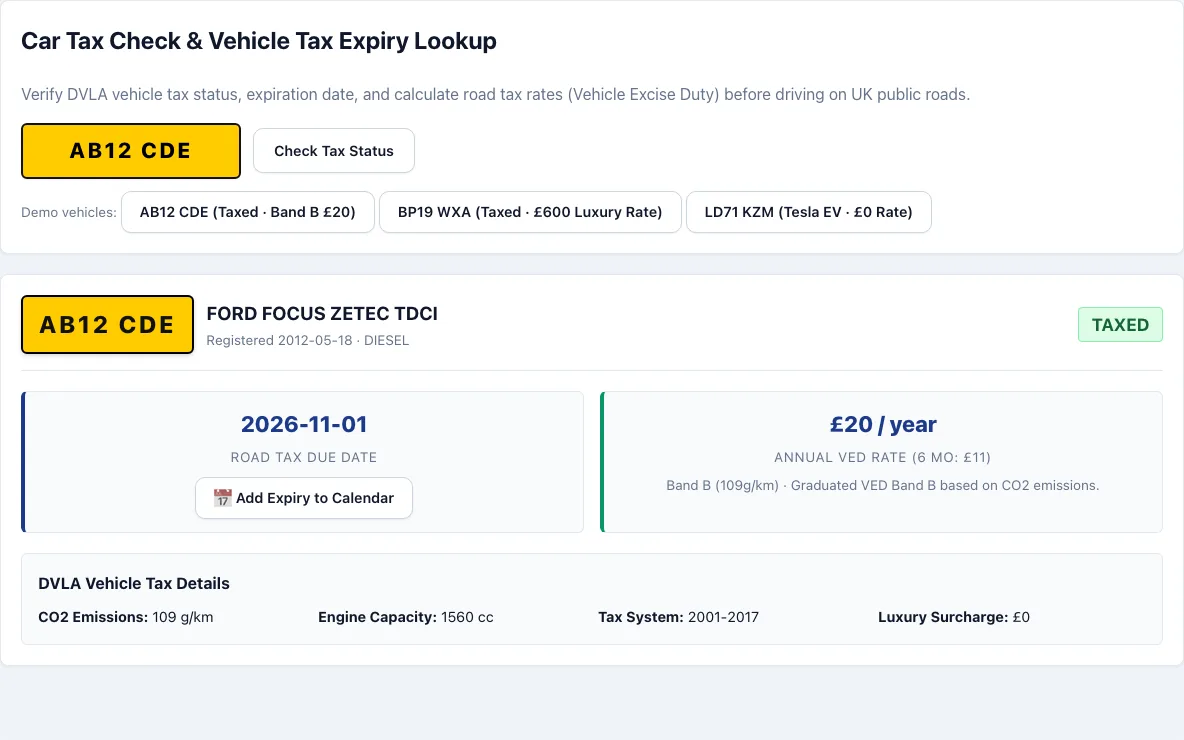
How to check car tax and plan the renewal
Check the status on GOV.UK: enter the registration on the vehicle enquiry service and note “Tax due”.
Type the due date here: the countdown turns amber inside 30 days and red once it has passed.
Add the car’s details: first registration date (V5C box B), fuel, CO2 in g/km (box V.7) and, for post-April 2017 cars, the list price when new.
Read the cost: the 12-month and 6-month single payments, and for post-April 2017 cars the 12 monthly Direct Debit total.
Save a reminder: Add to calendar (.ics) creates an all-day event on the due date with alerts 14 and 3 days before.
Pay on GOV.UK: tax the vehicle at GOV.UK Tax your vehicle with the reference from the V11 reminder or the V5C.
Recheck after any change: if you sell the car, make a SORN or change how you pay, the due date on GOV.UK changes; type the new date and save a fresh reminder.
Tip: if the car was registered from 1 April 2017 and you do not know its list price when new, leave the box empty and the page shows the standard rate; the expensive car supplement only applies above £40,000 (£50,000 for electric cars registered from 1 April 2025).
How vehicle tax works
Vehicle tax (Vehicle Excise Duty, VED) is due on every vehicle used or kept on a public road unless it is exempt; a vehicle kept off the road untaxed needs a SORN. Paper tax discs ended in October 2014, so the only record is DVLA’s, which is what the GOV.UK enquiry shows.
Car tax check and VED cost at 2026-27 rates
The rate depends on when the car was first registered (GOV.UK vehicle tax rate tables, rates from 1 April 2026):
- Registered on or after 1 April 2017: £200 a year (£110 for 6 months) for petrol, diesel, hybrid and electric cars alike. Cars with a list price over £40,000 (over £50,000 for electric cars registered from 1 April 2025) pay an extra £440 a year (£640 in total) for 5 years from the second time they are taxed. Electric cars registered before 1 April 2025 never pay the extra.
- Registered 1 March 2001 to 31 March 2017: 13 bands by CO2, from £20 a year (band A, up to 100 g/km) to £790 (band M, over 255 g/km).
- Registered before 1 March 2001: £230 a year for engines up to 1,549 cc, £375 above that. Paying by 12 monthly Direct Debits costs 5% more (£210 instead of £200).
Buying or selling a car
Tax does not pass to a new keeper. The seller gets a refund of any full months left; the buyer must tax the car before driving it, using the 12-digit reference from the green new keeper slip (V5C/2).
Direct Debit and 6-month payments
For cars registered from 1 April 2017, GOV.UK lists five ways to pay: £200 as a single 12-month payment or by a single Direct Debit, £210 in total by 12 monthly Direct Debits, £110 for 6 months, or £105 for 6 months by Direct Debit. In bands A to C of the 2001–2017 system there is no 6-month option.
Exempt vehicles
Some vehicles are taxed at £0 but still have to be taxed, for example vehicles in the historic class (built more than 40 years ago) and some vehicles used by disabled people. The GOV.UK vehicle enquiry shows whether a car is taxed even when it pays nothing.
Frequently asked questions
How do I check if a car is taxed?
Enter the registration on the GOV.UK vehicle enquiry service. It shows the tax status and the date tax is due. Motwatch then helps you count down and cost the renewal.
Does Motwatch show the real tax status of a car?
No. Motwatch does not connect to DVLA. Type the due date from GOV.UK and the page works with that.
How much is car tax for a car registered after April 2017?
£200 for 12 months in 2026-27, or £640 if the car had a list price over £40,000 (£50,000 for electric cars registered from 1 April 2025) and is in years 2 to 6.
Do electric cars pay car tax now?
Yes. Since 1 April 2025 electric cars pay vehicle tax. From 1 April 2026 the standard rate is £200 a year.
What if I drive an untaxed car?
DVLA can fine you, and an untaxed car on the road can be clamped or impounded. Tax it on GOV.UK before driving, or make a SORN if it stays off the road.
Why does the cost here differ from my reminder letter?
The reminder uses the rate for the date your tax starts. Rates usually change every 1 April, and the expensive car supplement stops after year 6, so set the date and details to match the letter.
Checked 3 November 2026 against the GOV.UK vehicle tax rate tables for 2026/27, including the pages for cars registered from 1 March 2001 and before 1 March 2001.
Related tools
- First Year Road Tax Calculator (Showroom VED Rates)
- Diesel Road Tax Calculator & RDE2 Surcharge Checker
- Electric Car Road Tax Calculator (2026/27 VED Rates)
- Classic Car Tax Exemption Checker (40-Year Rolling Rule)
- Company Car Tax Calculator & BiK Band Estimator
- SORN Declaration Guide & Road Tax Refund Tool
- Private Plate Transfer Cost Calculator & DVLA Fee Tool
- Clean Air Zone Checker & CAZ Fee Calculator
See all Road Tax and Vehicle Tax Tools.