
Car Trade-In Value Estimator & Part-Exchange Tool
A rough what-if: type a retail price you found and a dealer margin to see roughly what a part-exchange offer might be. It does not look up market data and is not a valuation.
Free · runs in your browser · nothing is uploaded
Recent
Your last 10 settings, saved only in this browser. Nothing is uploaded.
The Motwatch car trade-in value estimator helps UK car owners, used vehicle sellers, and motorists negotiating part-exchange deals see roughly how a dealer offer compares with retail prices. When changing vehicles, motorists face a fundamental decision: accept a convenient part-exchange offer from a franchised motor dealer or invest the time to sell the vehicle privately.
Dealers usually offer less than the price they will retail the car for, using trade price guides (such as Cap HPI and Glass’s) and their own costs. The gap pays for preparation, the legal obligations they take on as a trader, and profit. This tool only does the arithmetic on the retail price and margin you type in. Get real offers before you decide.
How to use the car trade-in value estimator & part-exchange tool
- Step 1: Type a retail price for cars like yours: the asking price of dealer adverts for the same model, age and mileage.
- Step 2: Pick a condition; it sets a starting margin (14%, 18% or 25%) that you can change.
- Step 3: Adjust the dealer margin if you have a better idea of it. The result updates as you type.
- Step 4: Read the rough trade-in figure: retail price minus the margin, rounded to £50.
- Step 5: Look at the gap to retail. A private buyer usually pays less than dealer retail, so your real gain from selling privately is smaller than this gap.
- Step 6: Decide whether the convenience of a part-exchange (one visit, the dealer can settle any finance) is worth the difference.
- Step 7: Prepare your vehicle for dealer appraisal by washing bodywork, vacuuming upholstery, and gathering service stamps.
- Step 8: Ensure both sets of original keys, locking wheel nut keys, and the V5C logbook are present.
- Step 9: Obtain competitive online quotes from car buying services (such as Motorway or WeBuyAnyCar) to compare them.
- Step 10: Negotiate part-exchange allowances directly against new car purchase discounts to maximize total deal value.
Changing the condition in Step 2 resets the margin to its default: 14% for excellent, 18% for good and 25% for poor. The result is rounded to the nearest £50.
Technical specifications and architecture
Worked example with the default values
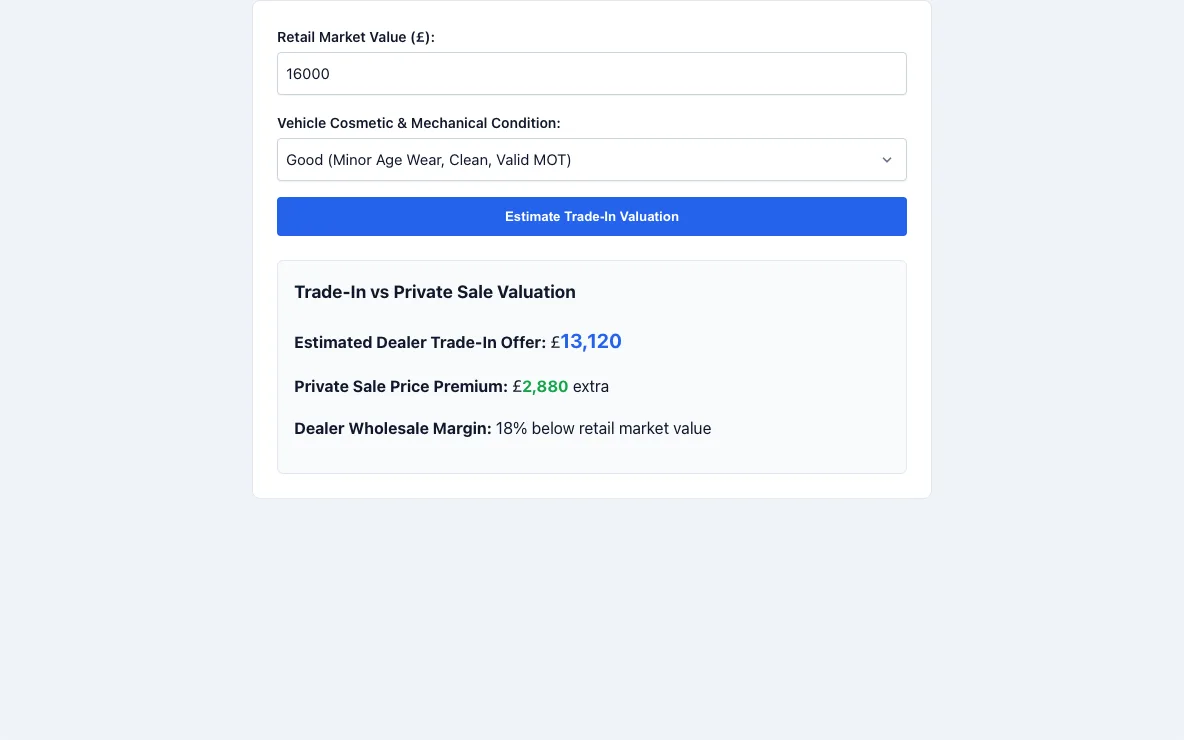
With the default retail price of £16,000 and the good-condition margin of 18%, the tool calculates £16,000 × 82% = £13,120. That is rounded to the nearest £50, giving an offer of about £13,100 and a gap to retail of about £2,900. With a 20% margin on a £15,000 car, the offer is £12,000 and the gap is £3,000.
Dealership Margin Economics and Trade-In Wholesale Valuations
When a dealership offers a trade-in price on your existing car, they are acquiring an asset at wholesale valuation to sell at retail pricing. The margin varies by car, dealer and demand, and there is no published standard figure. As an example, with a margin of 15% to 22% a car retailing at £15,000 would bring an offer of £11,700 to £12,750 (a £2,250 to £3,300 gap) to cover preparation, VAT on the margin and overheads.
Trade Price Guides
Many dealers check trade price guides, such as Cap HPI and Glass’s, alongside their own stock and demand when they price a part-exchange. These subscription guides are built from sales data and adjust for things like trim, options and mileage. This calculator does not use them or any other market data.
Trade-In Convenience vs Private Sale Effort and Financial Spread
Selling privately can get you more than a trade-in offer, though usually less than full dealer retail, and it takes more effort. Private sellers may pay for adverts, arrange test drives with strangers, guard against payment fraud and deal with haggling. Part-exchange avoids that work, at the cost of a lower price.
Common mistakes
- Using a private advert price as the retail figure. Use the asking prices of dealer adverts for the same model, age and mileage, as Step 1 says.
- Keeping the default margin without thinking about the car. A poor-condition car may need a bigger margin than a good one.
- Treating the rounded result as a valuation. Only a real offer from a dealer or online buyer gives a figure you can act on.
Consumer Rights Act 2015 Obligations on Motor Retailers
Under the Consumer Rights Act 2015, a car bought from a trader must be of satisfactory quality, and a fault that appears within six months is presumed to have been there at delivery unless the trader shows otherwise. Dealers therefore spend money on checks and preparation before selling, which is part of why trade-in offers are lower than retail prices.
Frequently asked questions
Why is a dealer trade-in offer so much lower than retail car prices?
The dealer’s offer has to leave room for preparation, its obligations under the Consumer Rights Act 2015, VAT on the margin, overheads and profit.
Can I negotiate a part-exchange trade-in valuation at a dealership?
Usually, yes. A written quote from an online car buyer (such as Motorway or WeBuyAnyCar) gives you a figure to negotiate from.
What documents do I need to hand over when trading in a car?
Bring the V5C registration certificate (logbook), service history, the handbook, the locking wheel nut key and all keys. MOT history is online, so a paper certificate is not essential.
Can I part-exchange a car that has outstanding finance on it?
Usually, yes. The dealer normally asks your finance company for a settlement figure, pays off the balance and uses any money left over towards your next car. If you owe more than the car is worth, you have to cover the difference.
Does having a full service history increase trade-in value?
It can help. A complete service history makes a car easier to sell on, and missing records can lead to a lower offer.
Is it better to sell to WeBuyAnyCar or part-exchange at a dealer?
It varies. Online car buyers give a quick quote, but the final price can change after an inspection; a dealer may match or beat it to win a new car sale. Get both and compare.
Related tools
- Car Finance PCP Calculator & Balloon GFV Tool
- Car Finance HP Calculator & Hire Purchase Tool
- Car Insurance Group Checker: Groups 1–50 Explained
- Car Scrappage Scheme Calculator & Scrap Value Estimator
- Car Warranty Expiry Checker & End Date Calculator
- EV Charging Cost Calculator & Home vs Public Rates
- Electric Vehicle Charging Time Calculator & Speed Tool
- Wheel Alignment Camber Toe Checker: Tyre Wear Guide
See all Car Running Cost and Finance Tools.