
Classic Car Tax Exemption Checker (40-Year Rolling Rule)
Type the year your car was built to see whether it can use the free historic vehicle tax class this tax year and when the 40-year MOT exemption starts. Rules checked against GOV.UK on 3 November 2026.
Free · runs in your browser · nothing is uploaded
Recent
Your last 10 settings, saved only in this browser. Nothing is uploaded.
The Motwatch classic car tax exemption checker helps vintage vehicle owners, restorers and collectors work out the UK’s 40-year rolling exemptions from the build year they type in (rules checked against GOV.UK on 3 November 2026). In recognition of the cultural heritage and low annual mileage of preserved historic automobiles, British legislation exempts vehicles over 40 years old from annual Vehicle Excise Duty (road tax) and mandatory annual MOT examinations. Understanding your vehicle’s eligibility date allows you to re-classify your tax class and eliminate recurring ownership taxes.
The checker compares the build year you type with the rolling 40-year cut-off for the current tax year. It shows whether the vehicle can use the historic tax class now or from which 1 April, and when the MOT exemption starts.
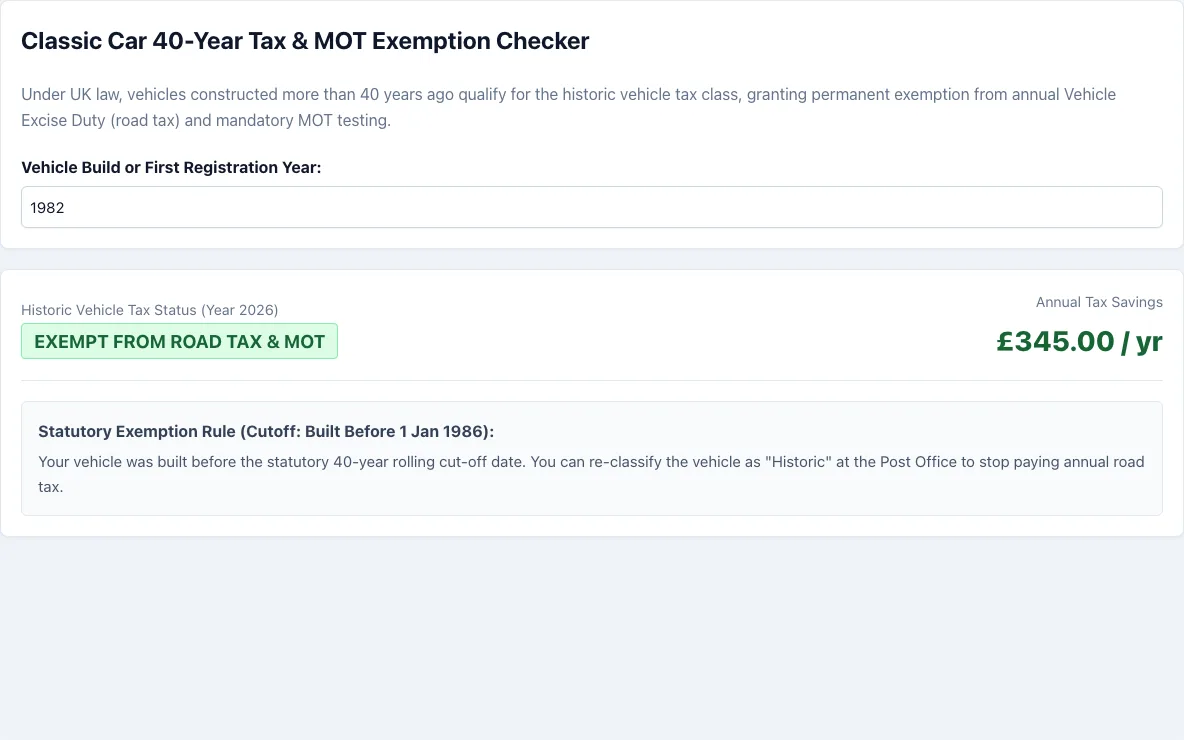
How to use the classic car tax exemption checker
- Input the vehicle build year: Enter the year the vehicle was built (if the build date is unknown, DVLA goes by the first registration date on the V5C).
- Review the statutory 40-year rolling cutoff: Observe the official cutoff threshold (vehicles built before 1 January 40 years prior).
- Inspect your historic exemption status: Check whether your vehicle is currently eligible for free historic road tax and MOT exemption.
- Calculate remaining qualifying countdown: If your vehicle is not yet 40 years old, check the remaining years until it attains historic status.
- Check the MOT line: See whether the 40-year MOT exemption already applies or the year it starts.
- Obtain manufacturer dating certificate if needed: Acquire heritage dating certificates if your car was built in an earlier year than its first registration.
- Complete DVLA V10 road tax application form: Download or pick up form V10 from an authorized UK Post Office branch.
- Present V5C logbook at an authorized Post Office: Submit your V5C logbook, V10 form, and insurance certificate to change the tax class to Historic.
- Consider voluntary annual safety inspections: Remember that even MOT-exempt classics benefit enormously from voluntary garage safety checks.
- Comply with continuous insurance mandates: Ensure your classic vehicle remains covered by valid insurance unless declared officially SORN off-road.
How the historic vehicle rules work
The 40-Year Rolling Historic Vehicle Exemption Mechanism
The statutory exemption for classic vehicles is governed by Schedule 2 to the Vehicle Excise and Registration Act 1994 (VERA). Under this legislation, the UK enforces a rolling 40-year exemption mechanism that updates automatically on 1 April of each calendar year. On 1 April of any given year, vehicles constructed more than 40 years prior become eligible for the “Historic Vehicle” taxation class. For example, on 1 April 2026, vehicles built before 1 January 1986 became eligible for the historic tax class. The MOT exemption is separate: it applies once a vehicle was built or first registered more than 40 years ago and has not been substantially changed.
Build Date vs Registration Date: Establishing True Age
A critical legal distinction in historic vehicle classification is the difference between build date and registration date. Under DVLA rules, exemption is determined strictly by the date of vehicle manufacture, not the date it was first registered. If a vehicle was manufactured in November 1985 but sat in a showroom until first registered in March 1986, the owner can obtain a certified dating letter or heritage certificate from an authorized owner’s club or British Motor Museum to establish 1985 manufacture, qualifying for immediate exemption.
MOT Exemption and Substantial Modification Rules
Under the Motor Vehicles (Tests) (Amendment) Regulations 2018, vehicles over 40 years old are also exempt from mandatory annual MOT testing, provided they have not been “substantially changed.” Under official DVSA guidance, a vehicle is considered substantially changed if the main structural components (chassis, monocoque bodyshell, engine capacity, steering, or suspension axles) have been altered within the previous 30 years with components of different specifications. Modified hot rods or classic restomods with modern crate engines must continue to undergo annual MOT tests.
The Administrative Process for Historic Re-Classification
Historic vehicle exemption is not applied automatically by the DVLA computer system; the vehicle owner must actively apply to change the tax class. To reclassify a vehicle, the owner must take their existing V5C registration certificate, an official V10 tax application form, and valid insurance documentation to an authorized Post Office that processes vehicle tax. The Post Office clerk updates the computer record, changes the tax class from “Petrol Car” or “Diesel Car” to “Historic Vehicle”, and the vehicle is then taxed at £0 (paper tax discs were abolished in 2014).
Frequently asked questions
How old does a car have to be to be road tax exempt in the UK?
For vehicle tax, it must have been built before 1 January of the year 40 years ago, and the cut-off moves on every 1 April: from 1 April 2026, vehicles built before 1 January 1986 qualify. For the MOT exemption it must have been built or first registered more than 40 years ago.
Do I automatically stop paying road tax when my car turns 40?
No. Exemption is not automatic. You must take your V5C logbook to an authorized Post Office to officially change the tax class to “Historic Vehicle.”
Does a classic car over 40 years old still need an MOT?
No, as long as the vehicle has not been “substantially modified” (e.g. chassis, engine, or suspension altered) in the past 30 years. However, voluntary MOTs are strongly recommended.
Can I drive an MOT-exempt classic car that is unsafe?
No. UK law strictly mandates that all vehicles driven on public highways must be completely roadworthy. Driving an unroadworthy classic car carries a fine of up to £2,500 and 3 penalty points.
What happens if my car was built in 1985 but registered in 1986?
Eligibility is based on the date of manufacture. If you obtain an official heritage dating certificate proving it was built before 1 January 1986, it qualifies for exemption.
Do classic motorcycles also qualify for 40-year exemption?
Yes, privately used motorcycles follow the same rolling rule. Vehicles used for hire or reward or commercially for a trade or business cannot use the historic tax class, and some heavy goods vehicles and buses are not covered by the MOT exemption.
Related tools
- Company Car Tax Calculator & BiK Band Estimator
- SORN Declaration Guide & Road Tax Refund Tool
- Private Plate Transfer Cost Calculator & DVLA Fee Tool
- Car Import Duty & VAT Calculator & HMRC Tariff Tool
- UK Road Tax Calculator 2026-27
- Car Tax Check – Due Date Countdown & VED Cost
- First Year Road Tax Calculator (Showroom VED Rates)
- Fuel Duty Calculator & Pump Price Tax Breakdown
See all Road Tax and Vehicle Tax Tools.