
Clean Air Zone Checker & CAZ Fee Calculator
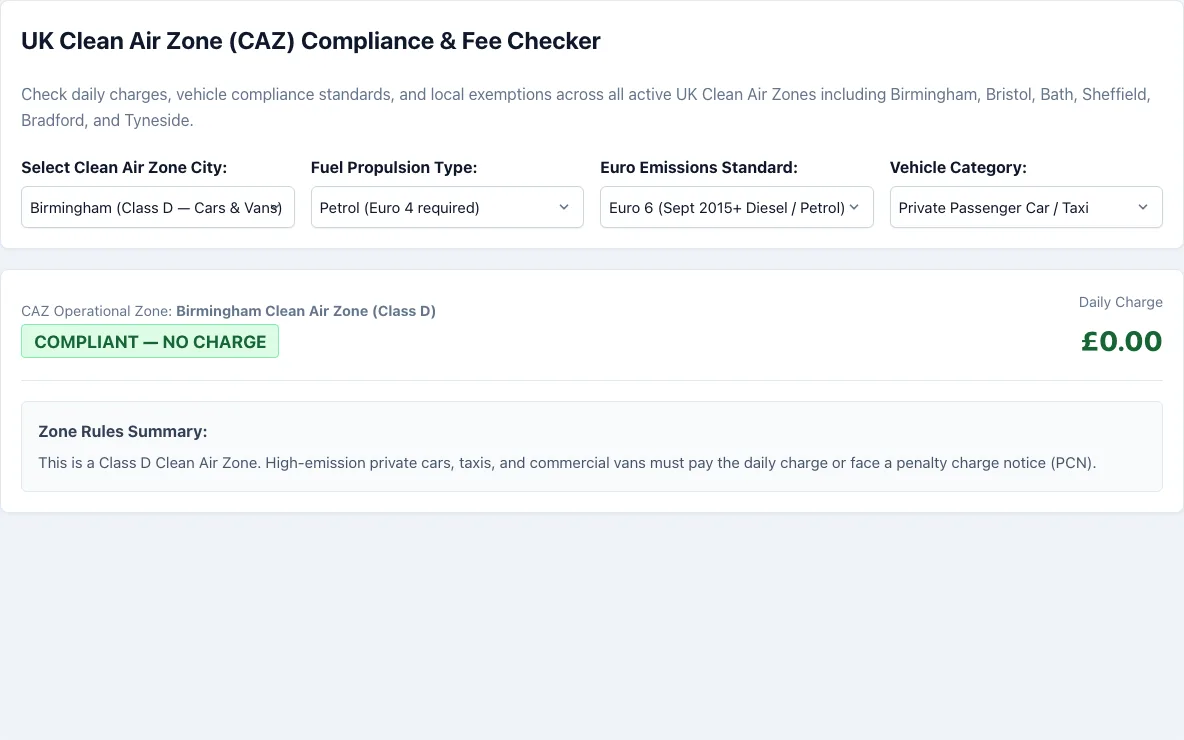
Pick a Clean Air Zone and enter your vehicle's fuel, Euro standard and type to see whether it is charged and how much per day. Charges checked 3 November 2026; confirm a specific plate on GOV.UK.
Free · runs in your browser · nothing is uploaded
Recent
Your last 10 settings, saved only in this browser. Nothing is uploaded.
The Motwatch clean air zone checker shows whether a vehicle is charged, and how much per day, in England’s Clean Air Zones (CAZ). Scotland’s Low Emission Zones work differently and are not covered. The checker applies the Euro standard, fuel type and vehicle type you enter to the rules for Birmingham, Bristol, Bath, Sheffield, Bradford and Tyneside, as checked against GOV.UK and council pages on 3 November 2026.
It does not look up number plates. For a definitive answer on a specific vehicle, use the GOV.UK Clean Air Zone guidance. Use the result to estimate daily charges and the annual cost of commuting through a zone.
How to use the clean air zone checker
- Select target Clean Air Zone city: Choose the urban boundary you intend to enter, such as Birmingham, Bristol, Bath, or Sheffield.
- Specify vehicle fuel type: Select whether the vehicle operates on petrol, diesel, or zero-emission electric powertrain technology.
- Select the Euro emissions standard: Choose Euro 3 or older up to Euro 6, using the V5C (where it shows the Euro status) or the manufacturer’s details.
- Designate vehicle usage classification: Specify whether the vehicle is registered as a private passenger car, licensed taxi, or light commercial goods van.
- Inspect real-time compliance outcome: Review the calculated status badge to verify whether your vehicle meets minimum legal clean air criteria.
- Evaluate daily fee liabilities: Check the daily charge (£7 to £12.50 for cars, taxis and vans) incurred if operating a non-compliant vehicle within active boundaries.
- Verify local municipal car exemptions: Note that Class C zones (such as Bath and Sheffield) exempt private passenger cars entirely from fees.
- Calculate annual commuting expenditure: Multiply daily charges by anticipated annual working days to evaluate the financial feasibility of vehicle upgrades.
- Review statutory payment timelines: Pay charges via the central GOV.UK Clean Air Zone portal within six days of travel to prevent PCN penalties.
- Check national exemptions: Vehicles in the disabled or disabled passenger vehicle tax class, and some others such as historic vehicles, are exempt in every zone; the tool does not apply exemptions.
How Clean Air Zones work
UK Clean Air Zone Framework Classes A Through D
The UK Department for Environment, Food & Rural Affairs (DEFRA) and the Department for Transport set out four classes of Clean Air Zone in the Clean Air Zone Framework. Class A covers buses, coaches, taxis and private hire vehicles; Class B expands coverage to heavy goods vehicles (HGVs); Class C encompasses light commercial vans and minibuses; and Class D represents the strictest tier, incorporating private passenger cars. Birmingham and Bristol currently enforce Class D zones, meaning older, high-polluting private passenger cars are charged daily. In contrast, Bath, Sheffield, Bradford and Newcastle & Gateshead (Tyneside) operate Class C zones, which do not charge private cars but do charge taxis, private hire vehicles, vans, minibuses, buses, coaches and lorries. Portsmouth runs a Class B zone (taxis, private hire vehicles, buses, coaches and lorries only).
Euro Emissions Thresholds: Petrol vs Diesel Criteria
Clean Air Zone compliance thresholds follow strict European emission standards designed to reduce airborne particulate matter (PM) and toxic nitrogen oxides (NOx). To enter an English Clean Air Zone without charge, petrol passenger cars and light commercial vehicles must meet at least Euro 4 standards (generally vehicles registered from January 2006 onward). Because compression-ignition diesel engines produce substantially higher levels of harmful NOx, diesel vehicles face a much stricter threshold, requiring certification to Euro 6 standards (typically vehicles registered after September 2015).
Automatic Number Plate Recognition (ANPR) Enforcement
Municipal Clean Air Zones operate through extensive networks of high-resolution Automatic Number Plate Recognition (ANPR) cameras positioned at all entry and exit corridors. As a vehicle passes an optical camera sensor, its registration number is read and matched against the DVLA vehicle database to determine fuel type and certified Euro emissions status. There are no toll barriers, physical booths, or roadside warning sirens. If a non-compliant vehicle enters an active zone, the motorist must settle the daily charge online within the statutory payment window.
Payment Windows and Penalty Charge Notices (PCN)
Motorists entering a charged Clean Air Zone must submit payment via the central GOV.UK online portal. The statutory payment window opens six days prior to travel, includes the day of travel, and closes at 11:59 pm on the sixth calendar day following travel. Failing to pay within this statutory window results in the automatic issuance of a Penalty Charge Notice (PCN), typically set at £120 (reduced to £60 if paid within 14 days), in addition to the original daily entry charge.
Frequently asked questions
How do I know if my car is compliant with UK Clean Air Zones?
Generally, petrol cars registered after January 2006 (Euro 4) and diesel cars registered after September 2015 (Euro 6) comply with all UK Clean Air Zones and enter without charge.
Do private cars have to pay in all UK Clean Air Zones?
No. Private passenger cars are only charged in Class D zones (Birmingham and Bristol). In Class C zones (Bath, Sheffield, Bradford, and Newcastle), private cars are completely exempt from charges.
What is the daily fee for driving a non-compliant car in Birmingham?
The daily charge for a non-compliant private car or taxi in the Birmingham Clean Air Zone is £8.00 per calendar day (midnight to midnight).
How long do I have to pay a Clean Air Zone charge?
You must pay the charge within a 13-day window: from 6 days before the day of your journey, on the day of travel, or up to 6 days after your journey.
Can I get an exemption if I live inside a Clean Air Zone?
Some councils have offered local exemptions or support schemes, often for a limited time. Check the council’s own Clean Air Zone pages; the tool does not apply local exemptions.
What happens if I drive through multiple Clean Air Zones in one day?
Each municipal Clean Air Zone is operated independently by its local council. Entering two separate zones (e.g. Birmingham and Bristol) on the same day requires paying both separate daily entry charges.
Related tools
- London Congestion Charge Calculator & Auto Pay
- Euro Emissions Standard Checker & Vehicle Identifier
- Car CO2 Emissions Calculator
- Fuel Duty Calculator & Pump Price Tax Breakdown
- Catalytic Converter Theft Risk & Security Checker
- London ULEZ Checker – Estimate by Fuel & Age
- Fuel Economy MPG Calculator & Trip Fuel Cost Tool
See all Clean Air Zone and Emissions Tools.