
Company Car Tax Calculator & BiK Band Estimator
Estimate company car benefit-in-kind tax from the P11D price, CO2 figure and your income tax rate, using HMRC's 2025/26 and 2026/27 percentages. Runs in your browser.
Free · runs in your browser · nothing is uploaded
Recent
Your last 10 settings, saved only in this browser. Nothing is uploaded.
The Motwatch company car tax calculator helps UK company car drivers and fleet administrators estimate employee Benefit-in-Kind (BiK) tax. Rates were checked against HMRC’s published appropriate percentages on 3 November 2026. In the United Kingdom, employees who are provided with a corporate vehicle available for private travel incur a taxable fringe benefit under HMRC regulations. The taxable value is derived by multiplying the vehicle’s published P11D price by an emissions-linked BiK percentage.
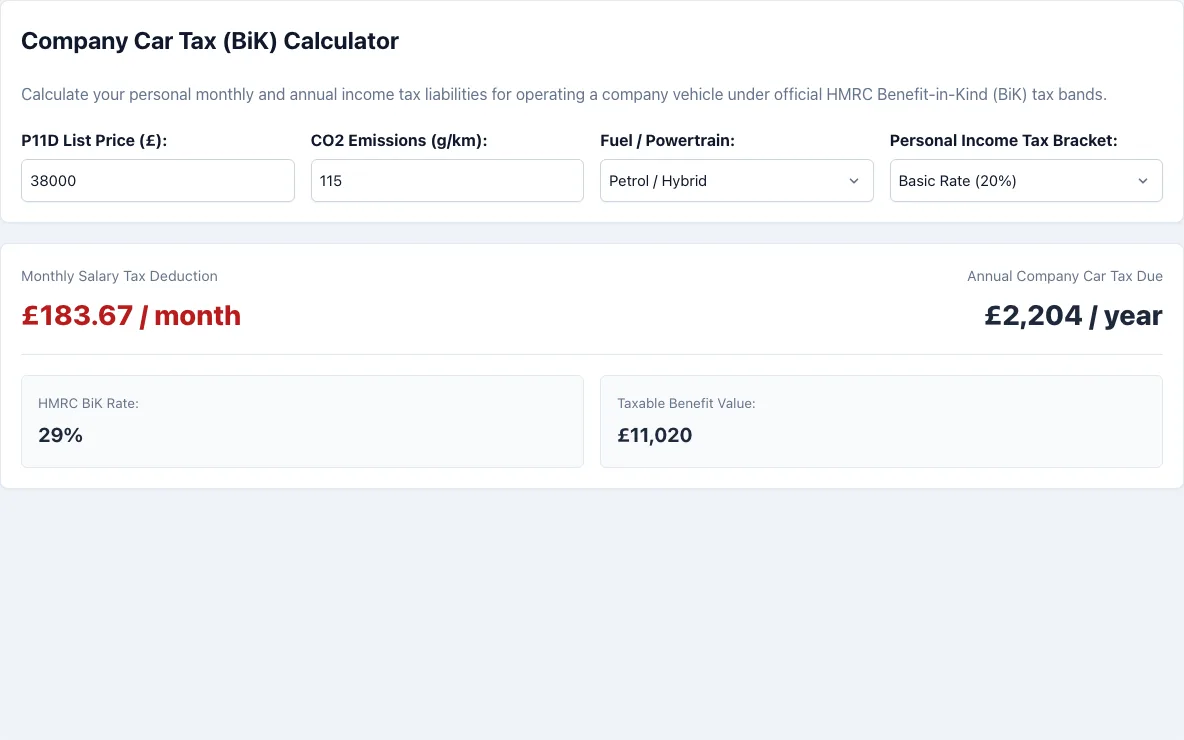
Our calculator evaluates your vehicle’s P11D list value, certified tailpipe CO2 emissions, and personal income tax bracket to estimate the extra income tax per year and per month. Compare financial savings between electric vehicles and combustion engines directly in your browser without software installations.
How to use the company car tax calculator
- Enter the vehicle P11D valuation: Input the official manufacturer list price including VAT and options, excluding the first registration fee and road tax.
- Enter certified tailpipe CO2 emissions: Type the certified emissions figure in grams per kilometre (g/km) from your fleet schedule.
- Select engine fuel technology: Choose petrol or hybrid, an RDE2 diesel, another diesel (4% supplement), or pure electric. Plug-in hybrids with 1–50 g/km also need their electric range in miles.
- Select your personal income tax bracket: Choose your marginal income tax band: Basic Rate (20%), Higher Rate (40%), or Additional Rate (45%).
- Inspect the assigned HMRC BiK percentage: Review your vehicle’s statutory BiK percentage, from 4% for a pure electric car in 2026/27 up to the 37% maximum.
- Review taxable benefit value: Check the calculated monetary value added to your annual taxable income for corporate reporting.
- Inspect the monthly figure: Review the estimated extra income tax per month, which is normally collected through your PAYE tax code.
- Evaluate electric vehicle tax advantages: Compare tax deductions between electric models and petrol vehicles to uncover substantial annual savings.
- Account for free employer private fuel: Note that if your employer covers private personal fuel, a separate fuel benefit multiplier applies.
- Consult your payroll department: Provide calculated figures to your corporate payroll team to verify correct tax code adjustments before delivery.
How company car tax works
How HMRC Works Out Company Car Tax
Under the Income Tax (Earnings and Pensions) Act 2003, when an employer provides an employee with a motor vehicle available for personal travel, the employee receives an employment perk classified as a Benefit-in-Kind (BiK). To calculate the annual tax due, the calculation is: Annual Tax = P11D Value × BiK Percentage × Marginal Income Tax Rate. The resulting sum is not billed directly; instead, HMRC adjusts the employee’s PAYE tax code, distributing the deduction equally across monthly pay slips.
The Significance of P11D Value vs Negotiated Price
A frequent point of confusion among corporate drivers is the distinction between invoice cost and P11D value. The P11D value represents the official manufacturer list price on the day prior to registration, including standard retail price, VAT, delivery charges, and all factory-fitted optional extras (such as leather upholstery or metallic paint). It explicitly excludes the DVLA first registration fee (£55) and first-year road tax. Importantly, any corporate fleet discounts or lease concessions negotiated by the employer do not reduce the P11D figure for employee tax purposes.
Lower Rates for Zero-Emission Cars
Zero-emission cars have much lower BiK percentages than petrol and diesel cars. In 2026/27 a petrol car emitting 130 g/km is at 32%, while a pure electric car is at 4% (3% in 2025/26, 5% in 2027/28, with further rises announced from 2028/29). For a 40% taxpayer with a £45,000 P11D price, that is about £60 a month for the electric car against about £480 a month for the 130 g/km petrol car.
The 4% Diesel Surcharge and Real Driving Emissions
Under HMRC regulations, diesel vehicles are subject to a mandatory 4% percentage point penalty added to their standard BiK bracket (up to the maximum 37% cap). This surcharge was originally introduced to reflect higher particulate and nitrogen oxide emissions. However, diesel vehicles that are certified to Real Driving Emissions Step 2 (RDE2 / Euro 6d) are legally exempt from this 4% penalty, paying identical BiK rates to equivalent petrol vehicles. Drivers should always verify RDE2 compliance on company fleet order forms.
Frequently asked questions
How is company car tax calculated in the UK?
Company car tax is P11D list price × the BiK percentage for the car’s CO2 (and electric range) × your income tax rate (20%, 40% or 45% outside Scotland).
What is the P11D price of a car?
The P11D price is the official list price of the car when new, including VAT, delivery charges, and all factory-fitted options, but excluding road tax and first registration fees.
What is the BiK tax rate for an electric company car?
Pure electric cars are at 3% in 2025/26, 4% in 2026/27 and 5% in 2027/28 (2% in 2024/25). The government has announced further rises from 2028/29.
Why do diesel company cars have a 4% surcharge?
Diesel vehicles that do not meet the Real Driving Emissions Step 2 (RDE2) standard incur a 4% BiK surcharge, capped at the maximum rate of 37%, to disincentivize high-NOx vehicles.
How do I pay my company car tax?
You do not pay a separate bill; HMRC usually adjusts your PAYE tax code, so the tax is deducted automatically from your monthly salary.
Can I reduce my company car tax through salary sacrifice?
Yes. Enrolling in an employer salary sacrifice scheme for an electric car allows you to pay for the vehicle from pre-tax gross salary, saving significant National Insurance and income tax contributions.
Checked 3 November 2026 against HMRC’s Employment Income Manual EIM24705: 2026/27 and 2025/26 appropriate percentages, 4% diesel supplement, 37% cap.
Related tools
- SORN Declaration Guide & Road Tax Refund Tool
- Private Plate Transfer Cost Calculator & DVLA Fee Tool
- Car Import Duty & VAT Calculator & HMRC Tariff Tool
- UK Road Tax Calculator 2026-27
- Car Tax Check – Due Date Countdown & VED Cost
- First Year Road Tax Calculator (Showroom VED Rates)
- Diesel Road Tax Calculator & RDE2 Surcharge Checker
- Catalytic Converter Theft Risk & Security Checker
See all Road Tax and Vehicle Tax Tools.