
DVSA Vehicle Recall Checker Guide & What-to-Do Checklist
This page does not look up recalls: the official free check is DVSA's service on GOV.UK. Answer three questions to get a checklist of what to do next.
Free · runs in your browser · nothing is uploaded
Recent
Your last 10 settings, saved only in this browser. Nothing is uploaded.
The DVSA vehicle recall checker is the official, free GOV.UK service for finding out whether a car has an outstanding safety recall. You need the registration number, or the make, model and year, and you use the service at Check if a vehicle has been recalled. Motwatch does not look up recalls and does not see your registration.
This page explains how to use that service and turns the GOV.UK guidance into a short checklist. You answer whether you have had a recall letter, what kind of recall it is and whether you are buying the car used. Checked 3 November 2026.
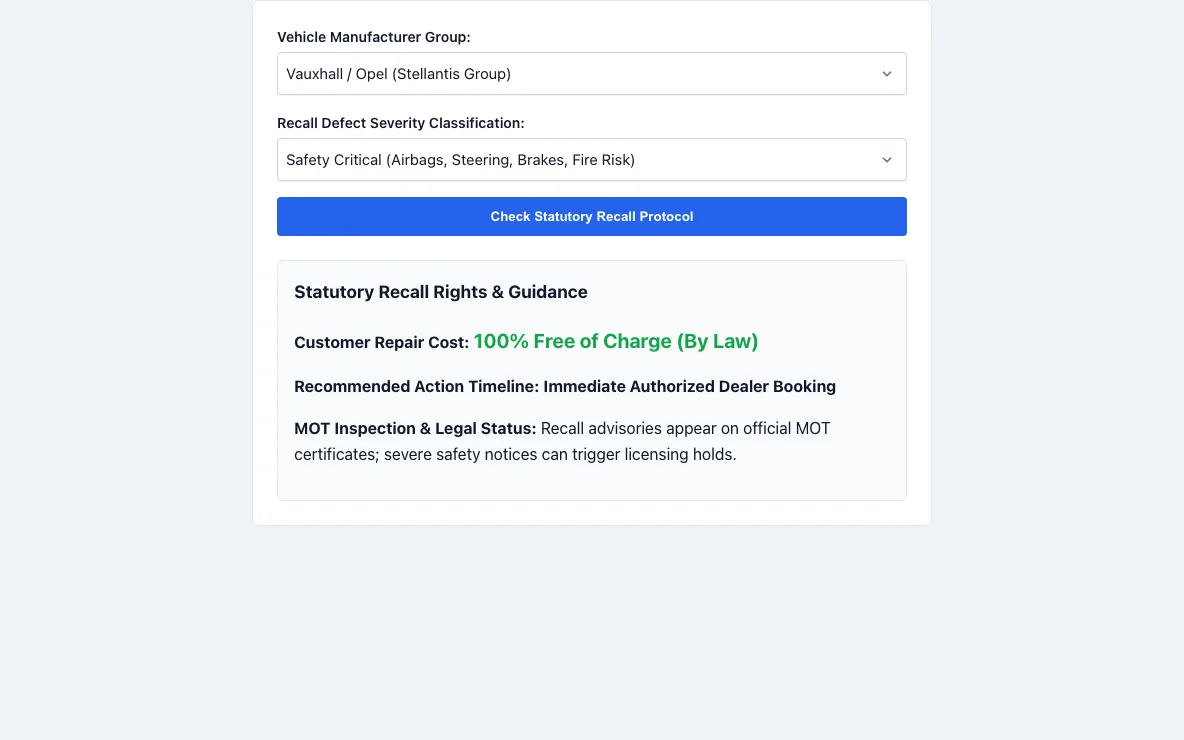
How to check a vehicle recall
- Open GOV.UK Check if a vehicle has been recalled and enter the registration number, or the make, model and year.
- Note the result. The DVSA service is the check that counts, so the checklist on this page does not replace it.
- On this page, answer the three questions: have you had a recall letter, what kind of recall it is, and are you buying the car used.
- Read the checklist that appears. It lists the next steps for your answers, and the list changes as you change them.
- If there is an outstanding safety recall, contact the manufacturer or one of its dealers to book the work. The letter names who to contact.
- If you are buying the car used, check the registration on the recall service before you pay, and ask the seller for proof that any recall work was done.
For example, an owner who has had a safety recall letter sees a checklist that says to read the letter first, and not to drive the car if the letter says so. A used-car buyer who has had no letter sees the step to check the registration before paying. Keep the GOV.UK result with your records, because it is the check that counts.
What GOV.UK says about recalls
What GOV.UK says owners must do about recalls
- If the manufacturer finds a serious safety problem, it must fix or replace the vehicle, part or accessory. You will not usually have to pay for repairs or parts under a safety recall.
- If your vehicle has a serious safety defect, the manufacturer writes to you to tell you what to do. You must not drive the vehicle if the letter says so.
- Manufacturers write to the keeper address DVLA holds, so keep the address on your V5C up to date.
- In England, Scotland and Wales the MOT certificate may tell you about an outstanding safety recall, depending on the manufacturer. An outstanding recall is not an MOT failure in itself.
- You are legally responsible for keeping your vehicle safe. Driving a vehicle in a dangerous condition can mean a fine of up to £2,500, a driving ban and 3 penalty points.
DVSA publishes a Code of Practice on vehicle safety defects and recalls that sets out what manufacturers, dealers and DVSA do when a safety defect is found. Faults that are not a safety risk but mean a vehicle may not meet the legal standard are registered with DVSA too, and are usually fixed free.
The three questions and what they change
The first question is whether you have a recall letter. A letter means the manufacturer has contacted you, so the checklist starts with reading it. The second question is the kind of recall. A safety recall adds the steps for booking the work with the manufacturer. Another recall or a registered fault adds the steps for a free fix, which GOV.UK says is usually the case for those. The third question is whether you are buying used, which adds the steps for the buyer.
Used-car buyers
A buyer should check the registration on the recall service before paying. Ask the seller for proof, such as a dealer’s record, that any recall work was done. The GOV.UK service is the simplest way to see the recall status before you buy; a franchised dealer can also check by VIN.
Common mistakes
- Assuming an MOT pass means there is no recall. The MOT may not show one, and the official check is the one to use.
- Ignoring the letter because the car seems fine. A safety defect may not show on a normal drive.
- Using an old address on the V5C, so the letter never arrives.
Frequently asked questions
How do I check if my car has a recall?
Use GOV.UK Check if a vehicle has been recalled with the registration number, or ask a franchised dealer for the brand with the VIN.
Do I have to pay for a recall repair?
Usually not: GOV.UK says you will not usually have to pay for repairs or parts under a safety recall.
Will an outstanding recall fail the MOT?
Not by itself. The MOT certificate may mention it as information. The tester still fails any defect that breaks the MOT standards.
Where is the recall work done?
Normally by the manufacturer’s dealer network, which has the parts and instructions. The recall letter says who to contact.
What if I ignore a safety recall?
You put yourself and others at risk, it can affect an insurance claim, and driving a vehicle in a dangerous condition is an offence.
Does this page check the recall status of my car?
No. The checklist depends only on the three answers you select. For the status of a specific car, use the official DVSA service on GOV.UK.
Is the DVSA recall check free?
Yes. There is no charge for the GOV.UK check, and it needs only the registration number, or the make, model and year.
Sources (checked 3 November 2026): GOV.UK: check if a vehicle has been recalled; GOV.UK: vehicle recalls and faults; Auto Express: recall information on MOT documents; GOV.UK: Code of Practice on vehicle safety defects and recalls.
Related tools
- Number Plate Check – UK Plate Age & Area Decoder
- MOT Due Date Calculator
- MOT Expiry Calculator & Grace Period Rules
- MOT Fee Calculator & Re-Test Limits
- MOT Checklist – Pre-MOT Checks
- MOT Advisory Checker – What To Do Next
- Car Mileage Check – MOT Mileage History Analyser
- Private Plate Transfer Cost Calculator & DVLA Fee Tool
See all MOT Tools.