
Electric Car Road Tax Calculator (2026/27 VED Rates)
Enter your electric car's first-registration month and list price to see the vehicle tax for a licence taken out now. Rates for 1 April 2026 – 31 March 2027, checked against GOV.UK on 3 November 2026.
Free · runs in your browser · nothing is uploaded
Recent
Your last 10 settings, saved only in this browser. Nothing is uploaded.
The Motwatch electric car road tax calculator helps electric vehicle (EV) drivers and buyers work out what they pay under the Vehicle Excise Duty changes that began in April 2025 (rates checked against GOV.UK on 3 November 2026). Before April 2025, most electric cars paid no vehicle tax because rates for cars registered from 2001 are based on CO2 emissions. From 1 April 2025 electric cars pay vehicle tax like other cars, although which rates apply depends on when the car was first registered.
The calculator works from the registration month and original list price you type in. It shows the £200 standard rate, the £10 first-year rate and whether the £440 expensive car supplement applies, directly in your browser.
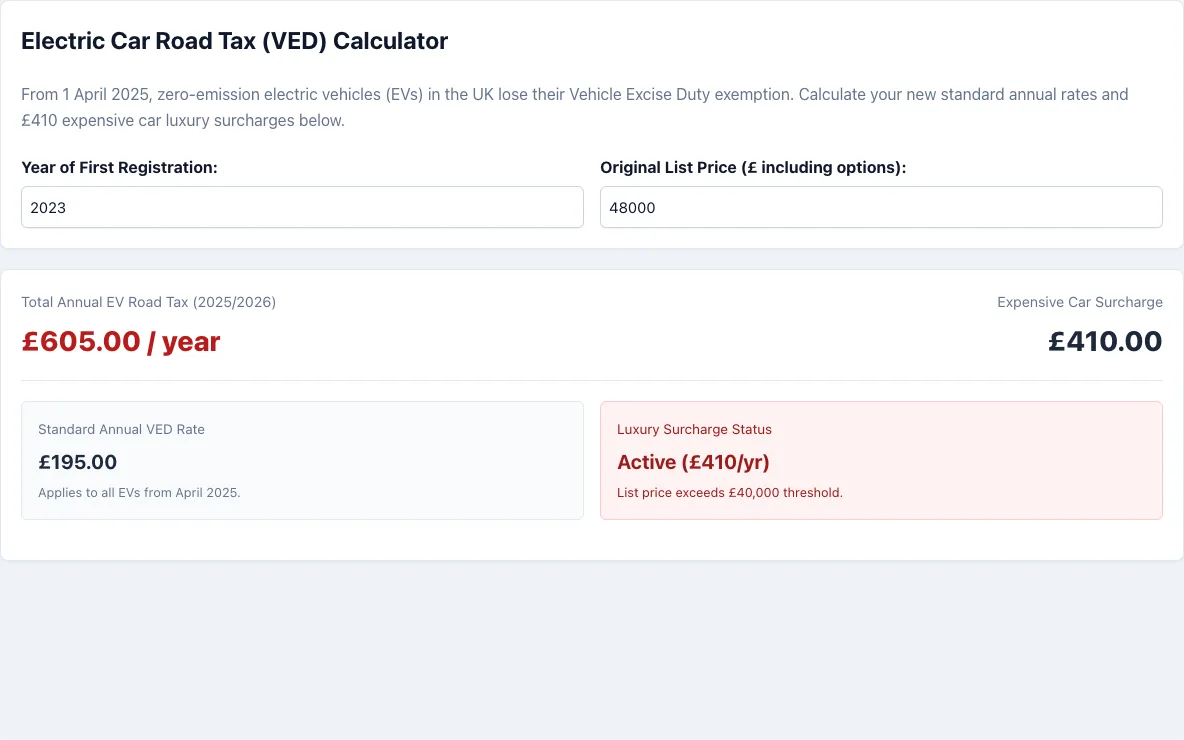
How to use the electric car road tax calculator
- Enter the first registration month: Input the month and year your electric car was first registered, from the V5C.
- Enter original brand-new list price: Input the manufacturer’s published retail price including battery, factory options, and VAT when new.
- Review the standard rate: Electric cars registered from 1 April 2017 pay the £200 standard rate (2026/27) after their first licence.
- Check the expensive car supplement: Only electric cars registered on or after 1 April 2025 with a list price over £50,000 pay it.
- Check the 5-year window: The £440 supplement is paid for 5 years, starting with the second licence.
- See the total: Up to £640 a year (£200 + £440) for an electric car over £50,000 registered from April 2025.
- First-year rate: Brand-new electric cars registered from 1 April 2025 pay £10 for the first licence.
- Older electric cars: EVs registered from 1 March 2001 to 31 March 2017 pay the lowest band rate, £20 a year.
- Paying monthly: 12 monthly Direct Debits cost 5% more (£210 instead of £200).
- Factor taxation into total cost of ownership: Incorporate the revised annual road tax into overall running cost calculations when comparing EVs against hybrids.
Worked example: a new electric car first registered in June 2025 with a list price of £52,000 pays £10 for the first licence. From the second licence it pays the £200 standard rate plus the £440 supplement, which is £640 a year for 2026/27 licences, for five years. The same car with a list price of £48,000 pays the £200 standard rate and no supplement.
How electric car vehicle tax works
The 2025 Electric Vehicle Road Tax Reform and Legislative Background
At the Autumn Statement 2022 the government announced that electric cars would start paying vehicle tax from April 2025. Before then, most electric cars paid nothing, because vehicle tax for cars registered since 2001 depends on CO2 emissions. From 1 April 2025, zero-emission cars, vans and motorcycles pay vehicle tax under the normal tables.
Standard Rate: £200 a Year in 2026/27
Zero-emission cars registered on or after 1 April 2017 pay the standard rate: £195 in 2025/26 and £200 for licences from 1 April 2026. Brand-new electric cars registered on or after 1 April 2025 pay £10 for the first licence, then the standard rate. Electric cars first registered between 1 March 2001 and 31 March 2017 pay the lowest band rate, £20 a year.
The Expensive Car Supplement for Electric Cars
The expensive car supplement is an extra charge for 5 years, starting with the second licence, on cars with a list price over a threshold. It is £440 a year for licences from 1 April 2026 (£425 in 2025/26). Electric cars registered before 1 April 2025 do not pay it. For electric cars registered on or after 1 April 2025, Budget 2025 raised the threshold from £40,000 to £50,000 for licences starting on or after 1 April 2026, so an electric car over £50,000 pays £200 + £440 = £640 a year in 2026/27. The threshold stays at £40,000 for petrol and diesel cars.
Calculating the Official List Price: Options and Delivery Fees
The threshold is based on the vehicle’s published list price on the day prior to first registration, not the negotiated invoice price or second-hand purchase price. Under DVLA regulations, list price encompasses the vehicle base price, VAT, delivery charges, and all factory-fitted options (such as larger alloy wheels, upgraded infotainment, or premium paint). So a second-hand electric car bought for £30,000 still pays the supplement if it was registered on or after 1 April 2025, its original list price was over £50,000 and it is still within its 5 supplement years.
Frequently asked questions
When do electric cars start paying road tax in the UK?
Electric cars have paid Vehicle Excise Duty (road tax) since 1 April 2025.
How much road tax will an electric car pay from April 2025?
For licences from 1 April 2026: electric cars registered from 1 April 2017 to 31 March 2025 pay £200 a year; new electric cars registered from 1 April 2025 pay £10 for the first licence, then £200 (plus £440 if the list price was over £50,000); those registered from March 2001 to March 2017 pay £20.
Does the expensive car supplement (“luxury car tax”) apply to electric vehicles?
Only for electric cars registered on or after 1 April 2025. For licences from 1 April 2026 their threshold is £50,000 (not £40,000), and the supplement is £440 a year for 5 years from the second licence, making £640 a year in total.
If I buy a used EV for £20,000, do I still have to pay the expensive car supplement?
Yes, if the car was registered on or after 1 April 2025, its original list price was over £50,000 and it is still in its 5 supplement years. The tax is based on the original list price, not what you paid second-hand.
Do electric vans also pay road tax from 2025?
Yes. Since 1 April 2025 electric vans pay the standard rate for light goods vehicles; check the current figure in the GOV.UK vehicle tax rate tables.
Are there any road tax exemptions remaining for electric vehicles?
There is no longer an exemption just for being electric. The general exemptions that apply to any vehicle, such as the disabled tax class, still apply to electric cars.
Related tools
- Classic Car Tax Exemption Checker (40-Year Rolling Rule)
- Company Car Tax Calculator & BiK Band Estimator
- SORN Declaration Guide & Road Tax Refund Tool
- Private Plate Transfer Cost Calculator & DVLA Fee Tool
- Car Import Duty & VAT Calculator & HMRC Tariff Tool
- UK Road Tax Calculator 2026-27
- Car Tax Check – Due Date Countdown & VED Cost
- Car CO2 Emissions Calculator
See all Road Tax and Vehicle Tax Tools.