
Engine Oil Change Interval Checker
Enter your handbook oil service interval and the miles and months since the last change: see what is left or how far it is overdue.
Free · runs in your browser · nothing is uploaded
Recent
Your last 10 settings, saved only in this browser. Nothing is uploaded.
This engine oil change interval tool checks the miles and months since your last oil change against your handbook interval, whichever comes first, and shows what is left or how far it is overdue. Enter the interval from your handbook, pick a preset or your own figures, and the result updates as you type.
Intervals depend on the engine and the service schedule: many cars use a fixed schedule of around 10,000–12,000 miles or 12 months, others a long-life or variable schedule of up to about 18,000 miles or 2 years with an approved oil, and older or hard-worked engines often less. The presets are examples; your handbook and any service indicator decide.
How to use the engine oil change interval tool
- Pick the kind of schedule your car uses, or choose “My own figures”. A preset fills both interval boxes: 10,000 miles and 12 months for fixed, 18,000 miles and 24 months for long-life, and 6,000 miles and 6 months for severe use or an older car. Changing either interval box switches the type to “My own figures”.
- Enter the interval from your handbook, in miles and months. The tool needs both figures, because it checks which limit is reached first.
- Enter the miles and months since the last oil and filter change. If you do not know when the oil was last changed, check the service book or the invoices, since the tool cannot know it.
- Read the status badge. “Within the interval” means both limits are still ahead, “Due soon” means 1,000 miles or less, or one month or less, is left, and “Oil change due now” means a limit has been passed.
- Read the two boxes, “By mileage” and “By time”. Each shows what is left or how far over.
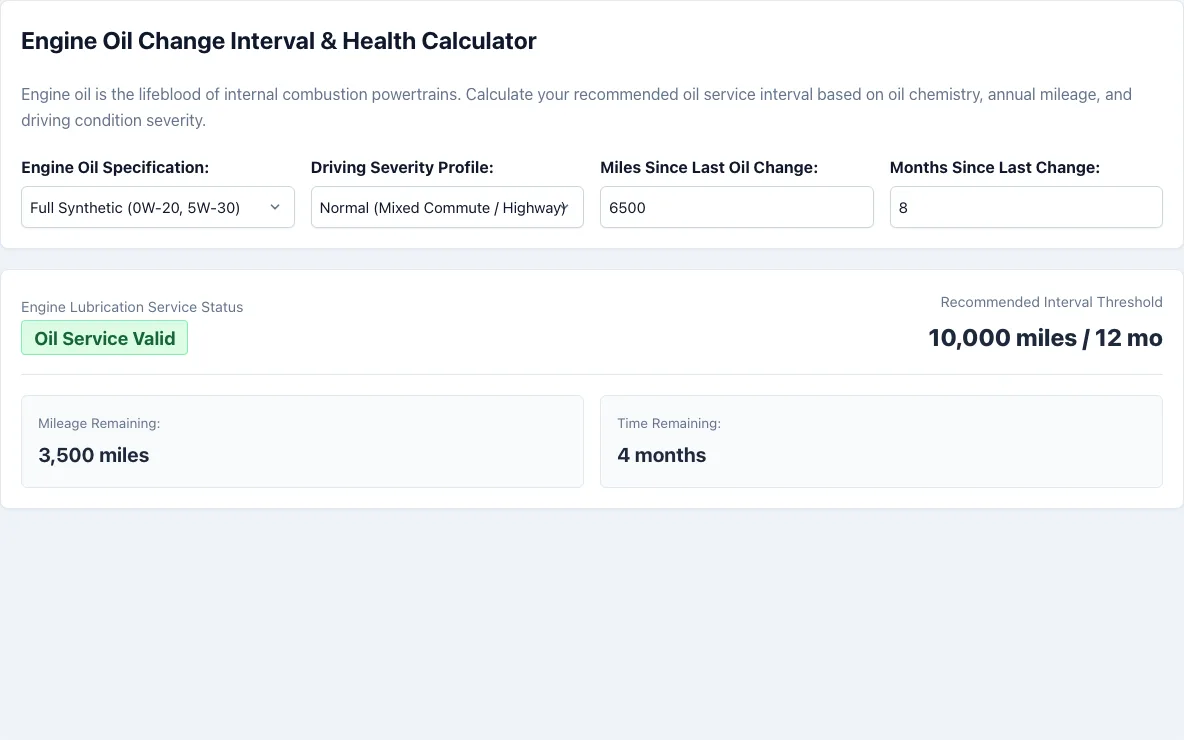
Worked example with the fixed preset (10,000 miles / 12 months): at 6,500 miles and 8 months the result is 3,500 miles and 4 months left, so the status is “Within the interval”. At 11,000 miles and 9 months the car is 1,000 miles over and 3 months from the time limit, so the status is “Oil change due now”.
Why oil gets changed
What oil does
Oil keeps a film between moving parts, carries heat away, holds soot and dirt in suspension and neutralises acids. Its additives are used up over time and miles.
Manufacturer service schedules (fixed and variable/long-life)
Each manufacturer sets its own service schedule, and the handbook or service book is where it is printed. Intervals vary by engine, so check the figure for your own engine. This tool does not look up a car or hold a list of intervals: it only works on the numbers you type.
Fixed and long-life schedules
A fixed schedule changes oil at a set mileage or time. Long-life (variable) schedules rely on a specific approved oil and on the car’s own monitoring, and can stretch to about two years. The oil specification named in the handbook (for example an ACEA class or a maker’s approval code) matters as much as the interval.
How the two limits work together
Both limits are checked at the same time, and the one reached first ends the interval. A car on a fixed 10,000-mile, 12-month schedule that covers only 3,000 miles in a year still needs its oil changed at 12 months. A car that covers 10,000 miles in six months is due on mileage, even though the time limit has not been reached.
Severe use
Many handbooks list “severe” or “arduous” conditions, such as many short trips, lots of idling, towing or dusty roads, and give a shorter interval for them. The severe preset in this tool (6,000 miles / 6 months) is an example, not a figure taken from any handbook.
Time as well as miles
Low-mileage cars still need oil changes on time: moisture and acids build up even when the car is driven little.
Common mistakes
- Entering the total odometer reading instead of the miles since the last oil change.
- Using a long-life interval on a car whose handbook only lists a fixed schedule.
- Forgetting the months: a car with low mileage can still be due on time alone.
- Treating a preset as the figure for your car. The handbook decides.
What the tool does not do
The tool does not read the car’s computer or service indicator, does not check the condition of the oil, and does not know which oil is in the engine. The result is only as good as the figures you enter.
Frequently asked questions
How often should I change my engine oil?
As your handbook says. Typical fixed schedules are around 10,000–12,000 miles or 12 months; long-life schedules can be up to about 2 years.
Can I wait two years if I drive very little?
Only if your handbook’s schedule allows it. On a fixed 12-month schedule, change it yearly even at low mileage.
What is the difference between synthetic and semi-synthetic oil?
Fully synthetic oils resist heat and oxidation better and flow better when cold. Use the specification your handbook names rather than choosing by type alone.
Can missing an oil change affect my warranty?
It can: if a fault is caused by lack of servicing, the manufacturer may refuse that claim. Keep receipts showing the oil used.
Does the MOT check engine oil?
The MOT does not assess the oil’s condition. Serious oil leaks are a defect.
What happens if I overfill the oil?
Too much oil can be churned into foam by the crankshaft and cause problems; drain it back to between the dipstick marks.
Does this tool look up my car’s service interval?
No. It does not look up any vehicle or hold a list of intervals. Enter the figure from your handbook, and it works out the miles and months left.
Related tools
- Cambelt Replacement Interval Calculator
- Brake Fluid Replacement Interval Checker
- Car Battery Lifespan Calculator
- Tyre Tread Depth Checker & 20p Coin Test Guide
- Wheel Alignment Camber Toe Checker: Tyre Wear Guide
- Speedometer Accuracy Calculator: True Speed & Tyre Size
- Stopping Distance Calculator (UK Highway Code Rules)
- MOT Due Date Calculator
See all Car Maintenance and Safety Tools.