
Euro Emissions Standard Checker & Vehicle Identifier
Enter the fuel and the month the car was first registered to see the minimum Euro emissions standard it had to meet, and whether that is enough for London's ULEZ and the Class D Clean Air Zones.
Free · runs in your browser · nothing is uploaded
Recent
Your last 10 settings, saved only in this browser. Nothing is uploaded.
The Euro emissions standard checker works out the minimum Euro standard a new petrol or diesel car had to meet in the month it was first registered. Every new car registered after a stage became compulsory meets at least that stage. Many cars met the next stage earlier, because new models had to meet it from the earlier type-approval date, so the result says “check” when your car may already meet a later standard. The exact standard is in box V.9 of the V5C or from the manufacturer.
Checked 3 November 2026. This page does not look up a registration number. For a definite answer use the official TfL vehicle checker or the GOV.UK Clean Air Zone checker.
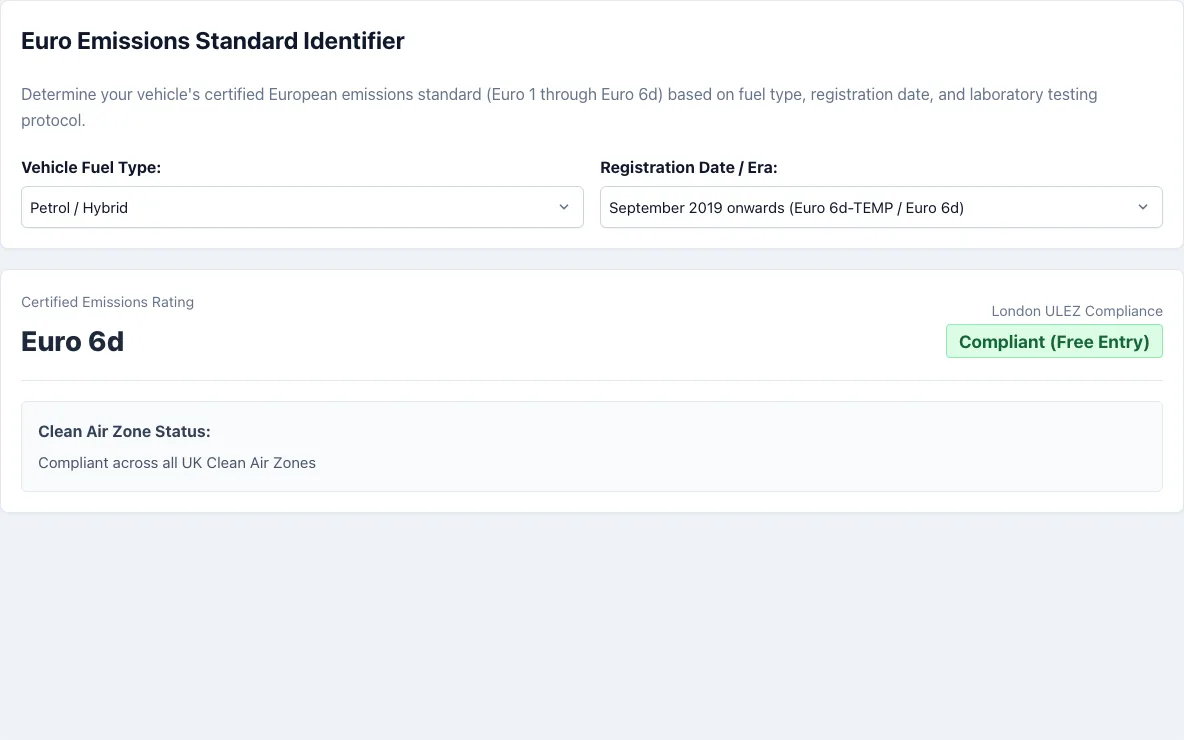
How to use the Euro emissions standard checker
- Choose petrol, diesel or electric. Petrol hybrids count as petrol.
- Enter the month and year of first registration (V5C box B).
- Read the minimum Euro standard and the ULEZ / Class D CAZ status: “meets”, “check” (it may meet it) or “probably does not”.
- Open “Euro standard dates for cars” to see both dates for every stage.
The tool asks for a month and year, and the default is March 2016. “Meets” means the minimum standard is at or above the one the zones ask for: Euro 4 for petrol and Euro 6 for diesel. “Check” means a car registered in that period may still meet the zone standard, so look at box V.9 of the V5C. Electric cars show “Zero emission” and meet both zones.
Worked examples: a petrol car first registered in March 2016 has a minimum of Euro 6, which meets the petrol requirement. A diesel first registered in June 2015 has a minimum of Euro 5b, so the result says “check”, and it lists Euro 6 as a possibly newer standard. A petrol car first registered in June 2001 has a minimum of Euro 3, and the result says “check”, because many petrol cars from 2001 met Euro 4 early.
Euro standard dates for passenger cars
The tool works from the date a standard becomes compulsory for all new registrations, and it also notes the earlier date when a new type had to meet it. Both dates are in the table below.
| Standard | New type approvals | All new registrations |
|---|---|---|
| Euro 1 | July 1992 | January 1993 (31 December 1992) |
| Euro 2 | January 1996 | January 1997 |
| Euro 3 | January 2000 | January 2001 |
| Euro 4 | January 2005 | January 2006 |
| Euro 5 | September 2009 | January 2011 |
| Euro 5b | September 2011 | January 2013 |
| Euro 6 (6b) | September 2014 | September 2015 |
| Euro 6c | - | September 2018 |
| Euro 6d-TEMP | September 2017 | September 2019 |
| Euro 6d | January 2020 | January 2021 |
What ULEZ and Clean Air Zones require
For cars the minimum is Euro 4 for petrol and Euro 6 for diesel, in London’s ULEZ and in English Clean Air Zones. Cars that do not meet it pay £12.50 a day in the ULEZ. Of the English CAZs, only the Class D zones, Birmingham and Bristol, charge private cars; Bath, Bradford, Portsmouth, Sheffield and Tyneside are Class B or C and do not. Scotland’s low emission zones (Glasgow, Edinburgh, Dundee, Aberdeen) use the same car standards but issue a penalty charge notice, starting at £60, instead of a daily charge.
Why petrol cars from 2001 may still pass
Euro 4 became compulsory for all new cars in January 2006, but many petrol models met it years earlier. A petrol car registered from 2001 may meet Euro 4; check V.9 or the TfL checker. New diesel models had to be type-approved to Euro 6 from September 2014, a year before it was compulsory for all new registrations.
How the minimum is worked out
The tool finds the last stage whose all-new-registration date is on or before the month you enter. That stage is the minimum. If a later stage’s type-approval date had already passed by then, the result names it as a possibly newer standard, because the car may have been built to it early. The zone requirement is then checked against the minimum.
Pollutant limits
For diesel cars the NOx limit is 0.08 g/km from Euro 6. Euro 1 had no separate NOx limit, only a combined HC + NOx limit of 0.97 g/km.
Common mistakes
- Entering the date of the last MOT or the date of purchase. Use the first registration month from V5C box B.
- Treating “check” as a fail. It means the car may meet the standard, and the V.9 box or the manufacturer gives the answer for that car.
- Choosing diesel for a petrol hybrid. The tool counts petrol hybrids as petrol.
- Reading the table as the standard of your own car. The table lists dates for all cars of each stage.
What the tool does not do
The tool does not look up a registration number or read the V5C. It works only on the fuel and month you type, so it can give a minimum and a status but not the exact standard of one car.
Frequently asked questions
What Euro standard is my car?
Look at box V.9 of the V5C. If it is blank, this checker gives the minimum standard for the registration date and the manufacturer can confirm the exact one.
Why do diesels need Euro 6 but petrol cars only Euro 4?
Diesel engines produce more nitrogen oxides (NOx) and particulates than petrol engines. GOV.UK sets the minimum for cars at Euro 6 for diesel and Euro 4 for petrol in Clean Air Zones, and London’s ULEZ uses the same standards.
Does a Euro 6 car pay nothing in London?
It meets the ULEZ, but the Congestion Charge is separate: £18 a day from 2 January 2026 in central London during charging hours, with a discount for electric cars on Auto Pay.
What does a “check” result mean?
It means the car may meet the zone standard even though its registration date alone does not prove it. Look at box V.9 of the V5C, or ask the manufacturer for the exact standard. The TfL vehicle checker linked above gives the answer for a specific car.
Can I upgrade my car to a newer Euro standard?
For cars it is rarely practical. Retrofit equipment accredited under the Clean Vehicle Retrofit Accreditation Scheme (CVRAS) can exempt a vehicle from Clean Air Zone charges, but it is aimed mainly at buses, coaches, lorries and vans.
Sources (checked 3 November 2026): RAC: Euro emissions standards; Wikipedia: European emission standards; GOV.UK: Driving in a Clean Air Zone; What Car?: Congestion Charge rises to £18; Transport Scotland: low emission zones introduced; Fleet News: Glasgow LEZ launches.
Related tools
- Car CO2 Emissions Calculator
- Fuel Duty Calculator & Pump Price Tax Breakdown
- Catalytic Converter Theft Risk & Security Checker
- London ULEZ Checker – Estimate by Fuel & Age
- Clean Air Zone Checker & CAZ Fee Calculator
- London Congestion Charge Calculator & Auto Pay
- Total Cost of Ownership Calculator & Car TCO Tool
See all Clean Air Zone and Emissions Tools.