
EV Battery Degradation Calculator & SoH Health Tool
A rough state-of-health estimate from age and charging habits, based on fleet averages, not a test of your battery.
Free · runs in your browser · nothing is uploaded
Recent
Your last 10 settings, saved only in this browser. Nothing is uploaded.
The Motwatch EV battery degradation calculator provides UK electric vehicle owners and used car buyers with a rough estimate of battery state of health (SoH) and capacity lost. Battery health is a common worry for used EV buyers, because it affects range and resale value.
Lithium-ion battery packs undergo two parallel aging processes: calendar degradation (gradual chemical decomposition over time) and cyclic degradation (wear from charging and discharging cycles). The calculator applies average yearly capacity loss from Geotab’s 2026 study of more than 22,700 EVs, about 1.5% a year for cars that rarely use DC fast charging, 2.5% for regular fast charging and 3.0% for mostly high-power (over 100 kW) charging, to the age you enter, and checks the result against the warranty terms you type. Only a battery health test shows your car’s real figure.
Study figures and warranty wording checked 3 November 2026.
How to use the ev battery degradation calculator & soh health tool
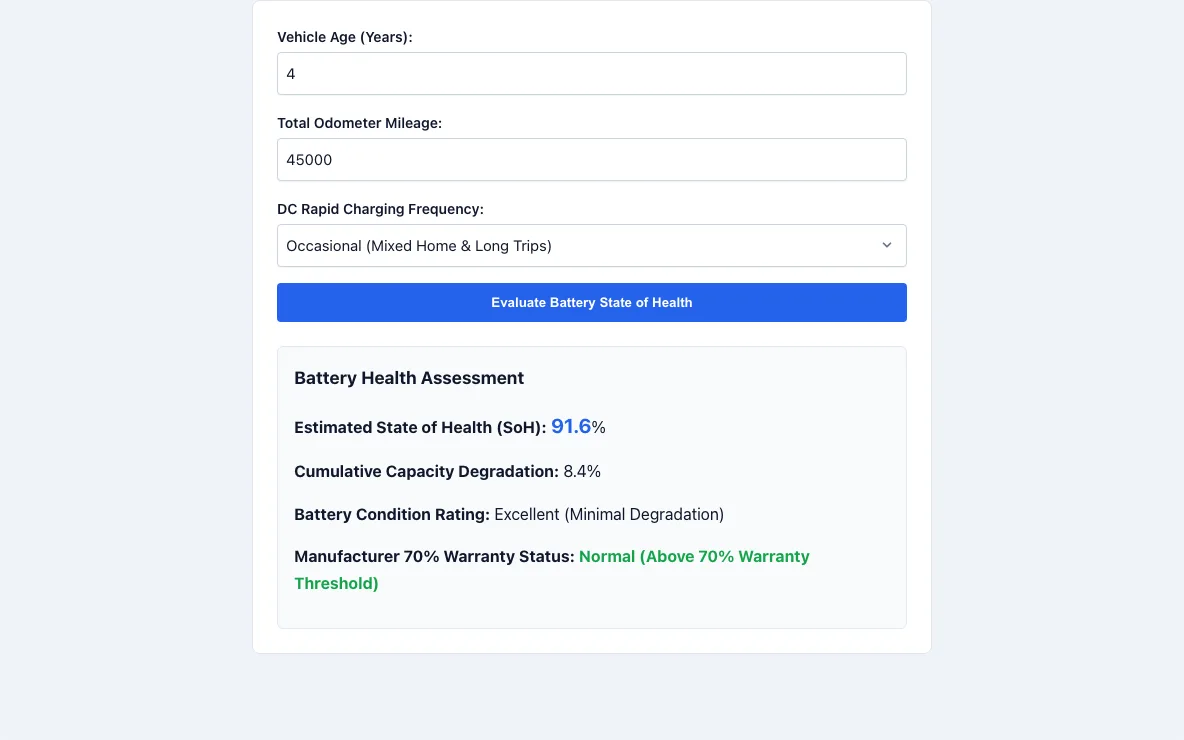
- Step 1: Input your electric vehicle chronological age in years from first registration on your V5C logbook.
- Step 2: Enter the odometer mileage shown on the dashboard.
- Step 3: Select your historical DC rapid charging usage pattern from rare home charging to heavy commercial duty.
- Step 4: Type your warranty terms (many makers use 8 years / 100,000 miles to 70%); the result updates as you type.
- Step 5: Review your estimated battery State of Health (SoH) percentage reflecting usable capacity retention.
- Step 6: Examine the cumulative capacity degradation percentage compared against original factory delivery specifications.
- Step 7: Read the rating: “Little capacity lost” (90% or more), “Normal ageing” (80% to 89%) or “Noticeable range loss” (below 80%).
- Step 8: Check the warranty line: below your floor and still inside the warranty period means it is worth asking the maker for a battery test.
- Step 9: Remember the tool uses a straight-line yearly average; a real battery can lose a little more in its first years and less later.
- Step 10: Follow your maker’s charging advice; the Geotab study found frequent high-power DC charging the biggest factor.
- Step 11: Obtain an independent high-voltage diagnostic health certificate (such as Aviloo) before buying a used EV.
Worked example with the defaults: a car aged 4 years with 45,000 miles and regular DC fast charging gives an estimated SoH of 90%, shown as a range of 85% to 95%, with about 10% of capacity lost. Change the age to 9 years and the estimate falls to 78%, which the tool labels “Noticeable range loss”.
Technical specifications and architecture
Lithium-Ion Calendar Aging and State of Health Benchmarks
State of Health (SoH) compares a battery’s usable capacity now with its capacity when new. A battery with a 100% SoH holds its full rated kilowatt-hours, while a pack degraded to 85% SoH holds 15% less energy, reducing maximum driving range proportionally. Geotab’s telematics study of more than 22,700 EVs (2026) found an average loss of 2.3% a year, with a range from about 1.5% to 3.0% depending mainly on how much high-power DC charging the car gets.
Cyclic Degradation vs Solid Electrolyte Interphase (SEI) Formation
Battery degradation is driven by two distinct mechanisms. Calendar aging occurs continuously over time regardless of whether the car is driven, accelerated by high ambient temperatures and storing vehicles at 100% charge. Cyclic aging occurs through physical lithium-ion intercalation during driving and recharging cycles, gradually expanding the Solid Electrolyte Interphase (SEI) layer on cell anodes and trapping active lithium ions permanently.
Typical Battery Warranty Terms: 8 Years, 100,000 Miles, 70%
Battery warranties are given by the manufacturer, not set by law, and the terms differ. Many makers cover the battery against falling below about 70% state of health for 8 years or 100,000 miles, whichever comes first; some use different years, mileage or percentages. Read your own warranty booklet for the exact terms.
Best Practices to Maximize Electric Vehicle Battery Longevity
Charging habits make a difference. Follow the maker’s advice on daily charge limits, avoid leaving the car parked for long periods at very high or very low charge, and use AC charging for day-to-day top-ups where you can; the Geotab study found frequent high-power DC charging the biggest single factor in faster capacity loss.
Reading the SoH range
The tool shows the estimate with a band five points either side. A 90% estimate is therefore shown as 85% to 95%. The band reflects that the study figures are averages across many cars, so one car can sit above or below its estimate. The capacity loss in the result is the same figure the other way round: 100% minus the SoH, rounded.
Common mistakes
- Treating the estimate as your battery’s real health. Only a battery health test on the car shows the real figure.
- Leaving the charging pattern on regular DC fast charging when most charging is at home. Choose the pattern that matches your own use.
- Checking the warranty years without the mileage limit. The warranty check uses both the years and the miles you type.
Frequently asked questions
How fast do electric car batteries degrade in the UK?
Geotab’s 2026 fleet study found an average of 2.3% a year, about 82% of original capacity after 8 years, ranging from roughly 1.5% a year for cars that rarely fast-charge to 3.0% for cars charged mostly at high-power DC.
What is State of Health (SoH) on an EV battery?
State of Health (SoH) is a percentage metric comparing the current usable energy capacity of a battery pack against its original factory specification when brand new (e.g. 90% SoH on a 60 kWh pack means 54 kWh usable).
What happens if an EV battery drops below 70% capacity during the warranty?
If the maker’s own test shows the battery below the level in your warranty (often 70%) while the warranty is still running, the maker should repair or replace it under the warranty terms. The exact level, period and remedy depend on your warranty booklet.
Does rapid DC charging damage an EV battery?
Frequent use can speed it up. In Geotab’s 2026 study, cars using DC fast charging for more than 12% of sessions lost about 2.5% a year versus 1.5% for lighter users, and mostly high-power (over 100 kW) charging averaged about 3.0% a year.
How do I check the battery health on a used electric car before buying?
You can check battery health using an OBD2 dongle with a suitable app (for example LeafSpy for the Nissan Leaf), or request an independent third-party battery diagnostic certificate (such as an Aviloo battery test) from the seller.
Can degraded electric car batteries be repaired or reconditioned?
Often, yes. Many packs are built from modules, and specialist high-voltage garages can sometimes replace a weak module rather than the whole pack. Whether that is possible depends on the car.
Related tools
- Car Running Cost Calculator & Cost-Per-Mile Tool
- Fuel Economy MPG Calculator & Trip Fuel Cost Tool
- Annual Mileage Calculator for Car Insurance
- Total Cost of Ownership Calculator & Car TCO Tool
- Car Depreciation Calculator & Value Curve Estimator
- Car Trade-In Value Estimator & Part-Exchange Tool
- Car Finance PCP Calculator & Balloon GFV Tool
- Tyre Tread Depth Checker & 20p Coin Test Guide
See all Car Running Cost and Finance Tools.