
EV Charging Cost Calculator & Home vs Public Rates
Calculate home and public charging costs with our ev charging cost calculator. Compare off-peak tariffs, pence-per-mile rates, and annual fuel savings.
Free · runs in your browser · nothing is uploaded
Recent
Your last 10 settings, saved only in this browser. Nothing is uploaded.
The Motwatch EV charging cost calculator provides UK electric car drivers, prospective EV buyers, and fleet managers with a side-by-side cost of charging at home and on public chargers. Where you charge makes a big difference to what an EV costs to run.
Electricity prices vary a lot. Off-peak EV tariffs can be well under 10p per kWh, the standard price-cap rate is 26.32p per kWh (Ofgem, 1 October – 31 December 2026, Direct Debit average), and Zapmap’s average pay-as-you-go price at rapid and ultra-rapid chargers was 79p per kWh in September 2026. Type your own tariffs and mileage; the calculator adds charging losses and shows the yearly and per-mile cost each way.
Prices and tax figures on this page checked 3 November 2026.
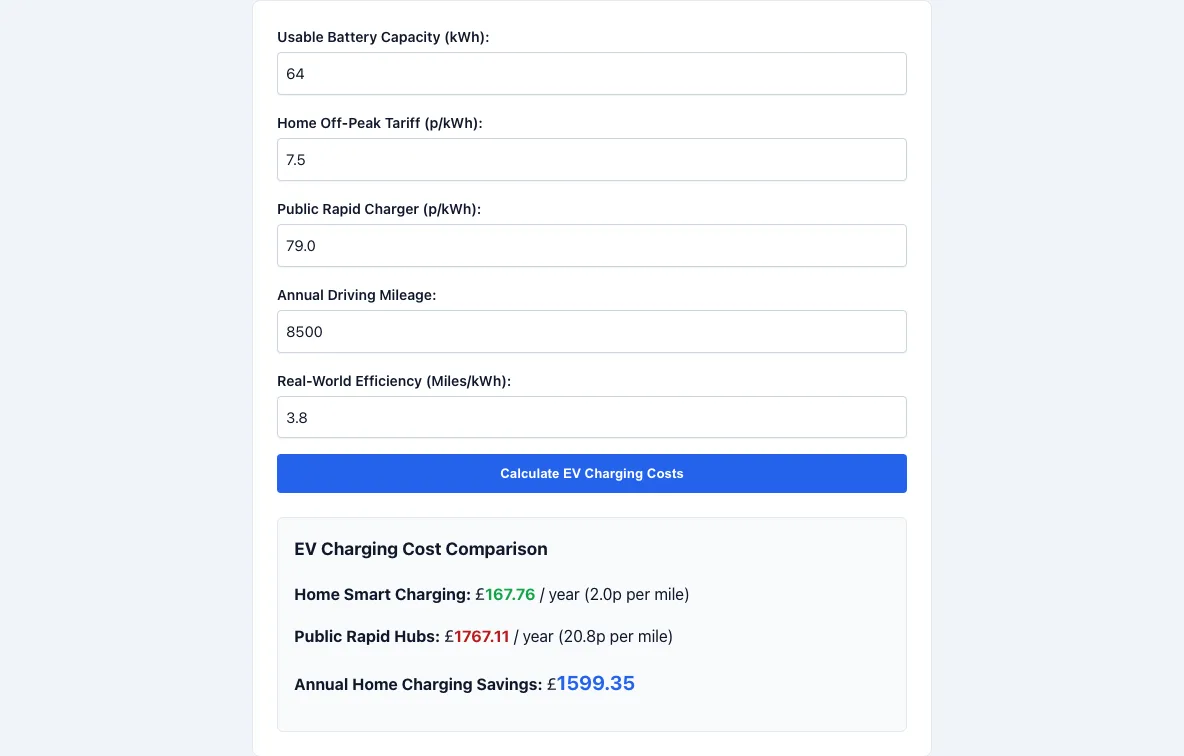
How to use the ev charging cost calculator & home vs public rates
- Step 1: Input your vehicle usable battery pack capacity in kilowatt-hours (kWh) according to manufacturer technical specifications.
- Step 2: Enter your current domestic off-peak EV electricity tariff rate in pence per kilowatt-hour from your utility supplier.
- Step 3: Input the prevailing public rapid or ultra-rapid DC forecourt charging rate in pence per kilowatt-hour.
- Step 4: Enter your projected annual driving distance in miles across routine commuting, domestic travel, and motorway trips.
- Step 5: Input your vehicle real-world seasonal driving efficiency measured in miles per kilowatt-hour from your dashboard trip computer.
- Step 6: Set the charging losses (about 10% is a common allowance for energy lost between the meter and the battery); results update as you type.
- Step 7: Review the calculated annual cost of charging exclusively at home on specialized off-peak overnight smart tariffs.
- Step 8: Examine the equivalent annual financial expenditure if relying entirely upon high-power public rapid charging stations.
- Step 9: Inspect the pence-per-mile operating metrics to compare your electric vehicle directly against petrol and diesel benchmarks.
- Step 10: Review your net annual financial savings achieved by maximizing domestic smart home charging over commercial public hubs.
- Step 11: Experiment with seasonal efficiency parameters (such as 3.2 mi/kWh in winter versus 4.2 mi/kWh in summer) to model variations.
The results show the yearly home and public cost (each also in pence per mile), the difference between them, and the cost of one full charge each way.
Technical specifications and architecture
Electric Vehicle Tariff Economics and Efficiency Conversions
Electric vehicle propulsion economics rely on measuring energy consumption in kilowatt-hours (kWh) rather than gallons or litres of fossil fuel. Energy efficiency is expressed as miles per kilowatt-hour (mi/kWh), analogous to miles per gallon. To determine annual energy requirements, total annual mileage is divided by efficiency. Because some energy is lost while charging, the electricity you pay for is a little more than what reaches the battery; the calculator divides by (1 − losses). Multiplying by the unit rate gives the cost, before standing charges or subscriptions.
Domestic Smart Charging vs Commercial Rapid Charging Hubs
The British retail energy market offers specialized dual-rate domestic tariffs specifically designed for plug-in vehicle keepers. Off-peak windows, usually a few hours overnight, offer much cheaper units than the standard rate. Conversely, commercial rapid DC charging operators must cover capital installation costs, grid connection upgrades, and high-voltage transformer substations, so pay-as-you-go rapid charging can cost several times the off-peak home rate.
Pence-Per-Mile Comparisons Against Petrol and Diesel Forecourts
At an off-peak rate of 7.5p per kWh and 3.8 miles per kWh, with 10% charging losses, an electric car costs about 2.2p per mile in electricity. A petrol car doing 45 mpg with fuel at 142p a litre costs 4.54609 ÷ 45 × 142 = 14.3p per mile. Over 10,000 miles that is about £220 against £1,430, roughly £1,200 a year less, if all charging is at the off-peak rate.
Worked example with the default figures
The tool starts with a 64 kWh battery, a 7.5p home tariff, a 79p public price, 8,500 miles a year, 3.8 miles per kWh and 10% losses. The car then needs about 2,485 kWh a year from the plug (2,237 kWh of driving, divided by 0.9 for losses). At home that is about £186.40 a year, or 2.2p per mile. At 79p per kWh on public chargers it is about £1,963.45 a year, or 23.1p per mile. The difference is about £1,777.05 a year. One full charge of the 64 kWh battery costs about £5.33 at home and £56.18 on public chargers at these rates.
The default figures are examples. Change any box to your own tariff, mileage or efficiency, and the results update straight away.
Seasonal Temperature Effects on Battery Consumption and Range
Cold weather lowers efficiency: the battery works less efficiently and cabin heating uses energy. Expect fewer miles per kWh in winter and re-run the calculator with your winter figure.
Frequently asked questions
How much does it cost to fully charge an electric car at home in the UK?
Putting 60 kWh into the battery at the October–December 2026 price-cap rate of 26.32p per kWh costs about £15.80 (£17.55 with 10% charging losses). On a 7.5p off-peak tariff it is about £4.50 (£5.00 with losses).
Is public EV charging cheaper than petrol or diesel?
Not always. At Zapmap’s September 2026 rapid/ultra-rapid average of 79p per kWh and 3.8 miles per kWh, it is about 21p a mile (23p with 10% losses). A diesel car doing 60 mpg at 150p a litre costs about 11.4p a mile, so relying only on rapid chargers can cost more than an efficient diesel.
What is a good real-world efficiency for an electric car?
Many family EVs show roughly 3.5 to 4 miles per kWh in mild weather and noticeably less in winter. Use the figure from your own car’s display.
How do I qualify for a cheap overnight EV electricity tariff?
Most EV tariffs need a smart meter, and some also need a compatible smart charger or car. Check the supplier’s eligibility rules.
Can I claim business mileage tax relief for driving an electric car?
Yes. For company cars, HMRC’s advisory electricity rate from 1 September 2026 is 7p a mile for home charging and 15p a mile for public charging. If you use your own EV for work, the approved mileage rate applies: 55p a mile for the first 10,000 business miles in 2026–27, then 25p.
Do electric cars pay UK road tax (VED)?
Yes, since 1 April 2025. From 1 April 2026 the standard rate is £200 a year. Electric cars with a list price over £50,000 also pay the expensive car supplement (£440 a year, years 2 to 6), except those registered before 1 April 2025. See gov.uk vehicle tax rate tables.
Related tools
- Electric Vehicle Charging Time Calculator & Speed Tool
- EV Battery Degradation Calculator & SoH Health Tool
- Car Running Cost Calculator & Cost-Per-Mile Tool
- Fuel Economy MPG Calculator & Trip Fuel Cost Tool
- Annual Mileage Calculator for Car Insurance
- Total Cost of Ownership Calculator & Car TCO Tool
- Car Depreciation Calculator & Value Curve Estimator
- Brake Fluid Replacement Interval Checker
See all Car Running Cost and Finance Tools.