
Electric Vehicle Charging Time Calculator & Speed Tool
Calculate recharging duration and speeds with our ev charging time calculator. Compare 7kW home wallboxes, 50kW rapid hubs, and 150kW DC chargers.
Free · runs in your browser · nothing is uploaded
Recent
Your last 10 settings, saved only in this browser. Nothing is uploaded.
The Motwatch electric vehicle charging time calculator gives UK electric car drivers and motorway commuters with realistic charging-time estimates for home, destination and rapid chargers. Charging speed depends on the charger, the car (its onboard AC charger and its peak DC power) and the battery temperature.
Charging is not linear: on DC the car takes less power as the battery fills. The calculator uses a simple model: on AC the speed is the lower of the charge point and the car’s onboard charger, less about 10% losses; on DC it is the lower of the charger and the car’s own peak, with a taper above 80% where the car slows charging sharply. Real curves vary by car and battery temperature, so treat the result as an estimate.
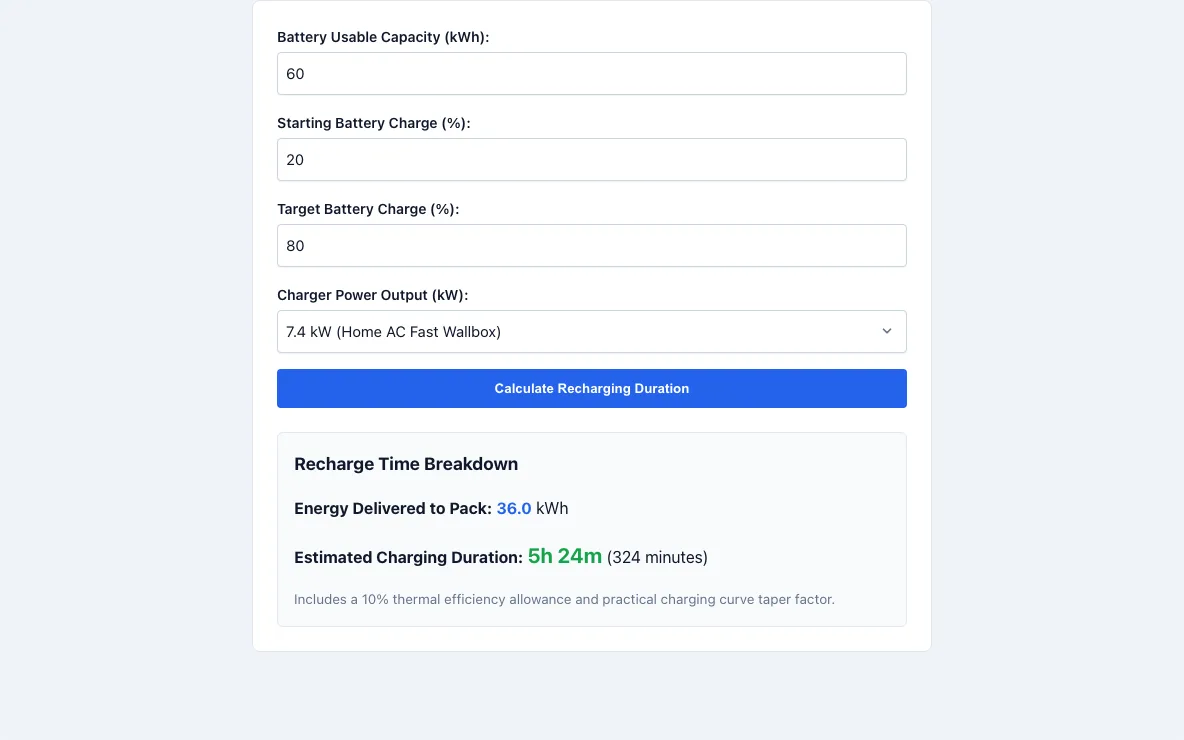
How to use the ev charging time calculator & charger speed tool
- Step 1: Input your electric vehicle total usable battery capacity in kilowatt-hours (kWh) using the numeric control field.
- Step 2: Enter your starting state-of-charge percentage representing current remaining battery reserve.
- Step 3: Specify your target charge percentage; 80% is a common stopping point on rapid chargers.
- Step 4: Select the charger, then enter your car’s onboard AC charger rating and peak DC charging power (both are in the car’s specifications).
- Step 5: The result updates as you type.
- Step 6: Review the total electrical energy volume in kilowatt-hours (kWh) required to achieve your target charge level.
- Step 7: Inspect the calculated charging duration expressed in hours and minutes for practical travel planning.
- Step 8: Note which side limits the speed, the charger or the car, shown under the result.
- Step 9: On DC, compare 20–80% with 80–100%: the last 20% can take as long as the rest because the car tapers the power.
- Step 10: Compare charging speeds between domestic 7.4 kW home wallboxes and en-route 50 kW motorway service stations.
- Step 11: Factor pre-conditioning battery thermal preparation into your navigation route planning during cold weather journeys.
Worked example with the defaults: a 60 kWh battery from 20% to 80% on a 7.4 kW home wallbox needs 36 kWh and takes about 5 h 24 min, and the tool shows the charger as the limit. Pick the 50 kW rapid option for the same 20% to 80% and the time drops to 48 minutes.
Technical specifications and architecture
Battery Charging Curves and Power Delivery Physics
A battery is always charged with direct current (DC); on AC the car’s onboard charger converts it first. A fairly empty, warm battery can take its highest power. As the battery fills, usually from around 80% State of Charge, the Battery Management System (BMS) cuts the power to protect the cells, so the last part of a DC charge is slow.
AC Single-Phase vs Three-Phase vs Direct Current (DC) Fast Charging
Domestic properties across Great Britain predominantly use 230V single-phase electrical supplies, so most home wallboxes are 7.4 kW (32 amps) at most. Commercial premises and public charging hubs frequently possess 400V three-phase supplies capable of delivering 11 kW or 22 kW AC. Direct Current (DC) rapid chargers bypass the vehicle internal AC converter entirely, delivering high-voltage direct current directly to the traction battery.
Why the 10% to 80% Charging Window Maximizes Motorway Travel Speed
On long journeys, charging beyond 80% is often slower overall than stopping again later. Because many cars cut their charging power sharply past 80%, the final 20% can take about as long as the whole 10% to 80% session. Many drivers therefore charge to about 80% and stop again at the next rapid charger if they need to.
Onboard Charger (OBC) Limits
When connecting to an AC destination charger, charging speed is limited by the vehicle onboard charger (OBC) as well as the charge point. For example, if a car is equipped with a 7 kW single-phase OBC, connecting to a 22 kW three-phase public post will still only charge at 7 kW. Check your car’s OBC rating (in its specifications) before relying on a fast AC post.
Worked example: the 80% taper
With the tool’s default 60 kWh battery on a 50 kW rapid charger, charging from 20% to 80% takes about 48 minutes. The same charger takes about 29 minutes for the 12 kWh from 80% to 100%, so the top of a DC session is the slow part. These are the tool’s estimates, not measurements, and a real car may charge more slowly or quickly.
Common mistakes
- Entering the charger’s rating and forgetting the car’s onboard charger. The slower of the two sets the AC speed.
- Using the 80% figure as a fixed stop. It is a planning point, and the tool shows the time to whatever target you type.
- Reading a 350 kW charger as a 350 kW charge. The car’s own peak DC power caps the speed.
Frequently asked questions
How long does it take to charge an electric car with a 7kW home charger?
About 9 hours from empty to full for a 60 kWh battery: 60 kWh ÷ (7.4 kW × 0.9) ≈ 9 hours. Most people top up from a higher level, which takes less time.
Can I charge an electric car from a standard UK 3-pin plug socket?
Yes, with the car’s 3-pin (‘granny’) cable, but a 3-pin socket gives only about 2.3 kW (10 amps): roughly 29 hours to fill a 60 kWh battery from empty.
Why does EV charging slow down drastically after 80%?
To protect the battery, the car’s Battery Management System (BMS) reduces the charging power as the battery fills, usually sharply above about 80%.
What is the difference between rapid and ultra-rapid chargers?
Zapmap and the Department for Transport class 50–149 kW chargers as ‘rapid’ and 150 kW and above as ‘ultra-rapid’. A 50 kW charger typically takes around 45–60 minutes for 10–80% on a mid-size battery; an ultra-rapid charger can be much quicker, but only if the car can accept that power.
Does rapid DC charging damage an electric vehicle battery?
Frequent high-power DC charging can speed up capacity loss. Geotab’s 2026 study of over 22,700 EVs found about 3.0% a year for cars charged mostly above 100 kW, against about 1.5% for cars that rarely fast-charge. Occasional rapid charging on trips is normal use.
Why is my EV charging slower in winter?
A cold battery cannot take high charging power safely. Until the battery is warmed up, the car limits charging power. Many cars can pre-condition the battery when you navigate to a charger.
Related tools
- EV Battery Degradation Calculator & SoH Health Tool
- Car Running Cost Calculator & Cost-Per-Mile Tool
- Fuel Economy MPG Calculator & Trip Fuel Cost Tool
- Annual Mileage Calculator for Car Insurance
- Total Cost of Ownership Calculator & Car TCO Tool
- Car Depreciation Calculator & Value Curve Estimator
- Car Trade-In Value Estimator & Part-Exchange Tool
- Car Battery Lifespan Calculator
See all Car Running Cost and Finance Tools.