
Exhaust Emissions Test Calculator & MOT Smoke Limits
Enter the date the car was first used and your own analyser or smoke-meter readings to see which MOT default emission limits apply and whether the readings are within them.
Free · runs in your browser · nothing is uploaded
Recent
Your last 10 settings, saved only in this browser. Nothing is uploaded.
The exhaust emissions test calculator compares readings you have taken, for example from a garage pre-test or your own gas analyser, with the default MOT exhaust emission limits for passenger cars in section 8.2 of the MOT inspection manual. The limits depend on the fuel and the date of first use. It is a guide: the MOT tester’s database can hold vehicle-specific limits that replace the defaults, and only an MOT test gives an MOT result.
Type the date of first use, the fuel and your readings, and the tool shows which default limits apply to that car and whether each reading is within them.
Limits checked 3 November 2026 against the MOT inspection manual, section 8.
How to use the exhaust emissions test calculator
- Choose petrol, diesel or hybrid and enter the date of first use (V5C box B).
- Petrol: enter fast idle CO (%), HC (ppm) and lambda at 2,500–3,000 rpm, and CO at normal idle. Older cars only need idle CO and HC.
- Diesel: enter the smoke reading in m⁻¹, and the limit printed on the manufacturer’s plate if there is one.
- Read which limits apply and any reading that is over.
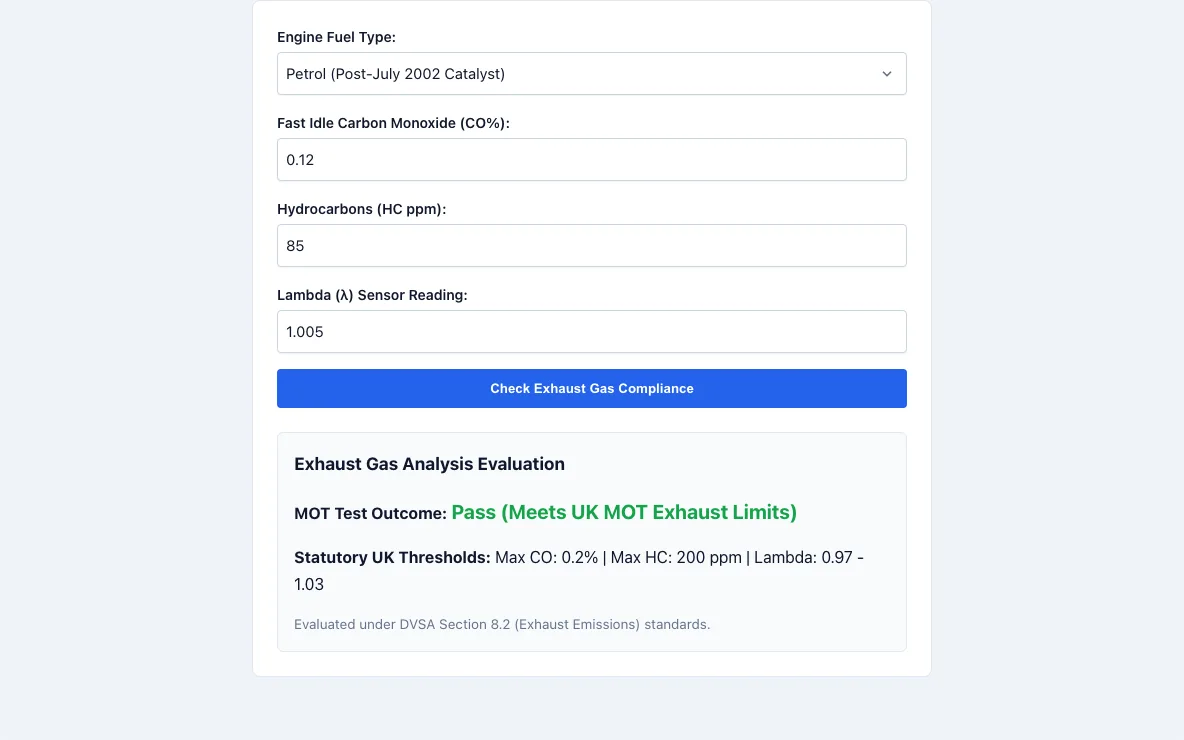
The tool starts with a petrol car first used on 1 June 2015 and sample readings of fast idle CO 0.12%, HC 85 ppm, lambda 1.005 and idle CO 0.10%, which pass. For that date the basic limits are fast idle CO 0.2%, HC 200 ppm, lambda 0.97 to 1.03 and idle CO 0.3%. Readings of fast idle CO 0.15%, HC 120 ppm, lambda 1.00 and idle CO 0.25% are also within them. A fast idle CO of 0.25% is over the 0.2% limit, and the result names that reading as the failure.
Worked example for diesel: a turbocharged diesel first used in May 2007 has a default smoke limit of 3.0 m⁻¹. A reading of 2.8 m⁻¹ is within it. The same car with a reading of 3.2 m⁻¹ is over. A diesel first used in May 2010 has a default of 1.5 m⁻¹, so the same 2.8 m⁻¹ reading is over.
MOT default limits for petrol cars
| First used | Test and default limits |
|---|---|
| Before 1 August 1975 | Visual smoke check only |
| 1 August 1975 – 31 July 1986 | CO ≤ 4.5%, HC ≤ 1,200 ppm |
| 1 August 1986 – 31 July 1992 | CO ≤ 3.5%, HC ≤ 1,200 ppm |
| From 1 August 1992 | Basic emissions test: fast idle CO ≤ 0.2%, HC ≤ 200 ppm, lambda 0.97–1.03; idle CO ≤ 0.3% |
If a car first used from 1 August 1992 fails the basic test, it is retested to its vehicle-specific limits if the database has them, otherwise to defaults: non-catalyst limits (CO ≤ 3.5%, HC ≤ 1,200 ppm) for cars first used before 1 August 1995; catalyst limits of fast idle CO ≤ 0.3%, HC ≤ 200 ppm, lambda 0.97–1.03 and idle CO ≤ 0.5% for cars first used from 1 August 1995 to 31 August 2002; and fast idle CO ≤ 0.2%, idle CO ≤ 0.3% from 1 September 2002.
MOT smoke limits for diesel cars
The limit is the value on the manufacturer’s plate. Without one, the default is 2.5 m⁻¹ (non-turbo) or 3.0 m⁻¹ (turbo) for vehicles first used before 1 July 2008, 1.5 m⁻¹ from 1 July 2008 to 31 December 2013, and 0.7 m⁻¹ from 1 January 2014. Diesels first used before 1980 get a visual check only.
MOT default exhaust emission limits and how the tool checks them
The tool works in two steps. First it picks the default limits from the date of first use and the fuel. Then it compares each reading you type with those limits. For petrol, the readings are checked against the basic test first. If any reading is over the basic figures, the same readings are checked against the default figures the tester falls back to for that date (catalyst or non-catalyst test), and the car is shown as over only if those are also exceeded. At a real MOT the tester takes new readings for that second test. For diesel, the smoke reading is compared with one limit: the plate value if you type one, otherwise the default for the date.
Hybrids
Hybrid cars, including mild hybrids, are not given the gas analyser or smoke meter test. The tester still checks for visible smoke, the emission control equipment and the engine warning light.
Other emission faults
An MOT also fails a car with dense blue or clearly visible black smoke, missing or obviously modified emission control parts (for example a removed diesel particulate filter), or an engine warning light that shows a malfunction.
Common mistakes
- Using the date the car was bought instead of the date of first use from V5C box B.
- Typing a smoke reading without choosing turbo or non-turbo for a diesel first used before July 2008. That choice changes the default limit.
- Mixing up the fast idle reading and the idle reading. The basic test uses both, at different engine speeds.
- Using readings taken with a cold engine. Testers test at normal operating temperature, and a cold catalytic converter reads higher.
What the tool does not do
The tool does not connect to the MOT database, so it cannot see any vehicle-specific limits. It does not measure emissions, and it does not give an MOT result.
Frequently asked questions
What are the MOT emission limits for a modern petrol car?
At 2,500–3,000 rpm: CO up to 0.2%, HC up to 200 ppm, lambda between 0.97 and 1.03; at idle: CO up to 0.3%, unless the car has vehicle-specific limits.
What is the diesel smoke limit?
The figure on the manufacturer’s plate, or by default 0.7 m⁻¹ for diesels first used from 1 January 2014, 1.5 m⁻¹ from July 2008, and 2.5/3.0 m⁻¹ before that.
Does the tool use the plate smoke limit if there is one?
Yes. If a smoke limit is printed on the manufacturer’s plate, the tool uses that value in place of the default for the date. Otherwise it uses the default for the date, and for diesels first used before July 2008 whether the car is turbocharged.
What does lambda mean?
Lambda is the air-fuel ratio compared with the ideal. 1.00 is ideal; below 0.97 is rich (too much fuel), above 1.03 is lean (too much air, which can mean an air or exhaust leak).
Will a warm engine help?
Yes. Testers must test with the engine at normal operating temperature, and a cold catalytic converter gives higher readings.
What are the limits for classic cars?
Petrol cars first used before 1 August 1975 get a visual smoke check only. From August 1975 to July 1986 the limits are 4.5% CO and 1,200 ppm HC; from August 1986 to July 1992, 3.5% CO and 1,200 ppm HC.
Sources (checked 3 November 2026): MOT inspection manual, section 8.2; GOV.UK: diesel vehicle emission limits (MOT changes May 2018); MoneyExpert: MOT exhaust emission test.
Related tools
- Headlight Aim Alignment Checker: MOT Cut-Off Limits
- DVSA Vehicle Recall Checker Guide & What-to-Do Checklist
- Number Plate Check – UK Plate Age & Area Decoder
- MOT Due Date Calculator
- MOT Expiry Calculator & Grace Period Rules
- MOT Fee Calculator & Re-Test Limits
- MOT Checklist – Pre-MOT Checks
- Company Car Tax Calculator & BiK Band Estimator
See all MOT Tools.