
Fuel Duty Calculator & Pump Price Tax Breakdown
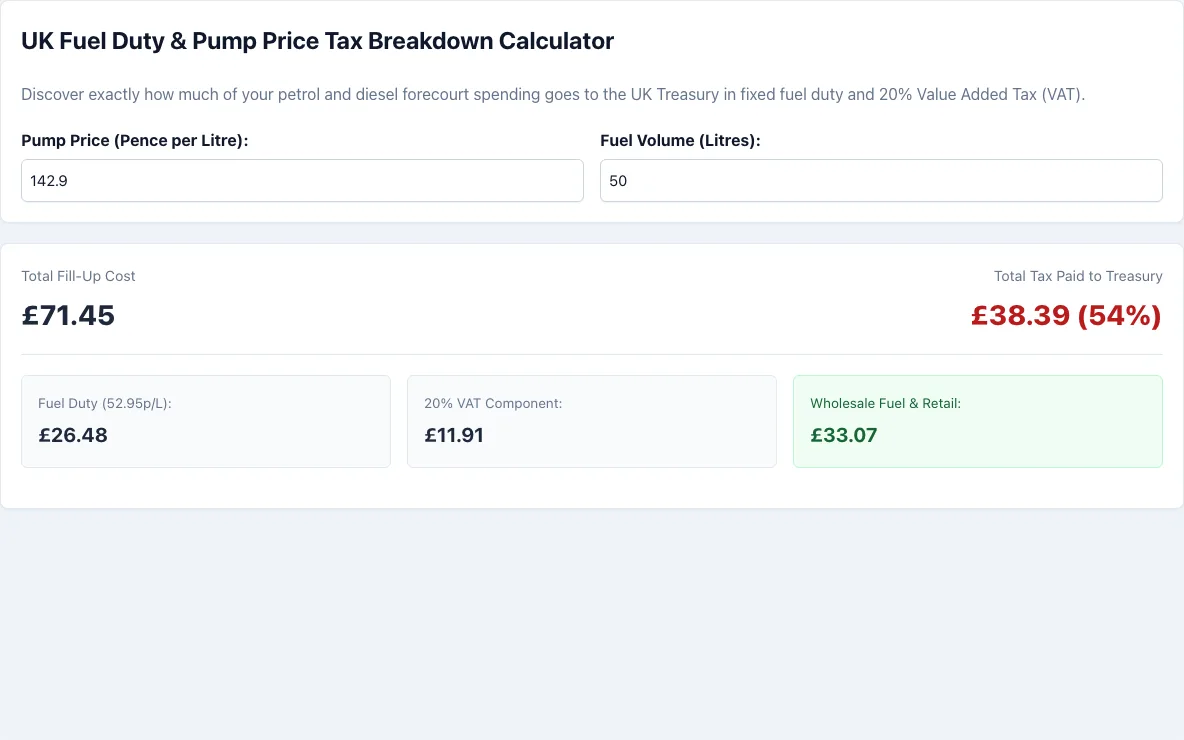
Type a pump price in pence per litre to see how much is fuel duty (52.95p a litre), how much is 20% VAT and how much is fuel and retailer margin. Duty rate checked 3 November 2026.
Free · runs in your browser · nothing is uploaded
Recent
Your last 10 settings, saved only in this browser. Nothing is uploaded.
The Motwatch fuel duty calculator provides UK motorists, commercial fleet operators, and financial analysts with transparent breakdowns of taxation bundled into retail petrol and diesel pump prices. In Great Britain and Northern Ireland, motor vehicle fuel is subject to two distinct forms of statutory taxation: fixed fuel duty and standard-rated Value Added Tax (VAT). Together they usually make up around half of the pump price. The duty rate used here (52.95p per litre for petrol and diesel) was checked against GOV.UK and HMRC on 3 November 2026.
Our calculator dissects your retail pump receipt into underlying wholesale fuel costs, fixed government fuel duty, and compound VAT components. Evaluate tax proportions across varying fill-up volumes, analyze wholesale margins, and track national treasury revenue splits directly in your web browser.
How to use the fuel duty calculator
- Input retail forecourt pump price: Enter the current advertised price in pence per litre (e.g. 142.9p) for petrol or diesel.
- Enter total fuel volume purchased: Type the volume in litres dispensed into your vehicle fuel tank during refueling.
- Inspect total fill-up financial expenditure: Review the cumulative retail cost billed at the forecourt checkout terminal.
- Examine the fixed fuel duty levy: Observe the statutory 52.95 pence per litre fuel duty collected directly on each dispensed litre.
- Inspect the compound 20% VAT portion: Check the Value Added Tax charged on top of both the fuel product and the fuel duty.
- Evaluate total government tax contribution: Review the combined total tax revenue received by HM Revenue and Customs from your transaction.
- Calculate the effective tax percentage: Observe the percentage of your total forecourt payment that represents government taxation (typically 45%–55%).
- Analyze underlying wholesale product costs: Examine the remaining wholesale production, refining, distribution, and retailer profit margins.
- Calculate annual commuting fuel tax totals: Multiply fill-up tax figures by your annual fill-up frequency to evaluate cumulative tax burdens.
- Compare combustion taxes against EV domestic charging: Contrast 50%+ motor fuel taxation against domestic residential electricity taxed at just 5% VAT.
- Retain forecourt fuel receipts for business VAT reclaims: Ensure business fuel receipts indicate VAT registration numbers so your company accountant can reclaim the 20% VAT portion on legitimate corporate business mileage.
How fuel duty works
How Fuel Duty and VAT Are Charged
Fuel duty is an excise tax levied on hydrocarbon oils under the Hydrocarbon Oil Duties Act 1979. In the United Kingdom, fuel duty is charged as a flat, volumetric tariff rather than a percentage of retail price. Following a temporary 5 pence per litre reduction introduced in March 2022 and subsequently extended, fuel duty on standard unleaded petrol and diesel is fixed at 52.95p per litre. Crucially, the UK tax code treats fuel duty as part of the baseline product cost before applying 20% Value Added Tax (VAT), a structure effectively creating a “tax on a tax.”
Dissecting the Pump Price: Refining, Transport, and Retail Margins
When a motorist buys fuel at 145p per litre, the government takes a flat 52.95p (about 36.5% of the price) in fuel duty and 24.17p (one sixth, 16.67%) in VAT, a total of about 53%. The remaining 67.88p (about 47%) pays for the fuel itself, refining, delivery and the retailer’s margin; the calculator shows that remainder but cannot split it further, because those costs vary from day to day and from one filling station to the next.
Treasury Fiscal Revenue and the Transition to Electrification
Fuel duty raises around £25 billion a year for the government. As more drivers switch to electric cars, that income falls, because electricity used for charging pays no fuel duty and home electricity is charged at the reduced 5% VAT rate (public chargers charge 20% VAT).
Regional Price Variations and Supermarket Price Competition
While fuel duty and VAT rates are uniform nationwide, retail forecourt prices vary significantly across geographical regions. Supermarket filling stations are often cheaper than other forecourts, and rural stations with lower sales and fewer competitors often charge more. Because duty is a fixed amount per litre, the tax share is higher when the pump price is lower.
Frequently asked questions
How much of the UK petrol price is tax?
Roughly 45% to 55% of the price of petrol and diesel at UK forecourts goes directly to the government in the form of fixed fuel duty (52.95p/litre) and 20% VAT.
What is the current rate of fuel duty in the UK?
As of 3 November 2026 the main rate for petrol and diesel is 52.95 pence per litre. That includes the 5p cut first introduced in March 2022, which has been extended several times; the planned step-by-step rises back to 57.95p have been postponed, so check GOV.UK for the current rate and dates.
Is VAT charged on top of fuel duty?
Yes. Value Added Tax (VAT) of 20% is charged on the total price of fuel, which includes the fuel duty itself. This compound taxation is often referred to as a “tax on a tax.”
Does electric car charging incur fuel duty?
No. Electricity used to charge electric vehicles does not incur fuel duty. Domestic home charging is subject only to the standard reduced domestic rate of 5% VAT.
How much revenue does fuel duty generate for the UK government?
Around £25 billion a year. It goes into general government funds rather than being set aside for roads.
Does red diesel pay standard fuel duty in the UK?
No. Rebated red diesel for agricultural and off-road plant machinery pays a much lower rate: 10.18p per litre as of 3 November 2026, against 52.95p for road fuel. Using it in a road vehicle is illegal.
Related tools
- Catalytic Converter Theft Risk & Security Checker
- London ULEZ Checker – Estimate by Fuel & Age
- Clean Air Zone Checker & CAZ Fee Calculator
- London Congestion Charge Calculator & Auto Pay
- Euro Emissions Standard Checker & Vehicle Identifier
- Car CO2 Emissions Calculator
- Car Trade-In Value Estimator & Part-Exchange Tool
See all Clean Air Zone and Emissions Tools.