
Fuel Economy MPG Calculator & Trip Fuel Cost Tool
Convert UK mpg to L/100km and work out the fuel and cost of a journey at the pump price you type in.
Free · runs in your browser · nothing is uploaded
Recent
Your last 10 settings, saved only in this browser. Nothing is uploaded.
The Motwatch fuel economy mpg calculator provides UK motorists, commercial drivers, and long-distance road trippers with quick conversions between fuel-economy units and an estimate of what a journey will cost in fuel. The United Kingdom’s unique automotive measurement system pairs metric forecourt pricing (sold in litres) with imperial efficiency ratings (measured in miles per gallon). This mix makes the cost of a journey awkward to work out by hand.
Our calculator bridges this gap by converting UK Imperial MPG to European litres per 100km (L/100km) and working out the litres a journey needs. Calculate journey fuel costs, analyze fuel price fluctuations, and evaluate personal commuting expenditure directly in your web browser.
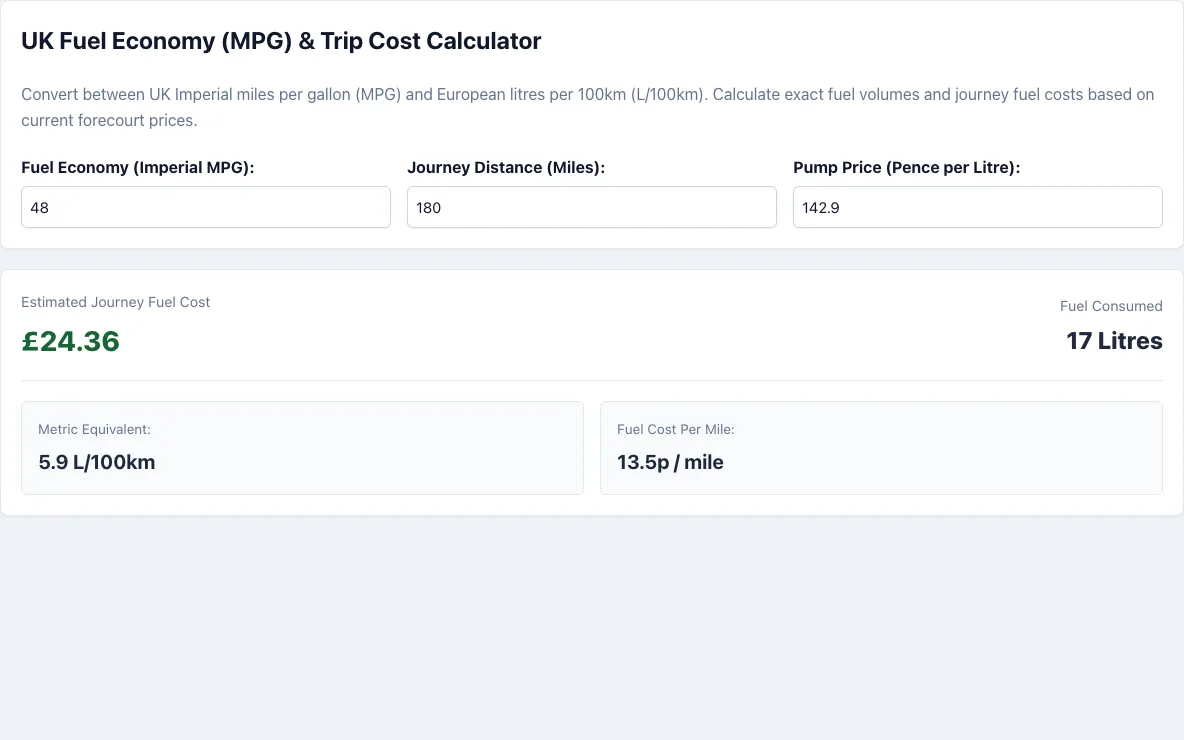
How to use the fuel economy mpg calculator
- Input vehicle fuel economy in Imperial MPG: Enter your car’s average miles per gallon from your trip computer or manufacturer figures.
- Input planned journey distance in miles: Enter the total driving distance for your planned commute, holiday trip, or business travel.
- Enter current forecourt pump price: Input the price in pence per litre advertised at your local petrol or diesel filling station.
- Inspect total estimated fuel cost: Review the projected monetary expenditure in pounds sterling required to complete the journey.
- Review total fuel volume consumed: Check the estimated number of litres the journey uses.
- Examine metric L/100km conversion: Review the converted European metric equivalent to compare with continental vehicle specifications.
- Calculate fuel cost per mile driven: Observe your direct fuel cost per mile in pence to split travel expenses fairly with passengers.
- Compare highway vs urban fuel consumption: Test different MPG figures (e.g. 55 MPG on motorways vs 38 MPG in city traffic) to evaluate route costs.
- Notice difference with US Gallons: Note that UK Imperial gallons are roughly 20% larger than US gallons when reading international car reviews.
- Practice fuel-saving driving techniques: Smooth acceleration, lower motorway speeds and correct tyre pressures all help; see the speed figures below.
Technical specifications and architecture
Imperial vs Metric Volume Standards and Conversion Mathematics
In the United Kingdom, automotive fuel economics involves an unusual hybrid measurement framework that dates from metrication (fuel has been sold by the litre since the 1980s). While retail forecourt pumps dispense fuel exclusively in metric litres, most dashboards and car reviews in the UK still quote fuel economy in miles per gallon (MPG). One British Imperial gallon is defined as exactly 4.54609 litres. In contrast, the United States gallon contains only 3.78541 litres. Consequently, a vehicle achieving 40 MPG in the UK would register only roughly 33.3 MPG when tested in the United States, creating significant confusion when reading American car reviews.
Mathematical Conversion to European Metric (L/100km)
Throughout continental Europe and many international markets, fuel consumption is expressed as litres consumed per 100 kilometres traveled (L/100km). Unlike MPG, where higher numbers represent better efficiency, L/100km is an inverse metric where lower numbers denote superior economy. The mathematical conversion formula between Imperial MPG and L/100km is: L/100km = 282.481 / Imperial MPG. For example, a modern diesel hatchback achieving 50 MPG Imperial uses about 5.65 litres of fuel per 100 kilometres.
The Aerodynamic Cost of Speed: 70 MPH vs 60 MPH
Aerodynamic drag increases with the square of vehicle velocity (Drag ∝ v²). At motorway speeds it is the main force the engine works against. Widely quoted fuel-saving advice from the Department for Transport and the AA says driving at 70 mph uses up to 9% more fuel than at 60 mph and up to 15% more than at 50 mph, and cruising at 80 mph can use up to 25% more than at 70 mph. To see what that means for your trip, run the calculator twice with a lower and a higher mpg figure.
Vehicle Weight, Tyre Pressures, and Auxiliary Loads
Beyond vehicle aerodynamics, mechanical rolling resistance and auxiliary electrical draw significantly impact real-world fuel economy. Under-inflated tyres increase rolling resistance and cost fuel. Carrying unnecessary weight, leaving roof racks or cycle carriers fitted when not in use, and running the air conditioning all add load and drag, so fuel use rises, most noticeably in town driving.
Frequently asked questions
What is the difference between UK and US miles per gallon (MPG)?
A UK Imperial gallon is 4.546 litres, whereas a US gallon is only 3.785 litres. This means UK MPG numbers are roughly 20% higher than US MPG numbers for the same car.
How do I convert UK Imperial MPG to Litres per 100km?
Divide 282.481 by the Imperial MPG figure. For example, 50 MPG equals 282.481 / 50 = 5.65 L/100km.
How much fuel does an average UK car use per mile?
A typical petrol car averaging 40 MPG uses roughly 0.11 litres of fuel per mile, costing around 16p per mile at a fuel price of 145p per litre.
Does turning off the air conditioning save fuel?
Usually a little. The air conditioning compressor adds load on the engine, so fuel use goes up, most noticeably in slow town driving. At motorway speeds an open window adds drag too, so the difference is smaller there.
Why is my real-world MPG lower than the official manufacturer figure?
Manufacturer test figures derive from laboratory conditions (WLTP tests). Real-world driving involves traffic congestion, cold engine starts, headwinds, hilly terrain, and passenger weight that lower actual MPG.
How does carrying luggage affect fuel economy?
Extra weight makes the engine work harder when accelerating and climbing, so heavy loads cost fuel. A roof box adds drag at speed as well, so take it off when you do not need it.
Related tools
- Annual Mileage Calculator for Car Insurance
- Total Cost of Ownership Calculator & Car TCO Tool
- Car Depreciation Calculator & Value Curve Estimator
- Car Trade-In Value Estimator & Part-Exchange Tool
- Car Finance PCP Calculator & Balloon GFV Tool
- Car Finance HP Calculator & Hire Purchase Tool
- Car Insurance Group Checker: Groups 1–50 Explained
- Cambelt Replacement Interval Calculator
See all Car Running Cost and Finance Tools.