
Headlight Aim Alignment Checker
Enter the lamp height, wall distance and cut-off height: get the beam drop in percent, the MOT range for your lamp and where the line should sit on the wall.
Free · runs in your browser · nothing is uploaded
Recent
Your last 10 settings, saved only in this browser. Nothing is uploaded.
This headlight aim alignment checker turns a simple wall measurement into the dip of your dipped-beam cut-off in percent and compares it with the limits testers use at the MOT. Measure the height of the headlamp centre, the distance to the wall and the height of the cut-off line on the wall; the tool shows the drop, whether it sits inside the MOT range and where on the wall the line should be.
A wall check is a rough guide. At the MOT the aim is checked with a calibrated beam setter on level ground, and that result is what counts.
Limits from the MOT inspection manual for cars (section 4.1), as of 3 November 2026.
How to use the headlight aim checker
- Park on level ground with the front of the car square to a wall, tyres at the correct pressure and the headlamp levelling dial at 0.
- Measure the height of the centre of the headlamp lens from the ground, in millimetres. The default in the tool is 650 mm.
- Measure the distance from the headlamp to the wall in metres. 5 m is easy to work with, and it is the default.
- Switch on dipped beam and mark where the flat part of the cut-off meets the wall; measure its height from the ground in millimetres.
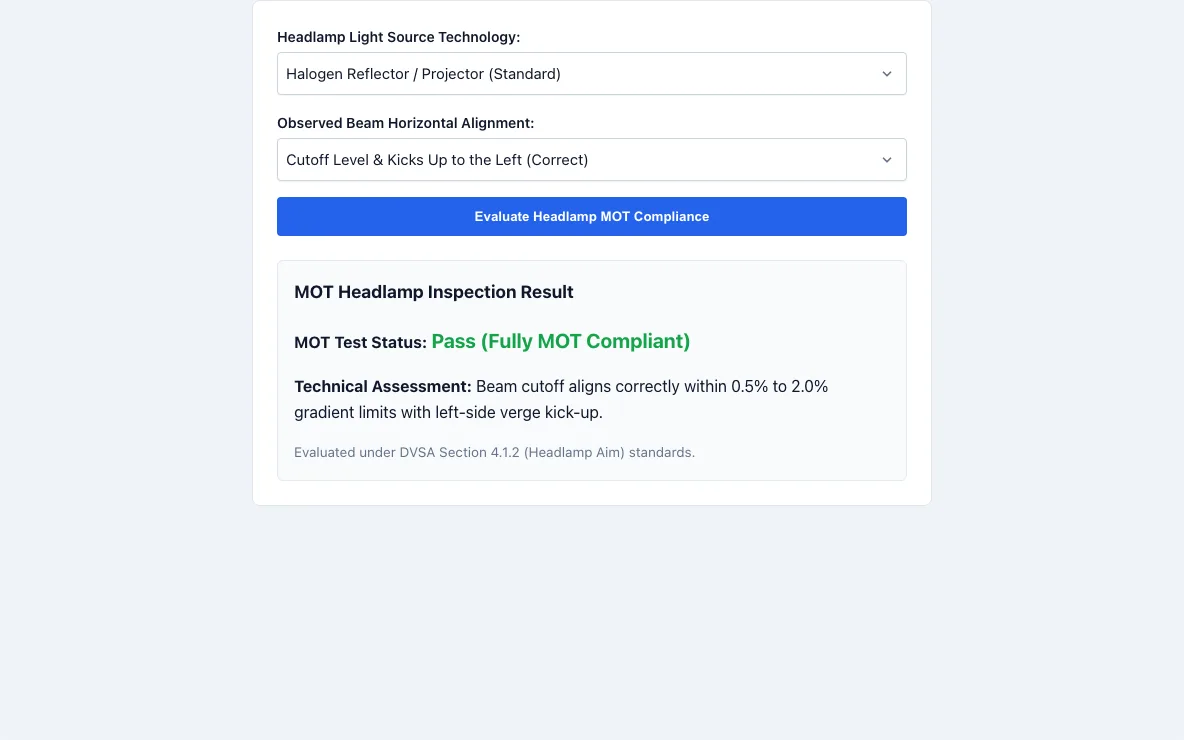
- Pick the shape of the cut-off you see: flat with the kick-up rising to the left, flat with the kick-up rising to the right, or a flat top with no kick-up.
- Read the drop in percent, the MOT range for your lamp height and the band on the wall the line should fall in.
Worked example with the default figures: a lamp centre at 650 mm, a wall 5 m away and a cut-off at 600 mm give a drop of 1.00%, which is within the 0.5% to 2.75% range. The line should sit between 513 mm and 625 mm above the ground. If the cut-off is at 500 mm instead, the drop is 3.00%, the tool shows “Aimed too low”, and that is a Major defect at the MOT.
A lamp centre above 850 mm uses the 1.25% lower limit: at 900 mm with a cut-off at 800 mm, the drop is 2.00%, within range.
What the MOT checks
Aim limits for dipped beam
For European-type dipped beams the manual (section 4.1.2) asks for the cut-off to lie between the 0.5% and 2.75% lines below horizontal when the lamp centre is 850 mm or lower, and between 1.25% and 2.75% when it is higher. A 1% drop is 1 cm per metre: at 5 m, a lamp centre at 650 mm should put the cut-off between 513 mm and 625 mm above the ground. Aim outside these limits, too high or too low, is a Major defect, and so is an obviously incorrect beam image.
Reading the percentage
The drop is the difference between the lamp centre height and the cut-off height, divided by the distance to the wall, shown as a percentage. The tool rounds the drop to two decimal places. A higher percentage means the beam is aimed lower. Because the wall is measured at one distance, the same drop gives a different height on the wall at a different distance, so keep the distance fixed while you adjust.
The kick-up
UK dipped beams are flat towards oncoming traffic and rise to the left, lighting the kerb side without dazzling drivers coming the other way. Lamps made for right-hand traffic rise to the right; the manual accepts masks or converter kits on these lamps to remove the kick-up to the right. Some lamps have a flat-top pattern with no kick-up, which is acceptable.
LED and HID conversions
Converting a halogen unit (first used from 1 April 1986) to HID is a Major defect (“light source and lamp not compatible”). An LED replacement bulb in a halogen lamp is only accepted when it is approved for that lamp and the approval sticker is fitted and readable; otherwise it is a Major defect. Complete lamp units built with HID or LED are not failed under this item.
Headlamp washers
On cars first used from 1 September 2009 that have them, washers are checked: not working is a Minor defect, or a Major one on LED or HID headlamps.
MOT inspection manual (cars) sections 4.1.2, 4.1.4, 4.1.6
Section 4.1.2 sets the dipped-beam aim, which this tool works from. Section 4.1.4 (compliance with requirements) covers the light source and conversion rules described above. Section 4.1.6 covers the headlamp washers. The page uses the manual’s own wording for the defect levels, and it does not add limits of its own.
Common mistakes
- Measuring the lamp height to the bottom of the lens or to the bulb, rather than to the centre of the lens.
- Measuring the distance from the lens to the wall with a tape that starts at the wrong end, which moves the result.
- Leaving the levelling dial at a setting other than 0 while adjusting, or with a load in the boot that you did not allow for.
- Working on a sloping drive. A floor slope shifts the line on the wall.
- Measuring at the kick-up instead of at the flat part of the cut-off line.
What the tool does not do
The tool does not test the beam itself, does not measure the lamps, and does not check the car. It only works on the numbers you type. For the result that counts, use a tester with a calibrated beam setter.
Frequently asked questions
Why did my car fail on headlight aim?
The cut-off was outside the allowed band: above the 0.5% (or 1.25%) line, so it can dazzle, or below the 2.75% line, so it lights too little road. Both are Major defects.
Can I adjust the headlight aim myself?
Most lamps have adjusters on the back or top of the unit. Make small changes, recheck on the wall, and remember the MOT tester’s beam setter has the final say; testers may make minor aim adjustments during the test.
Does a wall test replace the MOT aim check?
No. The wall test is a rough guide, and the tester’s calibrated beam setter at the MOT is what counts. Use the wall test to see whether an adjustment is needed before the test.
What should the headlamp levelling dial be set to?
Usually 0 with just the driver (and often a front passenger) on board; higher numbers lower the beams when the car is heavily loaded. Your handbook lists the right setting for each load.
Are LED replacement bulbs legal in halogen headlamps?
Only an LED replacement light source approved for that lamp, with the approval sticker in place. Unapproved LED bulbs in halogen lamps fail the MOT as a Major defect.
Do headlamp washers have to work?
If the car has them and was first used from 1 September 2009, yes: inoperative washers are a Minor defect, or Major on LED or HID lamps.
Related tools
- DVSA Vehicle Recall Checker Guide & What-to-Do Checklist
- Number Plate Check – UK Plate Age & Area Decoder
- MOT Due Date Calculator
- MOT Expiry Calculator & Grace Period Rules
- MOT Fee Calculator & Re-Test Limits
- MOT Checklist – Pre-MOT Checks
- MOT Advisory Checker – What To Do Next
- SORN Declaration Guide & Road Tax Refund Tool
See all MOT Tools.