
UK Number Plate Check: Age & Area Decoder
Type a 2001-onwards registration to read its age identifier period and the DVLA area and office of its memory tag. For a real car’s details, use the GOV.UK vehicle enquiry.
Free · runs in your browser · nothing is uploaded
Recent
Your last 10 settings, saved only in this browser. Nothing is uploaded.
This number plate check decodes the characters of a current-style UK registration, two letters, two numbers, three letters, used since September 2001, using DVLA’s published tables (leaflet INF104). It tells you the six-month period the age identifier stands for and the area and DVLA office the memory tag was allocated to, and it says when a plate cannot be dated (older formats, personalised numbers, Northern Ireland numbers, or an age identifier not issued yet). It reads only the letters and numbers you type. To see the make, colour, tax and MOT status of a real vehicle, use the free GOV.UK vehicle enquiry service.
It is useful when you look at a used car advert, when a plate seems too new for the car, or when you want to know which DVLA office a series came from.
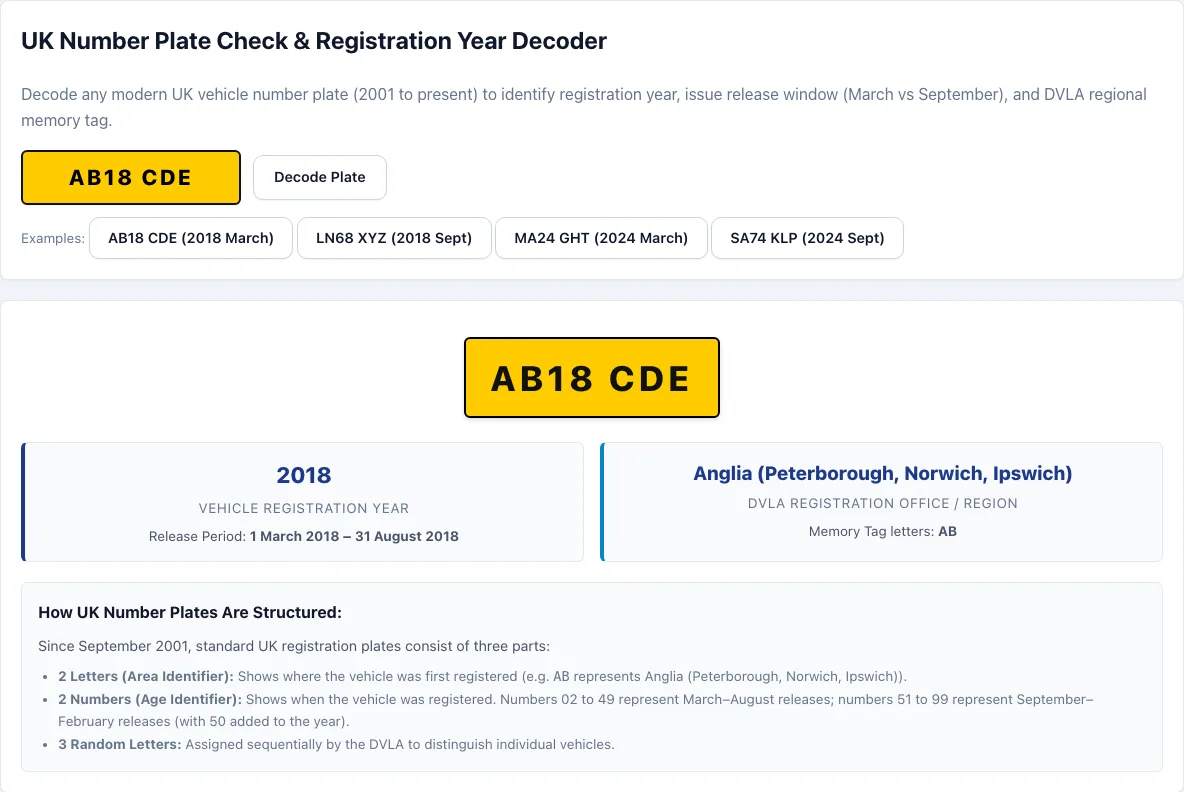
How to read a UK number plate
Type the registration: for example
AB18 CDE. Spaces and lower case do not matter.Read the period: the two numbers are the age identifier:
18means 1 March to 31 August 2018 and68means 1 September 2018 to 28 February 2019.Read the area: the first letter is the area (
LLondon,MManchester and Merseyside,SScotland …) and the two letters together give the DVLA office the series was allocated to.Treat the period as the earliest date: a personalised plate can make a car look older but never newer, so the real first-registration date is on the V5C (box B) or the GOV.UK vehicle enquiry.
Look up the real vehicle on GOV.UK: the vehicle enquiry shows the make, colour, tax and MOT status for that registration.
Watch for look-alike characters: plates use letters and numbers that are easy to confuse, such as O and 0 or I and 1. If the decoder says a memory tag is not in the DVLA list, check those characters first.
Tip: the March identifier for 2027 will be 27 and the September 2027 identifier 77; the decoder marks identifiers that have not been released yet as “Not issued yet”.
The decoder accepts plates typed with or without the space and in any case.
How current UK number plates are built
UK registration plate age identifiers and DVLA memory tags
A current-style plate has three parts:
- Memory tag (2 letters): the area and DVLA office the number was allocated to. The first letter is the area, A Anglia, B Birmingham, C Cymru, D Deeside to Shrewsbury, E Essex, F Forest and Fens, G Garden of England, H Hampshire and Dorset, K Borehamwood and Northampton, L London, M Manchester and Merseyside, N North, O Oxford, P Preston, R Reading, S Scotland, V Severn Valley, W West of England, Y Yorkshire. I, Q and Z are never used in memory tags.
- Age identifier (2 numbers): March releases use the year (
24= 1 March to 31 August 2024); September releases add 50 (74= 1 September 2024 to 28 February 2025). The newest released identifier is76(from 1 September 2026);27arrives on 1 March 2027. - Three random letters: Z is only ever used here. Dealers are given memory tags in batches, so the area shows where the number was allocated, not necessarily where the car was sold.
Older and personalised plates
Before September 2001 plates used a single age letter: at the end (suffix plates, 1963–1983) or at the start (prefix plates, 1983–2001). Numbers issued before 1963 carry no age identifier at all (“dateless”). These formats are widely reused as personalised numbers, so this tool does not date them. DVLA rules say a registration number cannot be used to make a vehicle appear younger than it is.
Displaying plates
Plates must follow the display regulations: you cannot rearrange or misrepresent the characters, and you can be fined up to £1,000, and the car will fail its MOT, for incorrectly displayed number plates.
Why some plates cannot be dated
A plate with letters and numbers in another order, for example A123 BCD or ABC 123D, follows the older systems, and those characters are now sold and transferred as personalised numbers. A car carrying one could be any age from the date the number series started onwards, so the decoder says so instead of guessing.
Northern Ireland numbers, which often contain I or Z, follow a separate system with no age identifier.
Frequently asked questions
How do I tell what year a car is from its number plate?
Look at the two numbers. 02–49 is the year (March to August); 51–99 is the year plus 50 (September to February). A personalised plate can make a car look older, so check the V5C for the real date.
Can this check tell me who owns a car or whether it is taxed?
No. It only decodes the characters. Tax and MOT status come from the GOV.UK vehicle enquiry service; keeper details are not public.
Which letters show a London-registered plate?
Memory tags starting with L: LA–LJ (Wimbledon), LK–LT (Borehamwood) and LU–LY (Sidcup).
Can I put a newer plate on an older car?
No. A registration cannot make a vehicle look younger than it is. You can put an older or dateless number on a newer car.
When do new number plates come out?
On 1 March and 1 September each year. The September 2026 identifier is 76 and the March 2027 identifier will be 27.
What does the X memory tag mean?
X is used for vehicles registered for personal export, not for a local area, so this decoder does not give an area for it.
Is the area the place the owner lives?
No. It is the DVLA office the number series was given to, often through a dealer.
Related tools
- MOT Due Date Calculator
- MOT Expiry Calculator & Grace Period Rules
- MOT Fee Calculator & Re-Test Limits
- MOT Checklist – Pre-MOT Checks
- MOT Advisory Checker – What To Do Next
- Car Mileage Check – MOT Mileage History Analyser
- Exhaust Emissions Test Calculator & MOT Smoke Limits
- Car Import Duty & VAT Calculator & HMRC Tariff Tool
See all MOT Tools.