
Speedometer Accuracy Calculator
Type your speedometer reading: see the true-speed range the approval rule allows, the police guidance threshold for the limit, and the effect of a tyre size change.
Free · runs in your browser · nothing is uploaded
Recent
Your last 10 settings, saved only in this browser. Nothing is uploaded.
This speedometer accuracy calculator works out what your speedometer reading can mean in true road speed under the type-approval rule, shows the police enforcement guidance threshold for the limit you pick, and shows how a change of tyre size moves the reading. Everything is worked out in your browser from the numbers you type.
Most speedometers read a little high on purpose: the approval rule forbids reading low, so makers build in a margin. That is why a sat-nav often shows a few mph less than the speedometer.
Rules as of 3 November 2026. This is a guide, not legal advice; drive to the limit shown on your speedometer.
How to use the speedometer accuracy calculator
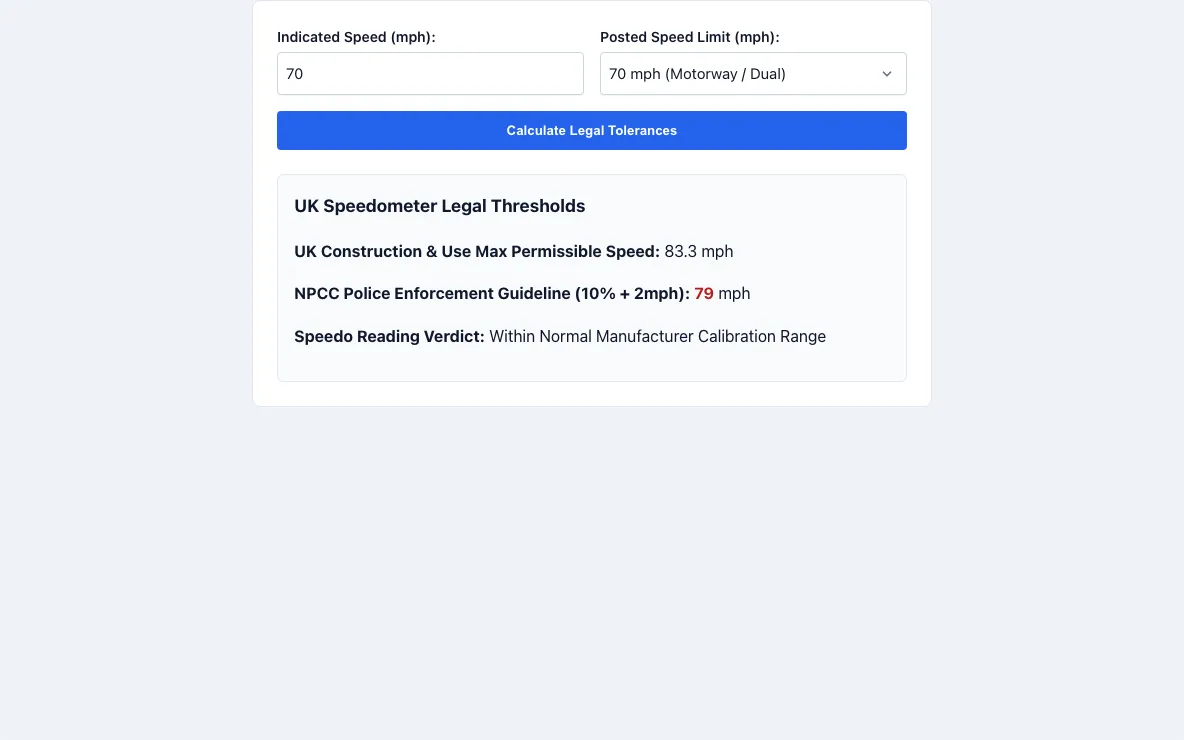
- Type the speed your speedometer shows, in mph. The tool starts with 70 mph.
- Pick the speed limit of the road from the list: 20, 30, 40, 50, 60 or 70 mph. The NPCC guidance threshold is worked out from this limit, so choose the limit that applies to the road you are on.
- Read the range of true speeds that reading can mean on a car that meets its type approval. At the default reading of 70 mph the range is about 61.4 to 70 mph.
- Read the NPCC guidance threshold for that limit (limit + 10% + 2 mph). For a 70 mph limit it is 79 mph; for a 60 mph limit it is 68 mph.
- Optional: type the original tyre size and the size now fitted, in the form 205/55 R16, to see how the change moves the reading. The original is the size the speedometer was set up for. Both boxes need a size before the result appears. For example, going from 205/55 R16 to 225/45 R17 at an indicated 70 mph means about 70.3 mph on the road.
Worked example: a reading of 66 mph in a 60 mph limit means a true speed of about 57.7 to 66 mph, so the true speed may be under or over the limit but is below the 68 mph guidance threshold. A reading of 70 mph in the same limit means about 61.4 to 70 mph: over the limit at every point of the range, and possibly over the threshold.
How the numbers are worked out
The type-approval rule (UNECE Regulation 39)
Cars approved to UNECE Regulation 39 (and the matching EC directive accepted by the Construction and Use Regulations) are tested so that the indicated speed V1 and the true speed V2 satisfy 0 ≤ V1 − V2 ≤ 0.1 × V2 + 4 km/h. In words: the speedometer must never show less than the true speed, and may show at most 10% plus 4 km/h (about 2.5 mph) more. At a true 60 mph the highest allowed reading is 68.5 mph. Working backwards, a reading of 70 mph means a true speed somewhere between about 61.4 and 70 mph. This is the approval test; it does not tell you where in that range your own car sits.
Police enforcement guidance (10% + 2 mph)
National Police Chiefs’ Council (formerly ACPO) guidance suggests enforcement normally starts at the limit plus 10% plus 2 mph: 24 mph in a 20 zone, 35 mph in a 30, 46 in a 40, 57 in a 50, 68 in a 60 and 79 mph in a 70. It is guidance, not law. Forces may set their own thresholds and officers can act at any speed over the limit.
Tyre size and the reading
The speedometer counts wheel turns. A tyre’s overall diameter is rim diameter × 25.4 + 2 × width × aspect ratio ÷ 100 (mm). A 205/55 R16 is 631.9 mm across; a 225/45 R17 is 634.3 mm, 0.38% bigger, so a reading of 70 mph then means about 70.3 mph. A much bigger tyre (195/65 R15 → 205/65 R16, about +6%) turns a reading of 60 mph into about 63.6 mph, which can cancel the built-in margin so the speedometer reads under the true speed. Tread wear also makes a tyre slightly smaller: a new tyre with about 8 mm of tread is roughly a centimetre bigger in diameter than one worn to 1.6 mm.
GPS speed
A phone or sat-nav measures speed from satellite signals. On a straight, level road at a steady speed with a clear sky it is usually close to the true speed, often within about 1 mph; it lags when you speed up or slow down and can be wrong in tunnels or between tall buildings.
Sources for these rules
The approval rule is UNECE Regulation 39, as the UK Government described it in a written answer in the House of Lords (12 March 2001). The 10% + 2 mph threshold is national police guidance from the NPCC (formerly ACPO), not a statute, and individual forces may differ. The MOT inspection manual, section 7.8, is the part of the test that covers the speedometer: it checks that one is fitted where required, works and can be lit, not how accurate it is.
Common mistakes
- Treating the true speed range as your exact speed. The range is what the approval test allows; it does not show where your own car sits inside it.
- Reading the NPCC guideline as a speed you may drive at. It is guidance on when enforcement normally starts, not a limit.
- Typing only the width of the tyre, such as 205, instead of the full size such as 205/55 R16.
- Swapping the original and the now fitted sizes. The original is the size the speedometer was set up for, so the result changes if they are reversed.
What the tool does not do
The tool does not read your speedometer or your GPS, does not know which car you drive or how it was approved, and does not measure speed. It works only on the numbers you type.
Frequently asked questions
Can a speedometer legally show less than the true speed?
No. Under the type-approval rule the indicated speed must never be below the true speed.
How far over can a speedometer read?
In the UNECE Regulation 39 approval test, up to 10% of the true speed plus 4 km/h (about 2.5 mph). At a true 60 mph that is up to 68.5 mph.
What is the 10% plus 2 mph guideline?
NPCC guidance on when police normally take enforcement action: for example 35 mph in a 30 limit and 79 mph in a 70 limit. It is not law and forces keep discretion to act from 1 mph over.
Why does a tyre size change affect the speedometer?
A bigger overall diameter covers more road per turn, so the car goes faster than the speedometer shows. A smaller one makes it read higher.
Is GPS speed more accurate than the speedometer?
At a steady speed on an open road it is usually closer to your true speed, because the speedometer is set to read high. It is less reliable while accelerating, braking or with poor signal.
Is speedometer accuracy tested at the MOT?
No speed accuracy test is done. The MOT checks that a speedometer is fitted, works and can be lit.
Related tools
- Stopping Distance Calculator (UK Highway Code Rules)
- Towing Capacity Weight Calculator & 85% Rule Tool
- Engine Oil Change Interval Checker
- Cambelt Replacement Interval Calculator
- Brake Fluid Replacement Interval Checker
- Car Battery Lifespan Calculator
- Tyre Tread Depth Checker & 20p Coin Test Guide
- Exhaust Emissions Test Calculator & MOT Smoke Limits
See all Car Maintenance and Safety Tools.