
Stopping Distance Calculator (UK Highway Code Rules)
Thinking plus braking distance at any speed, following the Highway Code table (30 mph = 23 m, 70 mph = 96 m), with the wet and icy multipliers.
Free · runs in your browser · nothing is uploaded
Recent
Your last 10 settings, saved only in this browser. Nothing is uploaded.
The Motwatch stopping distance calculator provides UK motorists, driving test learners, and road safety specialists with the typical stopping distances shown under Rule 126 of the Highway Code. Knowing how far a car travels before it stops helps you judge a safe gap, especially at higher speeds and in the wet, and the figures come up in the theory test.
The calculator gives the Highway Code’s typical thinking and braking distances and car-length equivalents for any speed, then applies the Code’s own wet (“at least double”, Rule 227) and icy (“can be ten times greater”, Rule 230) guidance. Real stopping distances depend on the driver, the car, its tyres and the road, so treat these as typical figures, not a promise.
Checked against the Highway Code on 3 November 2026.
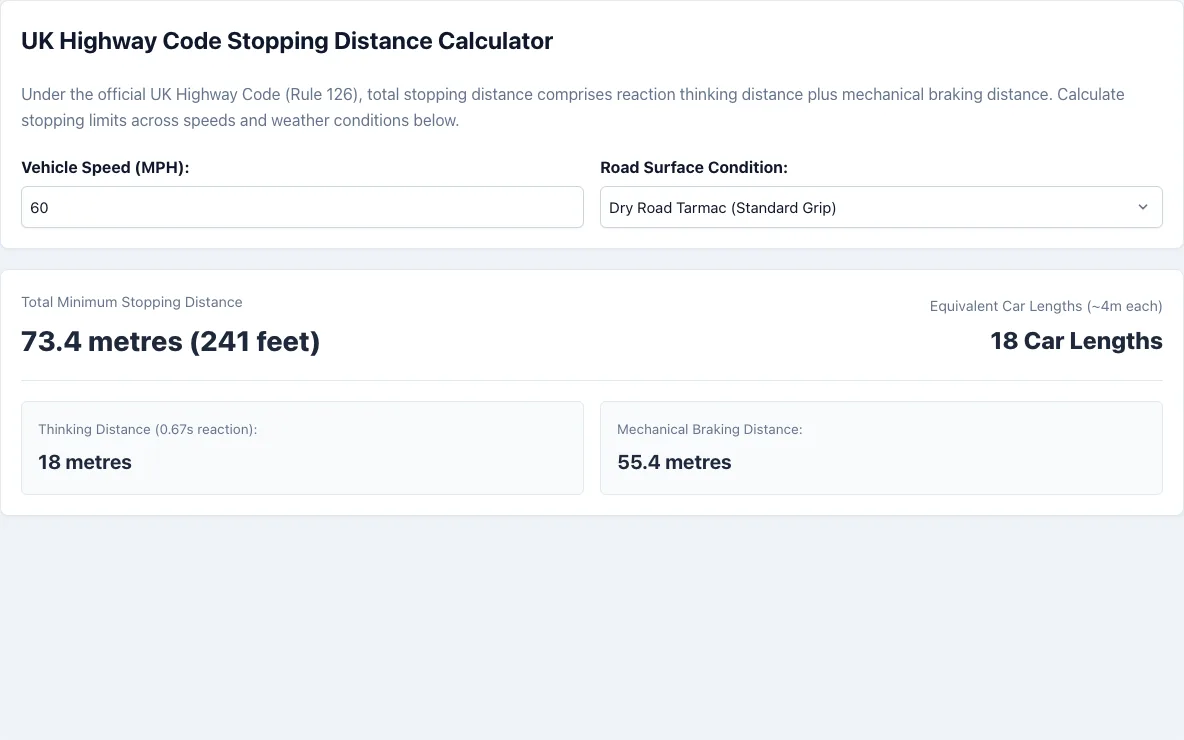
How to use the stopping distance calculator
- Enter vehicle travel speed: Type your speed in miles per hour (MPH), spanning urban limits up to UK national motorway limits.
- Select road surface weather condition: Choose between dry tarmac, wet asphalt (rain), or hazardous snow and ice.
- Inspect calculated thinking distance: Review the distance in metres traveled while the driver recognizes danger and moves their foot to the brake pedal.
- Examine mechanical braking distance: Observe the physical distance traveled while the vehicle’s braking system slows the car to a halt.
- Review total cumulative stopping distance: Check the combined stopping distance in both metres and feet on the results panel.
- Inspect equivalent car-length benchmarks: Visualize stopping distance measured in standard 4-metre average car lengths.
- Choose wet roads: The Highway Code says stopping distances will be at least double in the wet, so the calculator doubles the dry total. Thinking distance stays the same, so all the extra is braking.
- Review icy road safety limits: Note that icy or snow-covered surfaces increase stopping distance by up to ten times.
- Apply the two-second rule on fast roads: Rule 126 asks for at least a two-second gap on high-speed roads, at least doubled on wet roads and up to ten times greater on icy roads.
- Factor in tyre tread depth: Remember that worn tyres with low tread depth further expand stopping distances beyond Highway Code baseline figures.
Technical specifications and architecture
Highway Code Thinking and Braking Distances
The Typical Stopping Distances diagram under Rule 126 of the Highway Code splits stopping distance into two parts: thinking distance and braking distance. Thinking distance is how far the car travels before the driver starts braking. The Code does not state a reaction time, but its figures equal one foot per mph, which works out at about 0.68 seconds. At 30 mph, a vehicle travels roughly 9 metres before the driver’s foot even touches the brake pedal; at 70 mph, thinking distance expands to 21 metres.
Kinetic Energy Scaling: Why Braking Distance Squares with Speed
Braking distance does not rise in step with speed; it rises with the square of speed, because kinetic energy does (KE = ½mv²). Doubling your speed quadruples the kinetic energy that the vehicle’s brake discs and tyres must dissipate as thermal heat. For example, while the braking distance at 30 mph is approximately 14 metres, doubling the speed to 60 mph does not double the distance to 28 metres; it roughly quadruples to 55 metres. The Code’s braking figures follow speed² ÷ 20 in feet. At 70 mph, total stopping distance reaches 96 metres (about 24 car lengths).
Wet Road Tarmac and the Hydrodynamic Cushion
Under wet weather conditions, surface water forms a lubricating hydrodynamic film between the tyre tread rubber and the road aggregate. This substantially degrades the coefficient of friction. Highway Code Rule 227 says stopping distances will be at least double those on dry roads, so a car at 60 mph needs at least 146 metres in the wet (2 × 73 m). Rule 230 says that in icy or snowy weather stopping distances can be ten times greater, which is up to 730 metres from 60 mph.
Modern Cars and the Highway Code Figures
The Highway Code figures have not changed for decades. A modern car with ABS and good tyres can often brake in less distance on a dry road, but road-safety charities such as Brake argue that real drivers take longer to react than the Code assumes, so total distances are often longer. Distraction, tiredness, worn tyres and a downhill slope all add to the distance.
Frequently asked questions
What is the total stopping distance at 30 mph in the UK?
Under the UK Highway Code, the total stopping distance at 30 mph is 23 metres (75 feet), comprising 9 metres of thinking distance and 14 metres of braking distance (approx. 6 car lengths).
What is the total stopping distance at 70 mph on the motorway?
At 70 mph, the total stopping distance is 96 metres (315 feet), comprising 21 metres of thinking distance and 75 metres of braking distance (approx. 24 car lengths).
How much does rain increase stopping distance?
Highway Code Rule 227 says stopping distances will be at least double on wet roads, so a 70 mph stop needs at least 192 metres (2 × 96 m).
What is the “Two-Second Rule” in the Highway Code?
The Two-Second Rule provides a simple way to maintain a safe following distance: when the vehicle ahead passes a fixed object, at least two seconds should pass before you reach it. Rule 126 says the gap should be at least doubled on wet roads and up to ten times greater on icy roads.
Does thinking distance change when it rains?
No. Thinking distance depends on the driver’s reaction time and speed. The extra distance in the wet is all braking: to make the total at least double, braking distance more than doubles.
Does car weight change the stopping distance?
A heavily loaded car or one towing a trailer usually needs more distance, and the Highway Code reminds drivers that large vehicles and motorcycles need a greater distance to stop.
Related tools
- Towing Capacity Weight Calculator & 85% Rule Tool
- Engine Oil Change Interval Checker
- Cambelt Replacement Interval Calculator
- Brake Fluid Replacement Interval Checker
- Car Battery Lifespan Calculator
- Tyre Tread Depth Checker & 20p Coin Test Guide
- Wheel Alignment Camber Toe Checker: Tyre Wear Guide
- Headlight Aim Alignment Checker: MOT Cut-Off Limits
See all Car Maintenance and Safety Tools.