
Total Cost of Ownership Calculator & Car TCO Tool
Calculate complete 3-year and 5-year running expenses with our total cost of ownership calculator. Compare depreciation, fuel, tax, and pence-per-mile.
Free · runs in your browser · nothing is uploaded
Recent
Your last 10 settings, saved only in this browser. Nothing is uploaded.
The Motwatch total cost of ownership calculator provides UK motorists, personal finance planners, and fleet purchasers with one figure for what a car costs to keep. Looking only at the price or the monthly finance payment hides what is often the biggest cost of a newer car: the value it loses.
Total Cost of Ownership (TCO) adds the value the car loses to everything you spend running it: fuel or charging, insurance, vehicle tax, MOT, servicing and tyres. Type your own figures. The value-loss % is an assumption you can change (the example uses 45% over 3 years and 60% over 5).
UK figures on this page checked 3 November 2026: standard vehicle tax £200 a year, maximum car MOT fee £54.85, HMRC approved mileage rate 55p a mile (first 10,000 business miles, 2026–27).
How to use the total cost of ownership calculator & car tco tool
- Step 1: Input your vehicle initial purchase price or total capitalized invoice cost in British Pounds Sterling.
- Step 2: Enter your projected annual driving mileage based on daily commuting and domestic motoring patterns.
- Step 3: Select your intended vehicle holding duration from standard 3-year finance terms to 5-year ownership cycles.
- Step 4: Input your estimated annual fuel forecourt expenditure or domestic/public electric vehicle charging bills.
- Step 5: Enter your annual comprehensive motor insurance renewal quotation including voluntary excess fees.
- Step 6: Add annual vehicle tax (£200 standard rate from 1 April 2026, more with the expensive car supplement) and the MOT fee (up to £54.85; none in the first three years).
- Step 7: Estimate annual routine servicing, scheduled fluid replacements, wiper blades, and tyre renewals.
- Step 8: Set the value you expect the car to lose over the period, as a % of the price; check adverts for the same model a few years older.
- Step 9: Review the cumulative total financial outlay required to own and operate the vehicle across your tenure.
- Step 10: Look at the value lost and the resale value it implies.
- Step 11: Review the pence-per-mile figure to compare with other ways of travelling.
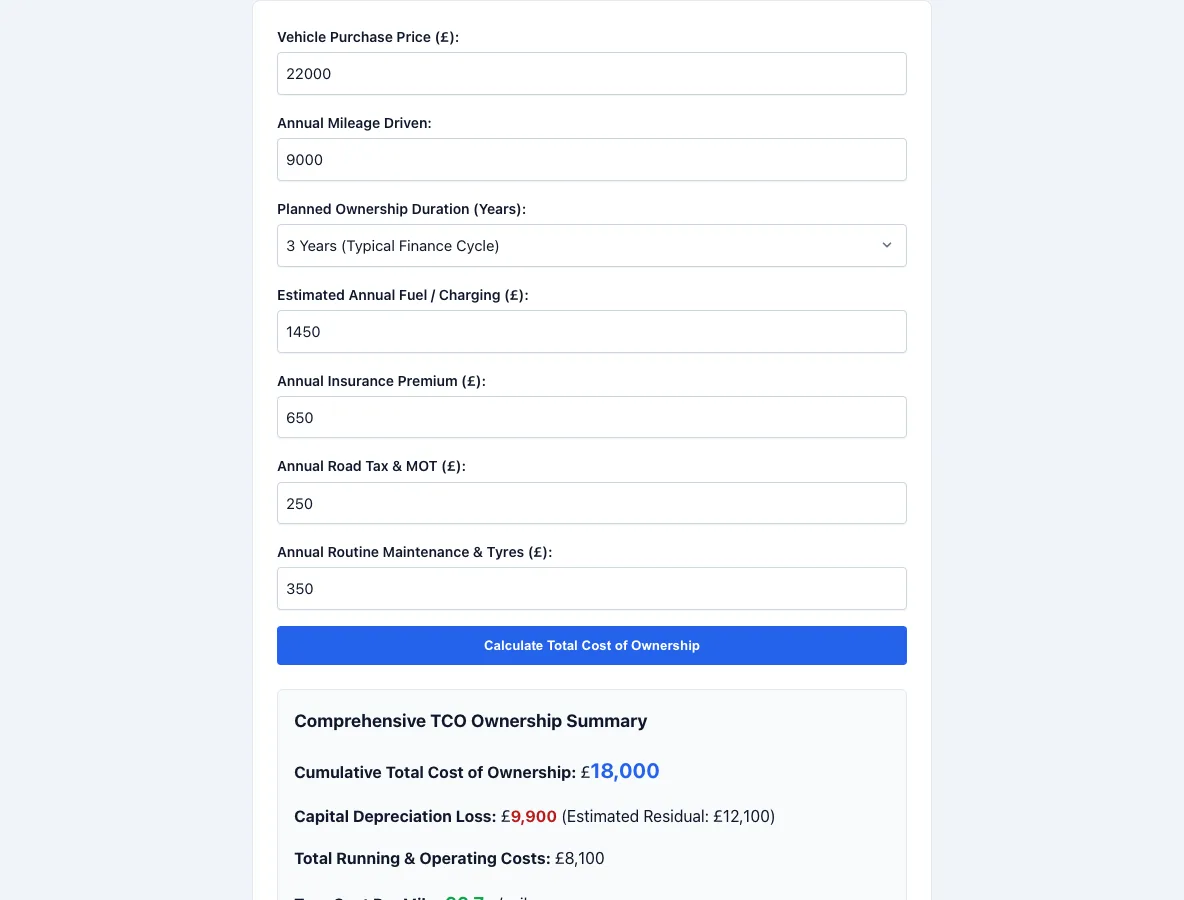
Worked example with the defaults: a £22,000 car, 9,000 miles a year, kept 3 years with 45% of its value lost, gives a total of about £18,015, or £6,005 a year (66.7p per mile).
Technical specifications and architecture
How the TCO Total Is Calculated
Total Cost of Ownership (TCO) is a simple way to compare cars on everything they cost. Rather than viewing purchase price, monthly finance, insurance, and fuel as isolated budget lines, TCO adds them up in one equation: Total Cost = (Purchase Price − Resale Value) + Running Costs over the period. This calculator works out the resale value from the value-loss % you enter. This perspective reveals that a vehicle with a higher purchase price but strong residual values can cost significantly less overall than a heavily discounted car that depreciates rapidly.
Depreciation: The Hidden Giant of Vehicle Running Costs
For a new or nearly-new car, value loss is often the biggest single cost. A £25,000 car that loses 45% over three years loses £11,250, about £312 a month before it turns a wheel. That is why some buyers choose 3-year-old vehicles where the steep initial depreciation drop has already occurred.
Pence-Per-Mile Financial Benchmarking Against HMRC AMAP Rates
Dividing total ownership costs by total miles driven gives the cost per mile. For an average motorist covering 9,000 miles annually with a £5,000 annual TCO (including depreciation), the vehicle costs about 55.6 pence for every mile travelled (5,000 ÷ 9,000). Compare it with HMRC’s approved mileage rate for business use: 55p a mile for the first 10,000 business miles in 2026–27, 25p after.
Electric Vehicle (EV) vs Petrol Internal Combustion TCO Parity
While electric vehicles often carry higher showroom purchase prices than equivalent petrol hatchbacks, lower per-mile energy costs (especially with cheap off-peak home charging), less brake wear thanks to regenerative braking and no exhaust or oil changes can close the gap over time. Whether they do for you depends on your prices and mileage. Run the calculator once for each car.
Worked example with the default figures
Of the £18,015 total, £9,900 is value lost (45% of £22,000) and £8,115 is running costs over three years. The running costs use the example figures: fuel or charging £1,450 a year, insurance £650, road tax and MOT £255, and servicing, tyres and repairs £350. Those four add up to £2,705 a year. Switching the holding period to 5 years also changes the default value loss to 60%, so the same car shows a total of about £26,725 (£5,345 a year, 59.4p per mile).
Common mistakes
- Leaving the value-loss figure at the example. Check adverts for the same model a few years older and use a figure that matches what similar cars sell for.
- Entering road tax without the MOT, or the reverse. The box asks for both together, per year.
- Comparing two cars over different holding periods. Use the same number of years for both, so the totals can be read side by side.
Frequently asked questions
What is included in the Total Cost of Ownership (TCO) of a car?
TCO includes depreciation, finance interest (this calculator leaves interest out, so add it to a yearly cost box if you have a loan), fuel or electricity charging, insurance premiums, Vehicle Excise Duty (road tax), annual MOT testing, scheduled servicing, replacement tyres, and wear repairs.
What is the biggest expense in car ownership?
For a new car it is usually depreciation (the value it loses). For an older, cheaper car, fuel and insurance often matter more.
How do I calculate my car’s true cost per mile?
Add up all costs incurred over your ownership period (depreciation + finance interest + fuel + insurance + tax + maintenance), and divide by the total number of miles driven during that timeframe.
Is an electric car cheaper to own than a petrol car over 5 years?
It can be, especially with cheap home charging and higher mileage, but it depends on the purchase prices, the value each car keeps, your tariff and your insurance. Enter both cars into the calculator to compare.
How much does depreciation cost per month on a new car?
As an example, a £28,000 car that loses 40% to 50% over three years loses £11,200 to £14,000, about £311 to £389 a month.
How can I minimize my vehicle Total Cost of Ownership?
Minimize TCO by buying nearly-new cars (2 to 3 years old) to bypass initial depreciation, choosing models in lower insurance groups, maintaining steady tyre pressures to optimize fuel economy, and adhering to service intervals.
Related tools
- Car Depreciation Calculator & Value Curve Estimator
- Car Trade-In Value Estimator & Part-Exchange Tool
- Car Finance PCP Calculator & Balloon GFV Tool
- Car Finance HP Calculator & Hire Purchase Tool
- Car Insurance Group Checker: Groups 1–50 Explained
- Car Scrappage Scheme Calculator & Scrap Value Estimator
- Car Warranty Expiry Checker & End Date Calculator
- Car Battery Lifespan Calculator
See all Car Running Cost and Finance Tools.