
Towing Capacity Weight Calculator & 85% Rule Tool
Calculate caravan weight matches and GTW limits with our towing capacity weight calculator. Check the 85% rule, MTPLM ratios, and safety ratings.
Free · runs in your browser · nothing is uploaded
Recent
Your last 10 settings, saved only in this browser. Nothing is uploaded.
The Motwatch towing capacity weight calculator helps British motorists, caravanners and horsebox owners check a car and trailer match. When pairing a passenger car or SUV with a touring caravan, horsebox, or flatbed trailer, matching vehicle kerbweights and weight distribution is essential for highway stability.
Our tool applies the 85% towing guideline recommended by the UK caravan clubs and, if you enter it, checks the trailer against the car’s braked towing limit. Check the gross train weight on the VIN plate yourself. Check the match before you set off, and enter the real figures from the V5C, the handbooks and the caravan’s plate rather than typical values for the model.
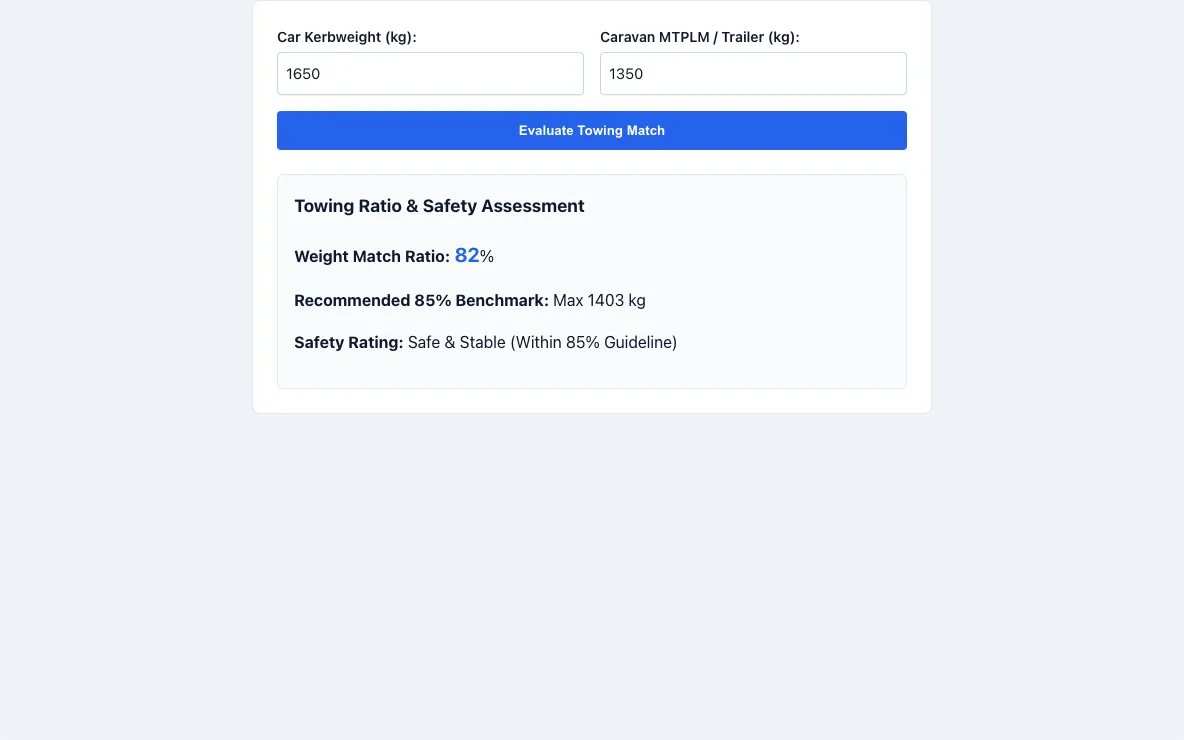
How to use the towing capacity weight calculator & 85% rule tool
- Step 1: Input your vehicle kerbweight (unladen weight including standard fluids and a 90% full fuel tank).
- Step 2: Enter the trailer or caravan Maximum Technically Permissible Laden Mass (MTPLM) in kilograms.
- Step 3: Click the Evaluate Towing Match action button to work out the weight ratio.
- Step 4: Review the weight match percentage ratio calculated between trailer and tow car in the output panel.
- Step 5: Check the 85% guideline weight recommended for less experienced towers.
- Step 6: See whether the match is within 85%, between 85% and 100%, above 100%, or over the braked towing limit you entered.
- Step 7: Verify the vehicle manufacturer braked towing capacity from your V5C logbook registration line O.1.
- Step 8: Inspect the Gross Train Weight (GTW) stamped on line 2 of the under-bonnet manufacturer VIN plate.
- Step 9: Review UK Category B driving licence towing entitlements following the December 2021 legal deregulation.
- Step 10: Check noseweight download limits (typically 75 kg to 100 kg) on the towbar ball hitch assembly.
- Step 11: Fit electronic stability dampers or friction stabilizers if operating between 85% and 100% weight ratios.
- Step 12: Review consumer legal protections and service history stamps to ensure complete historical compliance.
- Step 13: Check the figures against your own documents and the official GOV.UK guidance before acting on them.
How towing weights work
The 85% Towing Guideline and Gross Train Weight Engineering Limits
The 85% guideline, recommended by the UK caravan clubs, recommends that the fully laden weight (MTPLM) of a caravan should not exceed 85% of the towing vehicle kerbweight. It is a guideline, not a law: the legal limits are the car’s maximum braked towing mass (V5C box O.1) and its gross train weight. Ratios above 85% are legal within those limits but demand significant towing experience and reduced cruising speeds on exposed motorways.
Understanding Kerbweight, Payload, and Noseweight Dynamics
Kerbweight represents the mass of the car in running order without luggage or passengers, whereas Gross Vehicle Weight (GVW) is the maximum legally permitted total mass of the car fully loaded. Noseweight (the vertical downforce exerted by the trailer coupling onto the towball) should typically be maintained between 5% and 7% of the trailer laden weight without exceeding the towbar rating specified by the manufacturer.
Category B Driving Licence Towing Entitlements Since December 2021
On 16 December 2021, the rules on towing with a car licence changed. All drivers who passed their Category B car driving test on or after 1 January 1997 are now legally permitted to tow trailers up to 3,500 kg Maximum Authorised Mass (MAM) without needing to pass an additional Category B+E car and trailer practical driving test, significantly simplifying trailer towing for modern motorists nationwide.
Preventing Trailer Sway, Snaking, and Aerodynamic Turbulence
Trailer instability, commonly called snaking or sway, occurs when aerodynamic crosswinds, sudden steering inputs, or passing heavy goods vehicles initiate lateral oscillations in the trailer. A trailer heavier than the tow car is more able to push the car around, which is why ratios above 100% are not recommended. If sway starts, ease off the accelerator and keep the steering straight rather than braking hard.
Where to Find Your Car’s Towing Figures
The maximum braked towing mass is in box O.1 of the V5C and in the handbook; the unbraked limit is in box O.2. The gross train weight is usually the second weight on the manufacturer’s VIN plate. Kerbweight and the towball noseweight limit are in the handbook. For a caravan, the MTPLM is on the plate by the door and in its handbook. Enter these figures into the calculator rather than typical values for the model.
Frequently asked questions
What is the recommended 85% towing guideline?
The 85% guideline recommends that the Maximum Technically Permissible Laden Mass (MTPLM) of a caravan should not exceed 85% of the towing car kerbweight, ensuring aerodynamic stability and preventing trailer sway.
What is the difference between vehicle kerbweight and gross vehicle weight (GVW)?
Kerbweight is the unladen weight of the car with standard fluids and a 90% full fuel tank, while Gross Vehicle Weight (GVW) is the maximum legally permitted total weight of the car fully laden with passengers and luggage.
Can I legally tow a trailer that weighs more than 85% of my car?
Yes, provided you do not exceed the vehicle manufacturer braked towing limit (often up to 100% of kerbweight). However, ratios between 85% and 100% require greater towing experience, lower speeds, and sway dampers.
What are the UK driving licence rules for towing on a standard car licence?
Since December 2021, all UK motorists holding a standard Category B driving licence can legally tow trailers up to 3,500 kg Maximum Authorised Mass (MAM) without passing an additional trailer test.
What is Gross Train Weight (GTW) on a vehicle VIN plate?
Gross Train Weight (GTW), stamped on line 2 of the vehicle manufacturer VIN plate, represents the absolute legal maximum combined weight of the fully loaded car and trailer together on the road.
What happens if I exceed my vehicle manufacturer towing limit?
Towing more than the car’s plated limits is an offence (an overloaded or dangerous vehicle) that can bring a fine and penalty points, and it can give your insurer grounds to refuse or reduce a claim.
Related tools
- Engine Oil Change Interval Checker
- Cambelt Replacement Interval Calculator
- Brake Fluid Replacement Interval Checker
- Car Battery Lifespan Calculator
- Tyre Tread Depth Checker & 20p Coin Test Guide
- Wheel Alignment Camber Toe Checker: Tyre Wear Guide
- Speedometer Accuracy Calculator: True Speed & Tyre Size
- Vehicle Recall Checker Guide & What-to-Do Checklist
See all Car Maintenance and Safety Tools.