
Tyre Tread Depth Checker & 20p Coin Test Guide
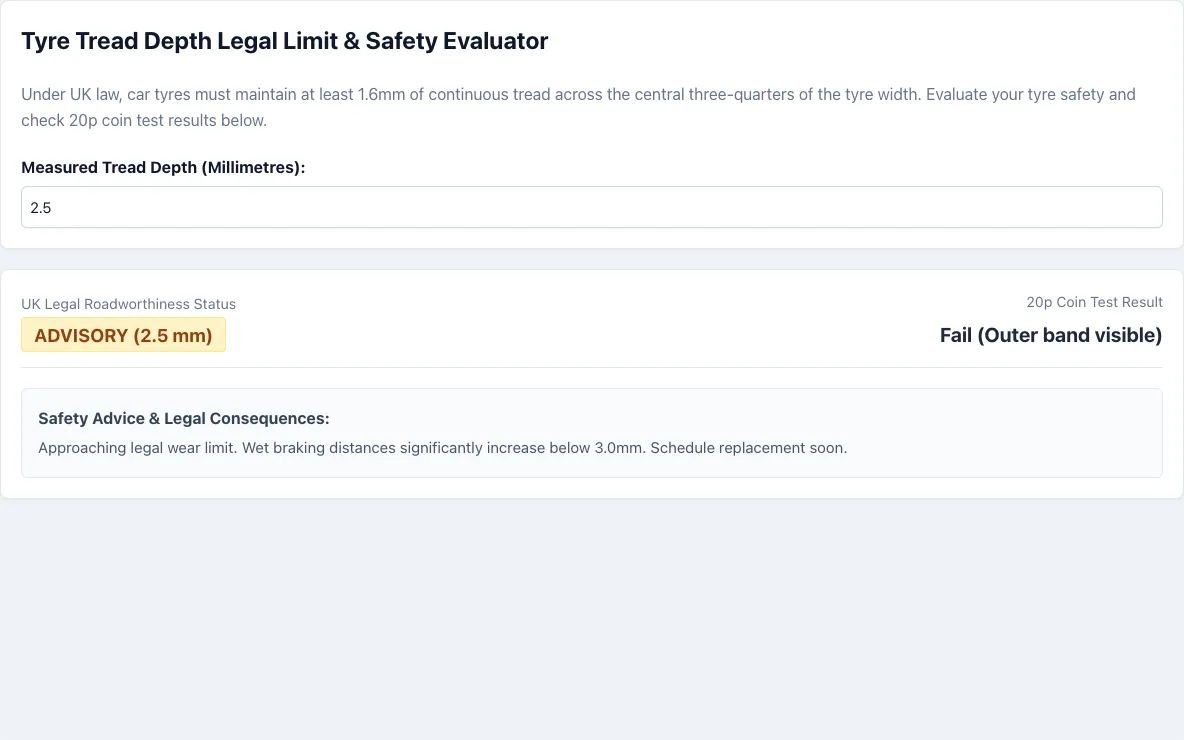
Type the tread depth you measured and see how it compares with the UK 1.6 mm legal minimum and the 3 mm replacement advice.
Free · runs in your browser · nothing is uploaded
Recent
Your last 10 settings, saved only in this browser. Nothing is uploaded.
The Motwatch tyre tread depth checker provides UK motorists with a quick check of a measured tread depth against the law. Tyres are the only contact between the car and the road, yet tyre-safety campaigners regularly find drivers who have not checked their tread for months. Under UK law, driving on tyres below the statutory minimum threshold carries severe legal repercussions, including an MOT failure and, if you are caught on the road, a fine of up to £2,500 and 3 penalty points for each illegal tyre.
Legal limits and penalties checked 3 November 2026.
Type the lowest depth you measured with a tread-depth gauge and the tool compares it with the 1.6 mm legal minimum and the 3 mm level many tyre-safety groups suggest replacing at. It cannot see your tyres, so measure in several places across and around each one.
How to use the tyre tread depth checker
- Park vehicle safely on level ground: Ensure the vehicle handbrake is firmly engaged and the engine is switched off before inspection.
- Turn steering wheel to full lock: Turn front wheels outward at a sharp angle to grant clear physical and visual access to tyre tread grooves.
- Insert depth gauge into primary grooves: Place a mechanical or digital tyre depth gauge into the central circumferential tread channels.
- Conduct the 20p coin test: Insert a 20p coin into the main tread groove; if the outer band of the coin is visible, the tread may be close to or below the limit, so measure it properly.
- Inspect the central three-quarters breadth: Measure tread depth across at least three distinct points across the central 75% width of the tyre.
- Check tread depth around entire circumference: Roll the car forward half a turn to verify depth across the entire outer circumference.
- Inspect tread wear indicators (TWIs): Check the raised rubber bars molded into the base of the tread grooves (set at 1.6mm).
- Examine sidewall rubber integrity: Inspect tyre sidewalls for cracks, bulges, cuts, foreign objects, or exposed cord ply layers.
- Check tyres on each axle match: Tyres on the same axle should be the same size and type.
- Replace tyres before reaching legal minimum: Schedule professional tyre replacement when tread drops to 3.0mm to preserve wet stopping power.
Technical specifications and architecture
UK Legal Tread Depth Regulations and the 20p Coin Benchmark
Regulation 27 of the Road Vehicles (Construction and Use) Regulations 1986 sets the tyre rules in Great Britain. For passenger cars, light commercial vans, and trailers under 3,500kg, the law mandates a minimum tread depth of 1.6 millimetres across the central three-quarters of the tyre breadth around its entire continuous circumference. The 20p test is a quick rough check: put a 20p coin into the main grooves, and if the outer band of the coin is visible the tread may be close to or below the legal limit and should be measured with a gauge.
Hydroplaning Physics and Wet Weather Water Evacuation
The fundamental engineering purpose of tyre tread grooves is water evacuation. At speed a tyre has to clear a large amount of water from under its contact patch every second. As the grooves wear down toward the legal minimum of 1.6 mm, there is less room for that water. The tyre can no longer channel surface water away from the contact patch, causing hydraulic pressure to lift the tyre off the tarmac. This phenomenon, known as aquaplaning or hydroplaning, results in total loss of steering response and braking control.
The 3.0mm Safety Threshold vs the 1.6mm Legal Limit
Wet-braking tests by tyre makers and safety groups show stopping distances growing noticeably as tread wears from 3 mm towards 1.6 mm, which is why many tyre-safety groups suggest replacing tyres at about 3 mm rather than waiting for the legal limit.
Penalties and Insurance
Police can prosecute drivers for illegal or dangerous tyres, and at the MOT a tyre below the legal tread depth is a fail. The maximum penalty is a fine of up to £2,500 and 3 penalty points for each illegal tyre. With four illegal tyres that could mean up to £10,000 and 12 points, and 12 points within three years normally leads to a driving ban. An insurer may also reduce or refuse a claim if the car was unroadworthy.
Frequently asked questions
What is the legal minimum tyre tread depth in the UK?
The legal minimum tread depth for cars in the UK is 1.6 millimetres across the central three-quarters of the tyre breadth around its entire outer circumference.
How do I use a 20p coin to check my tyre tread?
Place a 20p coin into the main tread groove of your tyre. If the outer band is hidden, the tread is probably above the legal limit; if you can see it, the tread may be too low. It is only a rough check; confirm with a tread-depth gauge.
What is the police fine for having bald tyres in the UK?
Driving with a tyre below 1.6mm carries a maximum fine of £2,500 and 3 penalty points per tyre. If all four tyres are illegal, that could add up to £10,000 and 12 points, which normally means a driving ban.
What are the raised bars inside my tyre grooves?
Those are Tread Wear Indicators (TWIs). They are moulded into the base of the main grooves at 1.6 mm. When the outer tread wears down flush with these bars, the tyre is legally bald.
At what tread depth should I actually replace my tyres?
Many tyre-safety groups suggest replacing tyres at about 3 mm of tread, as wet braking distances and aquaplaning risks increase significantly below this point.
Related tools
- Wheel Alignment Camber Toe Checker: Tyre Wear Guide
- Speedometer Accuracy Calculator: True Speed & Tyre Size
- Stopping Distance Calculator (UK Highway Code Rules)
- Towing Capacity Weight Calculator & 85% Rule Tool
- Engine Oil Change Interval Checker
- Cambelt Replacement Interval Calculator
- Brake Fluid Replacement Interval Checker
- MOT Advisory Checker – What To Do Next
See all Car Maintenance and Safety Tools.