
Wheel Alignment Camber Toe Checker
Pick the tyre wear pattern and the steering symptom: see whether it points to toe, camber, pressures or balance, and what to check first.
Free · runs in your browser · nothing is uploaded
Recent
Your last 10 settings, saved only in this browser. Nothing is uploaded.
This wheel alignment camber toe checker is a symptom guide: pick the wear pattern on your front tyres and the way the steering behaves, and it tells you the most likely cause, whether it points to toe, camber, tyre pressure or wheel balance, and what to check before paying for an alignment.
It cannot measure toe, camber or caster. Those angles can only be measured on an alignment rig and compared with your car’s specification.
The tool offers five wear patterns and four steering symptoms, so each result is a likely cause rather than a diagnosis. It runs in your browser and works only on the choices you make; it does not look up your car.
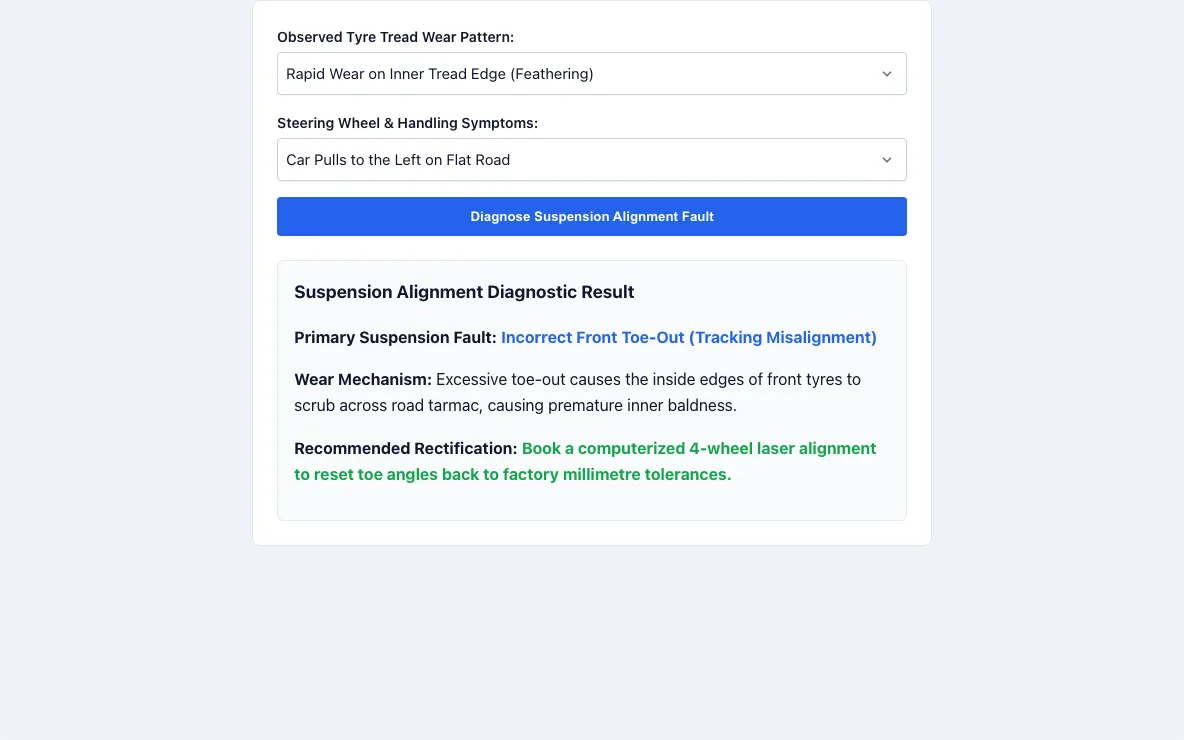
How to use the wheel alignment checker
- Look across the tread of both front tyres: is one edge, the centre or both edges worn more than the rest? Choose “Inside edge worn faster”, “Outside edge worn faster”, “Centre band worn faster”, “Both edges worn faster” or “Even wear across the tread”.
- Pick the steering symptom you notice on a straight, flat road: “Pulls to one side on a flat road”, “Steering wheel off-centre when driving straight”, “Steering shakes at 50–70 mph” or “No steering symptom”.
- Read “Most likely cause”. It gives the cause of the wear, a note on what the wear means, and what to do about it.
- Read the badge. “An alignment check is worth booking” appears when the wear or the symptom points to the geometry. Otherwise the tool says to check pressures and balance before paying for an alignment.
- Check tyre pressures first: wrong pressures copy some alignment symptoms, and you can check and correct them yourself.
Worked example: inside edge worn faster with a pull to one side on a flat road gives toe-out or negative camber as the likely cause, and the badge says an alignment check is worth booking. Centre band worn faster with no steering symptom gives pressure too high as the likely cause, and the badge says to check pressures and balance first.
The alignment angles in plain words
Toe, camber and caster
Toe is whether the fronts of the wheels point slightly in (toe-in) or out (toe-out) seen from above. Camber is the tilt of the wheel seen from the front: negative camber means the top leans in. Caster is the backward tilt of the steering axis, which helps the steering centre itself. Wrong toe scrubs the tyre sideways and wears one shoulder; too much camber loads one edge.
Reading tyre wear
Inside-edge wear usually points to too much toe-out or negative camber; outside-edge wear to too much toe-in or positive camber (or hard cornering). A worn centre band means pressures too high, both shoulders worn means pressures too low; neither is an alignment fault.
Two-wheel or four-wheel alignment
A front-only “tracking” check sets the front toe. A four-wheel alignment also measures the rear axle and the thrust angle, which matters when the steering wheel sits off-centre or the rear wheels are adjustable.
After a pothole
A hard hit can bend a track rod or damage a bush. If the steering wheel is suddenly off-centre or the car pulls after an impact, have the steering and suspension checked, not just the alignment.
What tyre wear tells you
A toe or camber fault usually shows as uneven wear across the width of the tread, heavier on one shoulder, which is why the tool starts from the wear pattern. Even wear across the whole tread does not point to a geometry fault. Wheel balance, bent rims and damaged tyres show up as vibration and a shake rather than as a pattern on the tread.
The MOT tread rule is 1.6 mm across the central three-quarters of the tread. The tool repeats that figure when the wear is even, so the tread depth is still checked alongside the pattern. Check the depth in several places around the tyre, not only at one point.
Common mistakes
- Looking at one tyre only. Compare both front tyres, because the wear on the other side often tells you more.
- Taking the symptom guide as a measurement. It is a list of likely causes, and only an alignment rig can give the angles.
- Paying for an alignment before checking the pressures, which you can do yourself, and the wheel balance.
- Assuming every pull is an alignment fault. The tool suggests swapping the front tyres from side to side: if the pull follows the tyres, the tyres are the cause.
What the tool does not do
The tool does not measure toe, camber or caster, does not read your car’s specification, and does not know your car’s age or mileage. The result depends on the two choices you make.
Frequently asked questions
What is the difference between alignment and balancing?
Alignment sets the angles of the wheels; balancing adds small weights to the wheel so it spins without vibration. A shake at motorway speed is usually balance.
How do I know if my tracking is out?
The car pulls on a flat road, the steering wheel is off-centre when driving straight, or one edge of the front tyres wears faster than the rest. Swapping the front tyres from side to side can show whether a pull follows the tyres or stays with the car.
Is wheel alignment checked at the MOT?
Alignment angles are not measured. The MOT does check steering components and tyres, and a tyre worn below 1.6 mm across the central three-quarters of the tread fails.
How often should alignment be checked?
When you fit new tyres, after suspension or steering work, after a hard knock, or whenever you see one-sided wear or a pull.
Why does my steering wheel shake at 60 mph?
Usually wheel balance, a bent rim or a damaged tyre. Have the wheels balanced before paying for an alignment.
How much does an alignment cost?
Prices vary by garage and by whether the rear axle needs adjusting; ask for a quote that includes a printout of the before and after readings.
Related tools
- Speedometer Accuracy Calculator: True Speed & Tyre Size
- Stopping Distance Calculator (UK Highway Code Rules)
- Towing Capacity Weight Calculator & 85% Rule Tool
- Engine Oil Change Interval Checker
- Cambelt Replacement Interval Calculator
- Brake Fluid Replacement Interval Checker
- Car Battery Lifespan Calculator
- Car Mileage Check – MOT Mileage History Analyser
See all Car Maintenance and Safety Tools.